

Clean Water and Sanitation
ENSURE AVAILABILITY AND SUSTAINABLE MANAGEMENT OF WATER AND SANITATION FOR ALL
Executive Summary
This report presents the evidence of Universitas Islam Internasional Indonesia (UIII) on Sustainable Development Goal 6, Clean Water and Sanitation, for the reporting year 2025 (January to December). Section 1 documents the academic contribution of the UIII community to research on water, and Section 2 documents how the University supplies, treats, conserves and reuses water on its 143-hectare campus in Depok, builds water efficiency into its buildings, and works with the Depok City Government on the water ecosystem it shares with its neighbours, with each activity mapped to the SDG 6 targets and to the THE Sustainability Impact Ratings indicators it supports.
Research on water. Scopus records three UIII publications from 2025 mapped to SDG 6, on the Islamic jurisprudence of water and mosque-based charity, coffee agroecosystems and biodiversity, and artificial intelligence for water management. UIII researchers also studied a community-owned, solar-powered drinking-water business in Gunungkidul, the effect of climate change on crop suitability and water balance, and tidal flooding and land subsidence in Demak.
A complete campus water cycle. A dedicated Water Treatment Plant with four pressurised filter vessels supplies treated water to every academic, residential, religious and administrative building. Every building treats its domestic wastewater in its own Sewage Treatment Plant using extended aeration; the treated effluent flows through the campus drainage network to three retention ponds and is treated again at the Water Treatment Plant before non-potable reuse for irrigation, toilet flushing and cleaning.
Water use and reuse. UIII's metered records for the annual reporting period show 3,045 m³ of treated water from the regional water utility (PDAM) and 1,023 m³ of recycled water used in seven main buildings, so that about a quarter of the water used came from recycling, well above UIII's internal minimum of 10 per cent.
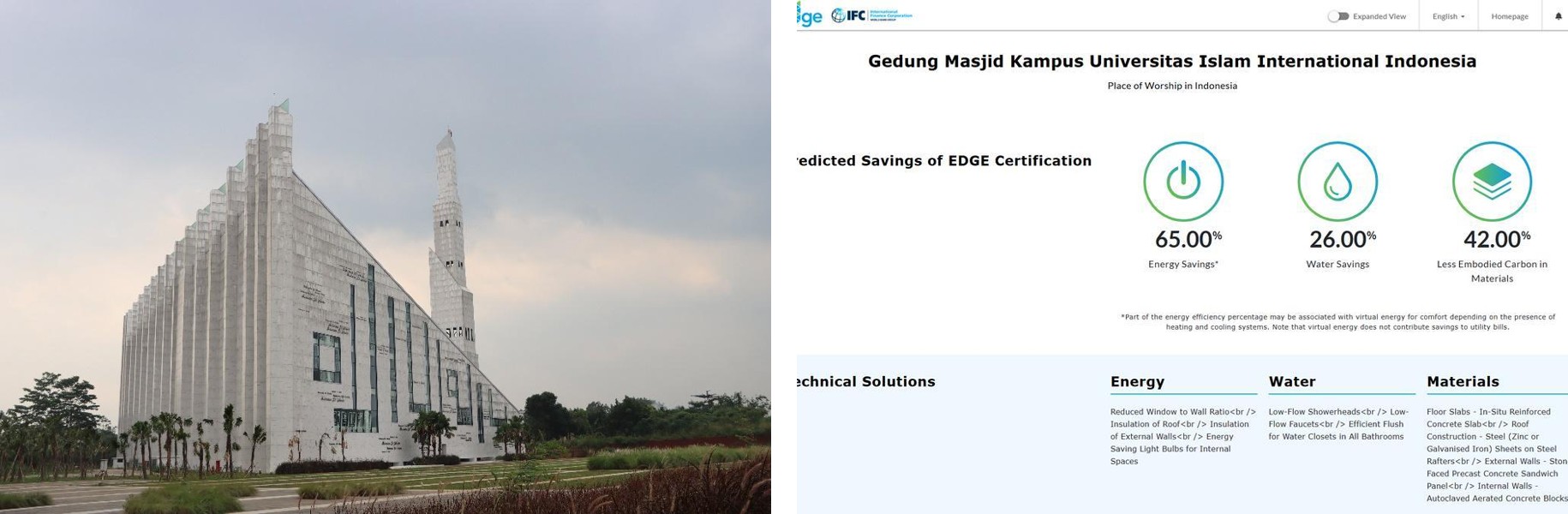
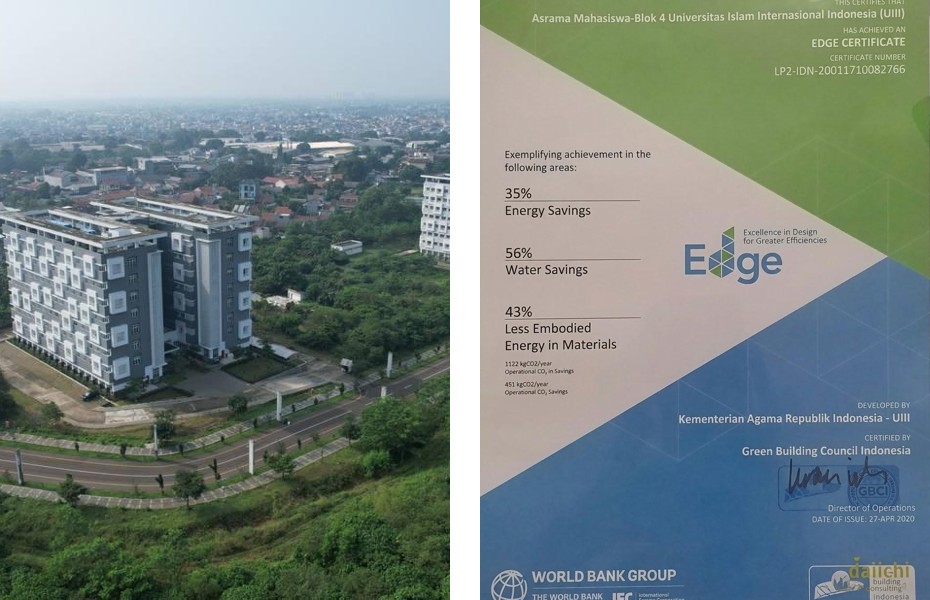
Water-efficient buildings. 1,755 of 2,085 installed sanitary fixtures (84.17 per cent) are water-efficient, and three campus buildings hold EDGE certificates from the Green Building Council Indonesia: Masjid Rahmatan lil-'Alamin and the Jusuf Kalla Library (EDGE Advanced) and Student Dormitory Block 4.
Land and water in the watershed. UIII keeps 98.13 per cent of its campus as green open space and 332,690 m² as dedicated water-absorption areas, protects about 70 ha of natural forest and riparian buffer along the Kali Cijantung river, and works with Depok City on retention lakes and flood mitigation. Rector's Regulations No. 26 and 27 of 2023 make water conservation, treatment and reuse mandatory.
The table below summarises the main figures.
| Dimension | UIII in 2025 |
|---|---|
| Research | 3 Scopus-indexed publications on SDG 6 (2025, 6 citations); 2025 studies of community drinking water in Gunungkidul, crop suitability and water balance, and tidal flooding in Demak |
| Water supply | Campus Water Treatment Plant with four pressurised filter vessels; supply from PDAM and the retention-pond network; rooftop stainless-steel and FRP storage tanks |
| Water use | Metered use in seven main buildings, annual reporting period: 3,045 m³ from PDAM and 1,023 m³ recycled |
| Wastewater | Sewage Treatment Plant (extended aeration) in every building; monthly monitoring; separate wastewater and stormwater networks |
| Water reuse | 1,023 m³ of recycled water for irrigation, toilet flushing and cleaning (about 25% of water used); internal minimum of 10% |
| Water-efficient fixtures | 1,755 of 2,085 fixtures (84.17%); 100% of urinals, showers and bidet sprayers |
| Green buildings | Three EDGE-certified buildings: Masjid Rahmatan lil-'Alamin and Jusuf Kalla Library (EDGE Advanced), Student Dormitory Block 4 |
| Water absorption | 332,690 m² of absorption areas; 3 retention ponds with 35,750 m³ capacity; 98.13% green open space; about 70 ha of riparian forest along Kali Cijantung |
Section 1: Evidence of Academic Contribution to SDG 6 (Research Impact)
Universitas Islam Internasional Indonesia (UIII) is a state postgraduate university and a National Strategic Project of the Government of Indonesia. UIII researchers in Islamic studies, economics, public policy and climate science address water access, water governance, water balance and water-related risk, often as part of wider studies of community livelihoods and climate change.
Community-owned drinking water and solar energy
In 2025 Aimatul Yumna and Teguh Yudo Wicaksono of the Faculty of Economics and Business studied Serikat Surya Handayani, a community renewable energy programme in Gunungkidul, Yogyakarta, a karst region with recurrent dry-season water shortages, led by the Islamic microfinance institution BMT Ummat. Of its 12,000 watts of solar capacity, 6,000 watts power a community drinking-water business, and a solar-powered irrigation system serves about 14 farmers. Revenue from the drinking-water business funds the maintenance of the installations and a weekly rice programme for about 80 low-income families. Through field visits in May and on 20–23 June 2025 and interviews with nine respondents, the study proposed a model linking institutional capacity and social capital with programme governance, with recommendations on monitoring, risk mitigation and technical maintenance.
Contribution to SDG 6: Targets 6.1 and 6.b (safe and affordable drinking water; community participation in water management); THE measure 6.1.
Water balance, tidal flooding and climate risk
Michiel Schaeffer of UIII co-authored "Have crops already reached peak suitability: assessing global climatic suitability decreases for crop cultivation" (Environmental Research Letters, 11 February 2025), which combines temperature, precipitation and water-balance analysis for nine crops under two emissions scenarios and assesses adaptation through irrigation and drainage. On 19 September 2025 the KOMITMEN programme of the Faculty of Economics and Business and the Faculty of Social Sciences published field observations from Demak Regency, Central Java, documenting 20 years of partial and fragmented tidal-flood management, land subsidence of 12–15 cm a year, faster than sea-level rise, and the loss of farmers' and aquaculture pond owners' livelihoods. In the Master of Public Policy in Climate Change, the compulsory course Understanding Multi-sector and Multi-thematic Models of Climate Change teaches integrated assessment across energy, water, food and land.
Contribution to SDG 6: Targets 6.4 and 6.5 (water-use efficiency; integrated water resources management); THE measure 6.1.
Scopus-indexed research on water, 2025
Scopus records three UIII-affiliated publications from 2025 that are mapped to SDG 6, all of them open access, which have received six citations. Hendra Darmawan of UIII, with colleagues from Universitas Ahmad Dahlan, examined the Islamic jurisprudence (fiqh) of water and how social capital and mosque-based charity can support community water provision (Afkaruna). Sonny Mumbunan of the Faculty of Social Sciences co-authored a systematic evidence map of coffee agroecosystem management and its links with biodiversity in producing countries (Cleaner and Circular Bioeconomy), and Safia Bibi of the Faculty of Economics and Business reviewed how artificial intelligence can support sustainable energy, transport, biodiversity and water management (Discover Artificial Intelligence) (Table 1).
| Publication | UIII author(s) | Source | Year |
|---|---|---|---|
| Fiqh Discourse on Water: Integrating Social Capital and Mosque-Based Charity through Concurrent Triangulation | Hendra Darmawan | Afkaruna 21(2) (open access; 0 citations) | 2025 |
| Systematic evidence map of coffee agroecosystem management and biodiversity linkages in producing countries | Sonny Mumbunan | Cleaner and Circular Bioeconomy 11 (open access; 3 citations) | 2025 |
| Artificial intelligence shaping a smarter and greener planet for sustainable energy, transportation, biodiversity and water management | Safia Bibi | Discover Artificial Intelligence 5 (review; open access; 3 citations) | 2025 |
Table 1: UIII Scopus-indexed publications on SDG 6, 2025. Source: Scopus export
Contribution to SDG 6: Targets 6.4, 6.6 and 6.b (water-use efficiency; water-related ecosystems; community participation in water management); THE measure 6.1.
Section 2: Evidence of Progress on SDG 6 in 2025
This section presents UIII's 2025 water management, drawn from the campus facility and environmental records of the Directorate of General Affairs and Facilities, Rector's Regulations No. 26 and 27 of 2023, EDGE certification records and UIII's official websites. The evidence is arranged under five themes that follow the THE Sustainability Impact Ratings measures for SDG 6.
| Theme | SDG 6 targets | THE 2027 indicators | Main evidence in 2025 | Entries |
|---|---|---|---|---|
| 1. Water Supply and Consumption | 6.1, 6.4 | 6.2.1, 6.3.3 | Water Treatment Plant; rooftop storage; metered use by building | 2 |
| 2. Wastewater Treatment and Pollution Control | 6.3 | 6.3.1, 6.3.2 | STP in every building; monthly monitoring; separate networks | 1 |
| 3. Water Conservation, Absorption and Reuse | 6.3, 6.4, 6.6 | 6.3.5, 6.4.1, 6.4.2, 6.5.4 | 332,690 m² absorption areas; 3 retention ponds; 1,023 m³ reused | 2 |
| 4. Water-efficient Buildings and Fixtures | 6.4 | 6.3.4, 6.5.2 | 84.17% water-efficient fixtures; three EDGE buildings | 2 |
| 5. Shared Watershed and Community Engagement | 6.5, 6.6, 6.b | 6.5.1, 6.5.3, 6.5.5 | Depok City cooperation; Kali Cijantung buffer; water education | 2 |
Table 2: Overview of the SDG 6 evidence for 2025 by theme
1. Water Supply and Consumption
SDG 6 alignment: Targets 6.1 and 6.4
A. Campus Water Treatment Plant and distribution
Date: In operation throughout 2025. Unit: Directorate of General Affairs and Facilities.
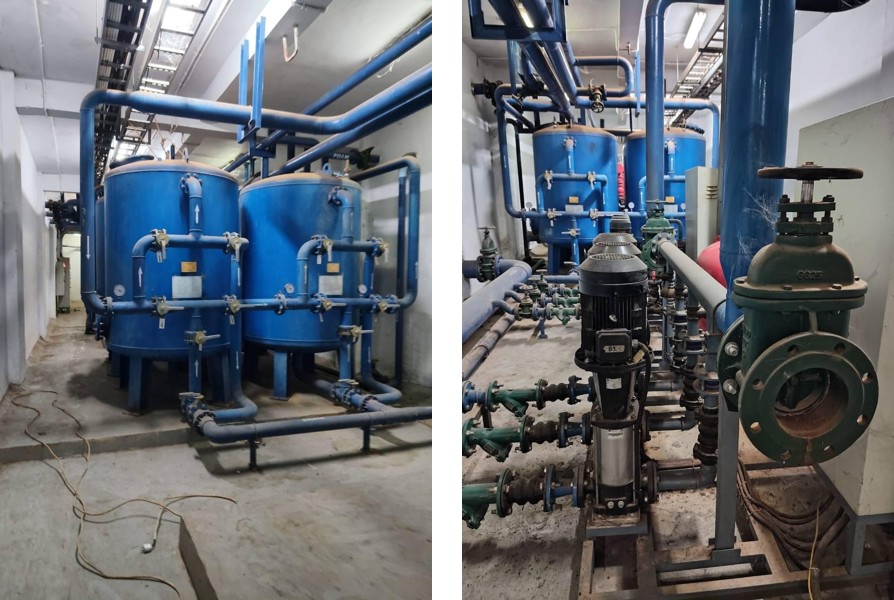
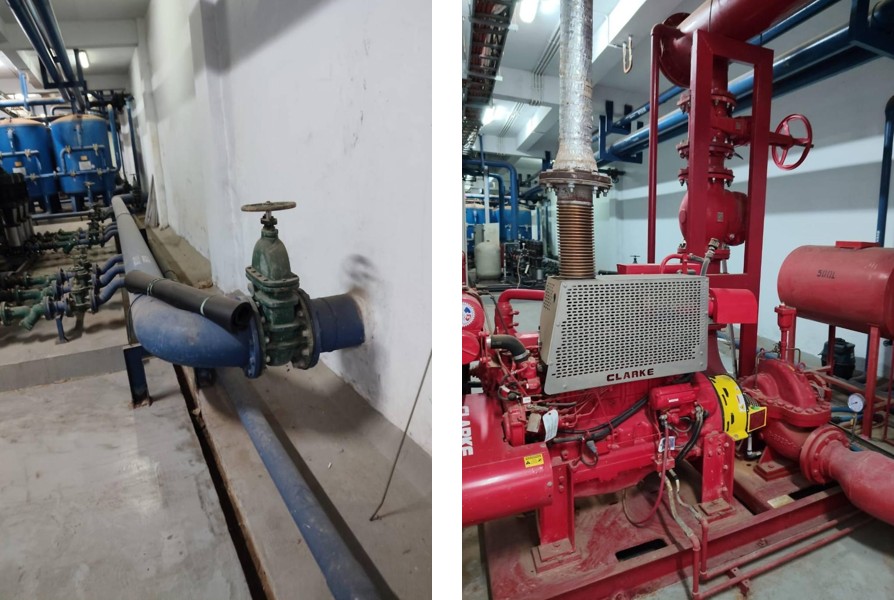
UIII operates a dedicated Water Treatment Plant that serves the whole campus. Raw water from the regional water utility (PDAM) and from the campus retention-pond network passes through multi-stage filtration in four large pressurised filter vessels and is pumped into the campus pipe grid to academic, residential, religious and administrative buildings. Gate valves and manifolds allow each section to be isolated for maintenance without interrupting supply to the rest of the campus, which matters for a campus with 24-hour residential occupancy. A separate diesel fire pump with a 500-litre pressure vessel keeps the sprinkler and hydrant network pressurised independently of the drinking-water circuit.
Contribution to SDG 6: Target 6.1 (universal and equitable access to safe drinking water); THE indicator 6.3.3.
B. Rooftop storage and water consumption
Date: Annual reporting period. Unit: Directorate of General Affairs and Facilities.
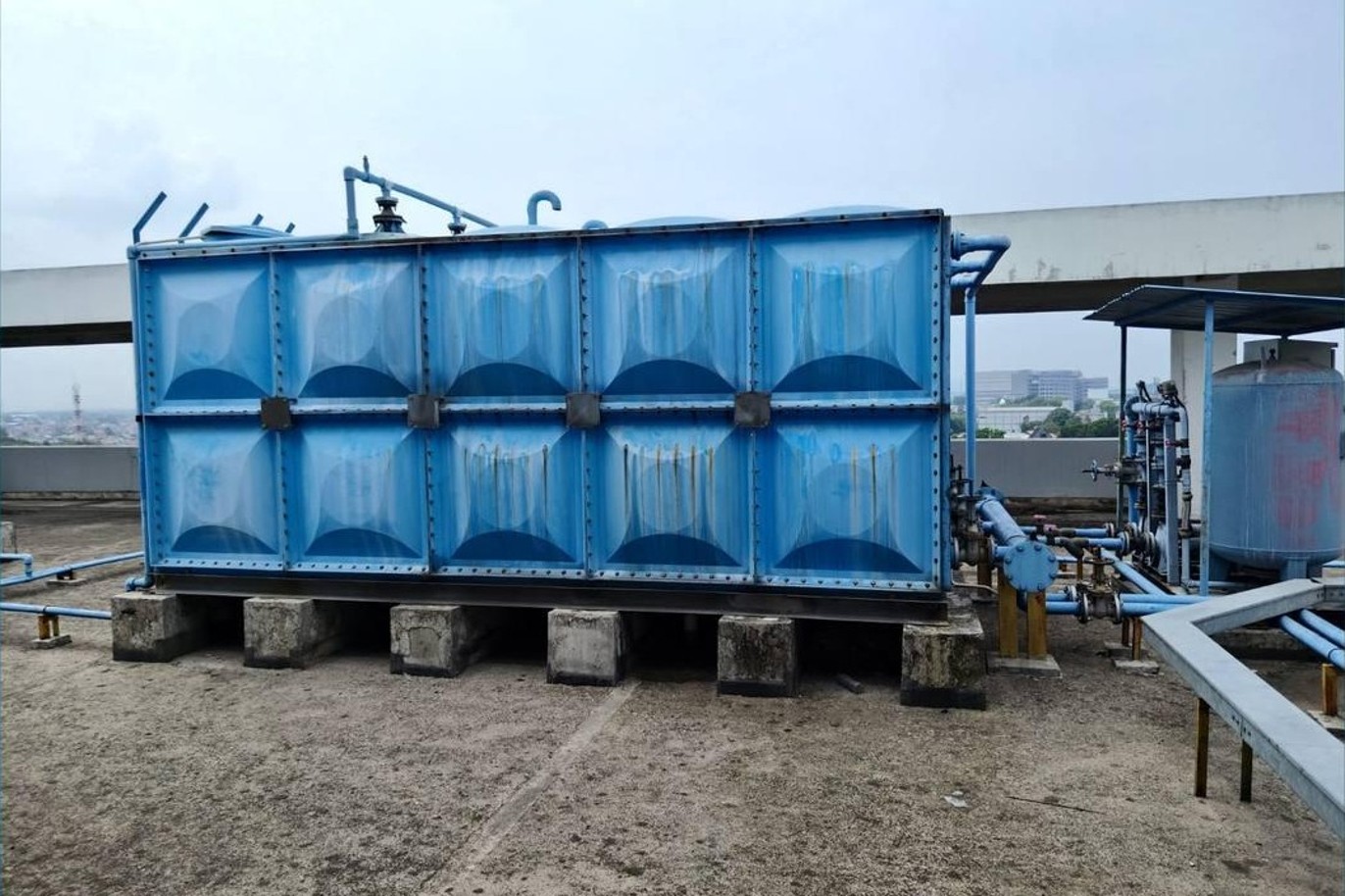
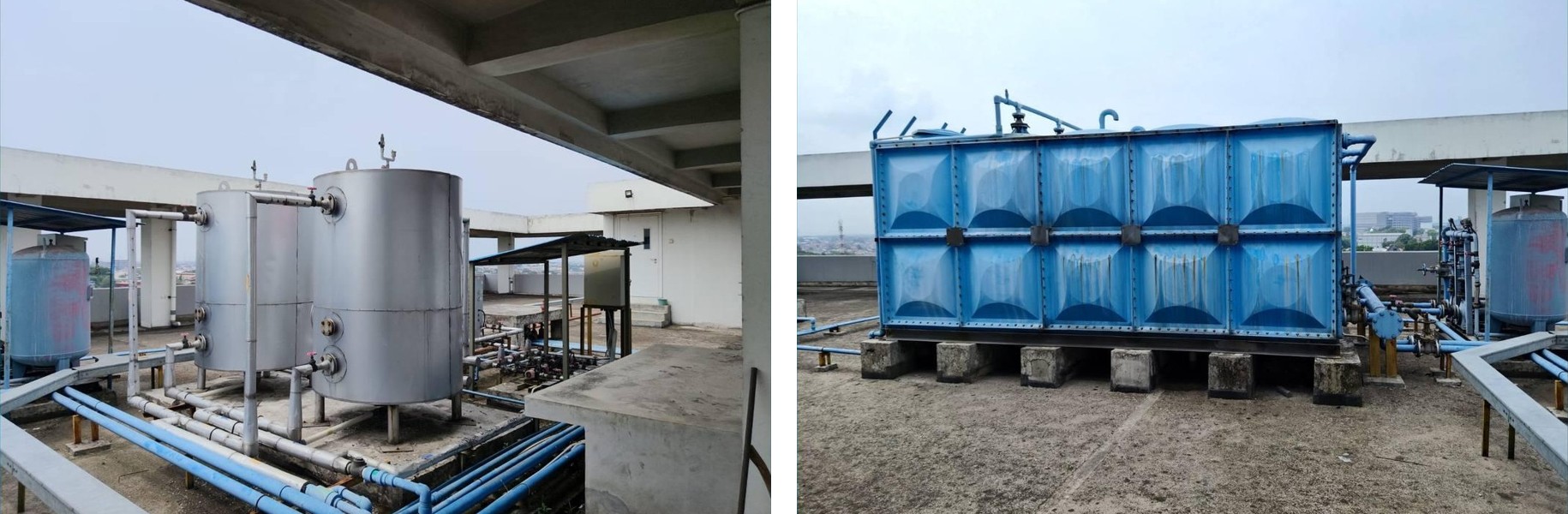
Stainless-steel rooftop tanks keep a gravity-fed buffer supply during pump maintenance or power interruptions, and modular fibre-reinforced plastic (FRP) panel tanks add capacity on buildings with high demand, particularly the student dormitories. Technical staff inspect and clean the tanks at regular intervals. UIII relies on metered treated water from PDAM Kota Depok for drinking and primary domestic use rather than drawing its own groundwater, to avoid lowering the water table in Sukmajaya, Depok. Table 3 shows metered use in the seven main buildings over the annual reporting period: 3,045 m³ of PDAM water and 1,023 m³ of recycled water. In the student dormitories, water stations provide drinking water to residents at no cost.
| Building | PDAM water (m³) | Recycled water (m³) | Total (m³) |
|---|---|---|---|
| Male student dormitory | 1,500 | 300 | 1,800 |
| Female student dormitory | 800 | 200 | 1,000 |
| Rectorate (left and right wings) | 200 | 170 | 370 |
| Jusuf Kalla Library | 185 | 95 | 280 |
| Faculty A | 160 | 78 | 238 |
| Faculty B | 180 | 85 | 265 |
| Masjid Rahmatan lil-'Alamin | 20 | 95 | 115 |
| Total | 3,045 | 1,023 | 4,068 |
Table 3: Metered water use by building, annual reporting period
Contribution to SDG 6: Target 6.4 (water-use efficiency); THE indicator 6.2.1.
2. Wastewater Treatment and Pollution Control
SDG 6 alignment: Target 6.3
Date: Rector's Regulations No. 26 and 27 of 2023, in force in 2025. Unit: Directorate of General Affairs and Facilities.
Domestic wastewater from every campus building is collected through a dedicated pipe network and treated in a Sewage Treatment Plant (STP) in that building using the extended-aeration process, which reduces BOD, COD and suspended solids, so that no untreated wastewater bypasses treatment. The STPs are inspected monthly and their effluent is tested before it enters the campus drainage network. Wastewater and stormwater flow through separate networks, to the STPs and to the retention ponds respectively, preventing cross-contamination, and open and closed drains are cleaned of sediment and waste every three months so that polluted runoff does not reach the ponds or the Kali Cijantung river. Signs in all campus toilets ask users not to throw waste into toilets, to flush after use and to keep facilities clean, and hazardous waste such as used lamps, electronics and batteries is kept in a licensed temporary store before transfer to licensed handlers.
| Measure | Implementation |
|---|---|
| Sewage Treatment Plants | Extended aeration in every campus building; treats all domestic wastewater before discharge |
| Monitoring | Monthly inspection and maintenance; effluent quality testing before discharge to the drainage network |
| Drainage maintenance | Regular removal of solid waste and sediment to prevent polluted runoff |
| Stormwater separation | Separate networks for wastewater (to STPs) and stormwater (to retention ponds) |
| Hazardous waste | Licensed temporary store; transfer to DLHK Depok and licensed transporters |
| Policy framework | Rector's Regulations No. 26 and 27 of 2023 require wastewater treatment and water-quality protection |
Table 4: Wastewater treatment and water pollution control
Contribution to SDG 6: Target 6.3 (improving water quality by reducing pollution and treating wastewater); THE indicators 6.3.1 and 6.3.2.
3. Water Conservation, Absorption and Reuse
SDG 6 alignment: Targets 6.3, 6.4 and 6.6
A. Water conservation and reuse policy
Date: Rector's Regulations No. 26 and 27 of 2023, in force in 2025. Unit: Rectorate; Directorate of General Affairs and Facilities.
Rector's Regulation No. 26 of 2023 on Eco-Friendly Campus Management and Rector's Regulation No. 27 of 2023 on Green Buildings make water conservation mandatory through technological, vegetative and land-use measures, and set an internal minimum of 10 per cent recycled water in campus use. The conservation programme has seven components: large green open spaces as infiltration areas; retention areas for stormwater and runoff control; a zero-runoff principle; protection of water catchment and recharge areas; an integrated stormwater drainage network; water treatment and storage infrastructure; and routine maintenance of the Sewage Treatment Plants.
Contribution to SDG 6: Targets 6.3 and 6.4 (safe reuse; water-use efficiency); THE indicators 6.4.1 and 6.5.4.
B. Water absorption and recycling
Date: Annual reporting period. Unit: Directorate of General Affairs and Facilities.
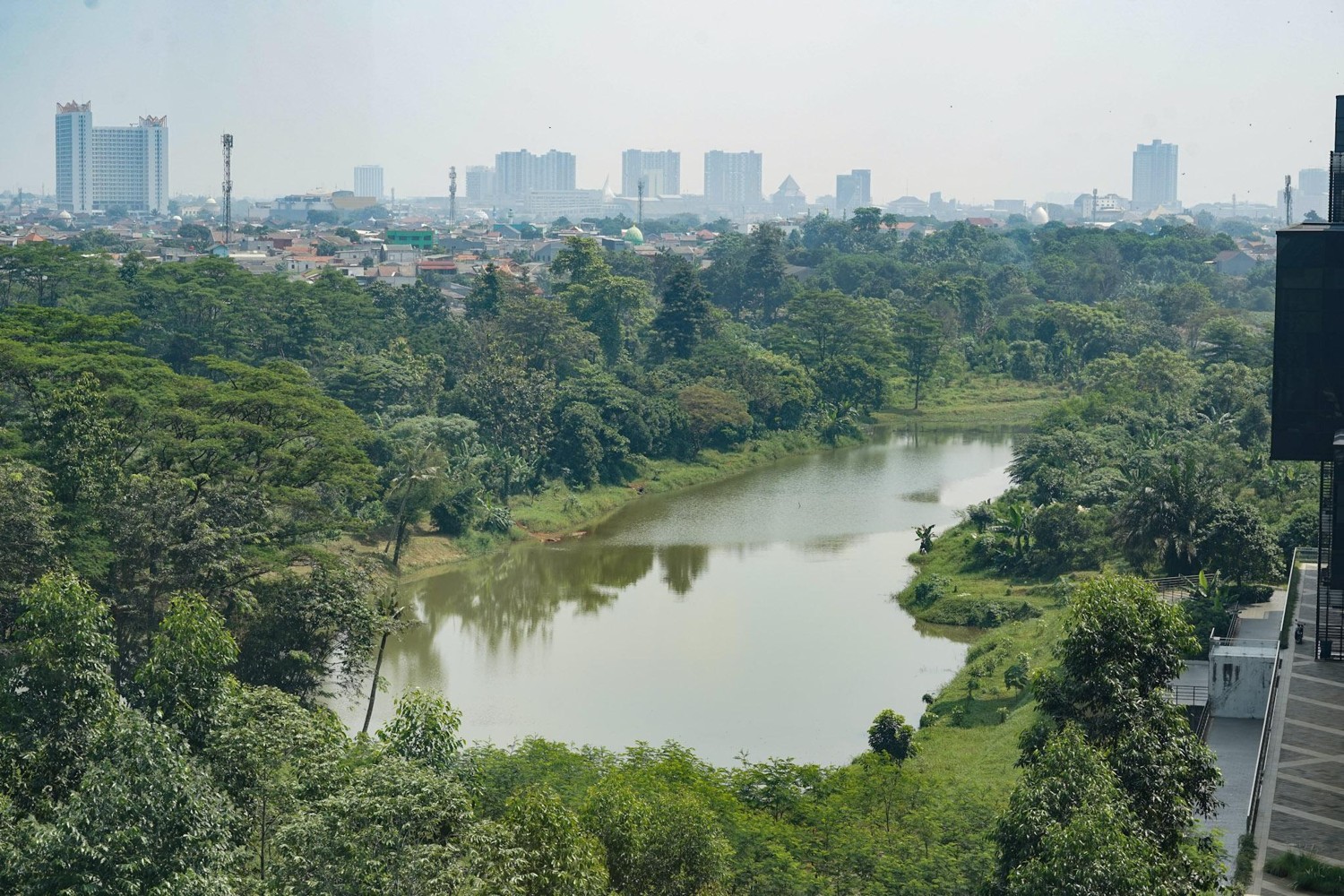
Beyond its forest and planted vegetation, UIII has designated 332,690 m², about 23 per cent of the campus, as water-absorption areas: 318,390 m² of open lawns and permeable paving on pedestrian paths and plazas, and 14,300 m² of retention ponds. The three ponds, at the Rectorate, the mosque and the dormitories, have an average depth of 2.5 m and a combined capacity of 35,750 m³, and apply a zero-runoff principle: rainwater is held and absorbed on campus before it flows in a controlled way to the Kali Cijantung river and Situ Pangarengan. Treated effluent from the Sewage Treatment Plants and stormwater collected in the ponds are pumped to the Water Treatment Plant and a ground water tank for further treatment, and then reused for landscape irrigation, toilet flushing and cleaning: 1,023 m³ in the annual reporting period. Landscaping relies largely on native and adapted trees within 1,399,257 m² of green open space (98.13 per cent of the campus), reducing the need for irrigation.
| Component | Area or quantity |
|---|---|
| Total campus area | 1,425,889 m² (about 143 ha) |
| Water-absorption areas (excluding forest and vegetation) | 332,690 m² |
| Green open space | 1,399,257 m² (98.13%) |
| Retention ponds | 3 (Rectorate, dormitories, mosque) |
| Retention pond area and capacity | 14,300 m²; 35,750 m³ (average depth 2.5 m) |
| Recycled water used, annual reporting period | 1,023 m³ |
| Internal minimum for recycled water | 10% of campus water use |
| Reuse applications | Landscape irrigation, toilet flushing, cleaning |
Table 5: Water absorption and recycling on campus
Contribution to SDG 6: Targets 6.4 and 6.6 (water-use efficiency; protecting water-related ecosystems); THE indicators 6.3.5 and 6.4.2.
4. Water-efficient Buildings and Fixtures
SDG 6 alignment: Target 6.4
A. Water-efficient sanitary fixtures
Date: Campus-wide fixture audit, 2025. Unit: Directorate of General Affairs and Facilities.
In line with Rector's Regulation No. 27 of 2023, campus buildings are fitted with water-efficient sanitary fixtures: dual-flush toilets, push-button urinals, low-flow aerator faucets, aerated showers and handheld bidet sprayers. Of 2,085 installed fixtures, 1,755 (84.17 per cent) are water-efficient.
| Fixture | Water-efficient units | Share | Technology |
|---|---|---|---|
| Toilets | 416 of 478 | 87.03% | Dual-flush valves |
| Urinals | 203 | 100% | Push-button flush |
| Hand-washing faucets | 545 of 813 | 67.03% | Low-flow faucets with aerators |
| Showers (dormitories) | 231 | 100% | Aerated showerheads |
| Bidet sprayers | 360 | 100% | Handheld, user-controlled |
| All fixtures | 1,755 of 2,085 | 84.17% | Share of installed fixtures that are water- efficient |
Table 6: Water-efficient sanitary fixtures on campus
Contribution to SDG 6: Target 6.4; THE indicators 6.3.4 and 6.5.2.
B. EDGE-certified buildings
Date: Certificates of 27 April 2020 and 1 February 2022. Unit: Directorate of General Affairs and Facilities.
Three campus buildings hold EDGE (Excellence in Design for Greater Efficiencies) certificates, a system of the International Finance Corporation verified in Indonesia by the Green Building Council Indonesia, which requires at least 20 per cent savings in energy, water and embodied energy in materials against a local baseline. Student Dormitory Block 4, certified on 27 April 2020, was the first EDGE building on campus and saves 56 per cent of water. Masjid Rahmatan lil-'Alamin and the Jusuf Kalla Library received EDGE Advanced certification on 1 February 2022. The mosque saves 26 per cent of water through low-flow faucets, showerheads and efficient flushing in its ablution and bathroom facilities, which matters because ablution before each prayer creates high and frequent demand, and the library applies rainwater harvesting, wastewater recycling and water-efficient fixtures.
| Building | Certification | Certified | Energy saving | Water saving |
|---|---|---|---|---|
| Student Dormitory Block 4 | EDGE | 27 April 2020 | 35% | 56% |
| Jusuf Kalla Library | EDGE Advanced | 1 February 2022 | 27% | Water-efficient design |
| Masjid Rahmatan lil-'Alamin | EDGE Advanced | 1 February 2022 | 65% | 26% |
Table 7: EDGE-certified buildings on the UIII campus
Contribution to SDG 6: Target 6.4 (water-use efficiency); THE indicator 6.3.4.
5. Shared Watershed and Community Engagement
SDG 6 alignment: Targets 6.5, 6.6 and 6.b
A. Cooperation with Depok City on retention lakes and flood mitigation
Date: Throughout 2025; meeting with the Mayor of Depok, 14 March 2025. Unit: Rectorate; Directorate of General Affairs and Facilities.
The campus lies in the catchment of the Kali Cijantung river, which drains into Situ Pangarengan. UIII protects about 70 ha of natural forest and riparian buffer along the river and works with the Depok City Government on retention lakes (embung) and flood mitigation along its course, and with the Citarum-Ciliwung Watershed Management Agency (BPDAS) on reforestation. When the Mayor of Depok, Supian Suri, visited UIII on 14 March 2025, the Rector, Prof. Jamhari, proposed building further retention lakes and extending reforestation so that the campus can serve as one of Depok's green "lungs" and a water-absorption zone for the city.
Contribution to SDG 6: Targets 6.5 and 6.6 (integrated water resources management; protecting water-related ecosystems); THE indicators 6.5.3 and 6.5.5.

B. Water and sanitation in education and outreach
Date: 2025. Unit: Faculty of Islamic Studies; Faculty of Social Sciences.
On 6 November 2025 the Faculty of Islamic Studies and PK-Tren Indonesia held a seminar and workshop on Green Islam for santri, teachers and kiai from about ten pesantren, presenting the clean-school model of shared cleaning duties, waste sorting and monitoring and the protection of water and soil as a religious trust. The Master of Public Policy in Climate Change teaches water within its multi-sector climate models, and the University's eco-friendly campus regulation asks every work unit to promote responsible use of water, energy and materials.
Contribution to SDG 6: Targets 6.b (participation of local communities in water and sanitation management); THE indicators 6.5.1 and 6.5.2.
Section 3: Conclusion
The evidence in this report shows that UIII manages water as a complete cycle on its campus. Target 6.1 is served by a campus Water Treatment Plant and rooftop storage that supply treated water to every building; Target 6.3 by a Sewage Treatment Plant in every building, monthly effluent monitoring, quarterly drain maintenance and separate wastewater and stormwater networks; and Target 6.4 by 1,023 m³ of recycled water in the annual reporting period, 84.17 per cent water-efficient fixtures and three EDGE-certified buildings.
Targets 6.5 and 6.6 are served by 332,690 m² of water-absorption areas, three retention ponds holding 35,750 m³, 98.13 per cent green open space and about 70 ha of riparian forest along Kali Cijantung, by relying on metered PDAM water rather than groundwater extraction, and by cooperation with the Depok City Government and the watershed agency on retention lakes, flood mitigation and reforestation. UIII's research on community drinking-water services, water balance and tidal flooding contributes to Targets 6.1, 6.4 and 6.5.
In 2026 UIII will continue to strengthen water monitoring across its campus buildings, extend its reporting on drinking water and water quality, and broaden water education for students and neighbouring communities. This report complements the SDG 6 chapter of the UIII Sustainable Development Goals Report 2025/2026.
References
[1] Universitas Islam Internasional Indonesia. Rector's Regulation No. 26 of 2023 on Eco-Friendly Campus Management.
[2] Universitas Islam Internasional Indonesia. Rector's Regulation No. 27 of 2023 on Green Buildings.
[3] Directorate of General Affairs and Facilities, UIII. Campus water, wastewater and fixture records, 2025.
[4] International Finance Corporation. EDGE certification records for the Jusuf Kalla Library and Masjid Rahmatan lil-'Alamin (EDGE Advanced, 1 February 2022) and Student Dormitory Block 4 (27 April 2020), certified by the Green Building Council Indonesia. https://edgebuildings.com/
[5] Yumna, A. and Wicaksono, T. Y. Understanding the Role of Islamic Finance in Community-Based Renewable Energy Projects: A Case Study of the Handayani Solar Union in Gunung Kidul, Yogyakarta. Final report, Faculty of Economics and Business, UIII, 2025.
[6] Mombo, V.-G., Duvallet, M., Schaeffer, M. and Baarsch, F. Have crops already reached peak suitability. Environmental Research Letters, 20(3), 034009, 2025.
[7] KOMITMEN UIII. Demak Regency Field Observations Narratives. 19 September 2025.
[8] UIII. News on the visit of the Mayor of Depok to UIII, 14 March 2025.
[9] Marwal, I. and team. From Eco-Technology to Eco-Theology: Diverse Innovations in Advancing Green Islam in Indonesian Pesantren. Final community engagement report, UIII, 2025.