















SDG 10.6.1 Non-Discriminatory Admissions Policy
Universitas Islam Internasional Indonesia
Universitas Islam Internasional Indonesia (UIII) admits master’s and doctoral students from Indonesia and around the world under an admissions policy that is non-discriminatory by law and publicly posted. Rector’s Regulation No. 17 of 2021 on New Student Admissions, enacted in Depok on 1 December 2021, requires admission to be objective, transparent, accountable and non-discriminatory, “without distinction of religion, race, ethnicity, group, nationality, disability or minority status” (Art. 3(d)), and opens admission equally to Indonesian citizens and foreign nationals (Art. 4).
Alongside this principle, UIII applies positive measures for groups whose access to international postgraduate education is limited by income, geography, conflict, gender or disability: a waiver of the application fee for applicants in financial need, fully funded scholarships, scholarship channels for students from low- and middle-income and conflict-affected countries, affirmative places for disadvantaged Indonesians, persons with disabilities and Papuans, scholarships for Afghan women, and exemptions from age and language requirements. These measures add support but do not lower academic standards: every applicant must meet the same minimum grade point average and pass the same document review and interview (Table 1).
Table 1. UIII admissions policy at a glance.
| Item | Detail |
|---|---|
| Policy | Rector’s Regulation No. 17 of 2021 on New Student Admissions, implementing Art. 15(3) of the UIII Statute (Government Regulation No. 23 of 2019) |
| Policy created | Rector's Regulation No. 17 of 2021 on Student Admission (enacted 1 December 2021) |
| Policy reviewed | Internal evaluation of the 2025/2026 admission cycle, resulting in the issuance of the Admissions SOP. |
| Non-discrimination principle | Art. 3(d): no distinction of religion, race, ethnicity, group, nationality, disability or minority status |
| Positive measures | Application fee waiver; UIII Scholarship; PEMRI, INSANI, Norway and Netherlands schemes; LPDP affirmative places; age and language exemptions |
| Public access | https://jdih.uiii.ac.id/detail/235 (regulation); https://admissions.uiii.ac.id/home/en (admissions portal); https://uiii.ac.id/how-to-apply/ |
1. The Non-Discriminatory Admissions Policy
1.1. Rector’s Regulation No. 17 of 2021 on New Student Admissions
The regulation implements Article 15(3) of the UIII Statute and has eight chapters and 24 articles covering the objectives and principles of admission, target groups, types and pathways of admission, capacity, the selection committee, requirements and selection, financing, and monitoring, evaluation and reporting. Article 3 sets four principles:
1. Objectivity: registration, selection and the determination of results rest on the requirements and test results as they are;
2. Transparency: registration, selection and the announcement of results are open;
3. Accountability: the process follows clear procedures and criteria;
4. Non-discrimination: new students are admitted without distinction of religion, race, ethnicity, group, nationality, disability or minority status (Art. 3(d)).
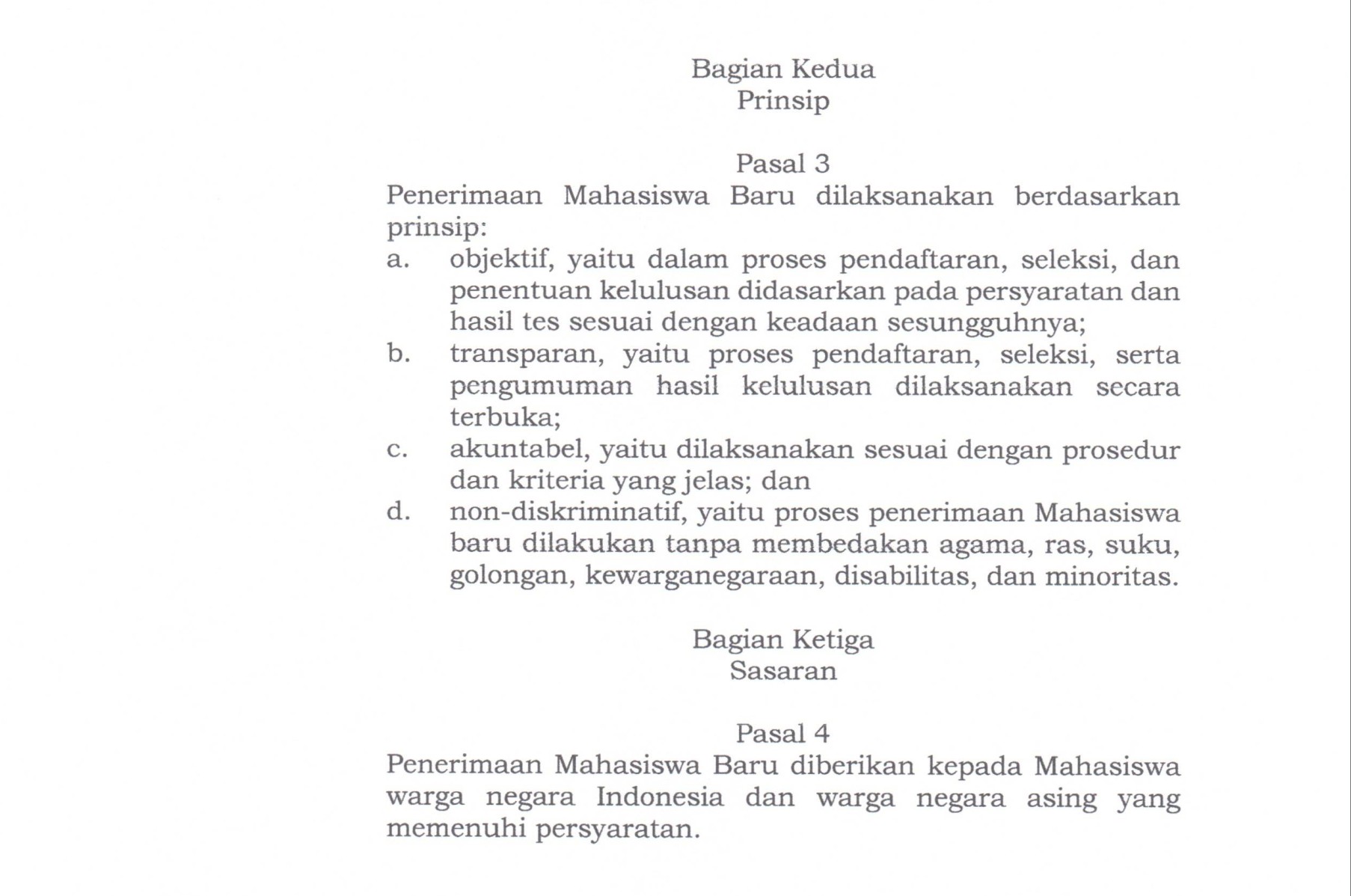
Public access: https://jdih.uiii.ac.id/detail/235
1.2. Safeguards in the selection process
Further articles make the principle operational. Admission is open to Indonesian citizens and foreign nationals who meet the requirements (Art. 4). Intake capacity is set by facilities, academic staff and educational resources (Art. 7). Selection is run by a committee appointed by the Rector, with reviewers and interviewers from the academic staff of each programme (Art. 8–9). Every applicant goes through the same eight stages: announcement, registration, administrative selection, document review, interview, background check for foreign nationals, plenary meeting, and determination and announcement of results (Art. 12), and the call for applications is published in media readily accessible to the public, including the UIII website and social media (Art. 13). Admission decisions are taken in a plenary meeting of the Rector, Vice Rectors, University Secretary, Deans and the reviewers and interviewers, and recorded in minutes (Art. 19), so that every decision is collective and documented.
1.3. Public statement to applicants
The admissions portal states, above the academic requirements for every programme, that “every applicant has a right to equal treatment without discrimination” and that UIII upholds the highest standards of fairness. The admissions page and guide add that “minorities, women, and individuals with disabilities are encouraged to apply”. The Rector reaffirmed the policy publicly when launching the 2022/2023 admissions on 13 May 2022, stating that UIII’s scholarships are non-discriminatory, that the University is not only for Muslims and that it welcomes young people from all over the world regardless of national or religious background.
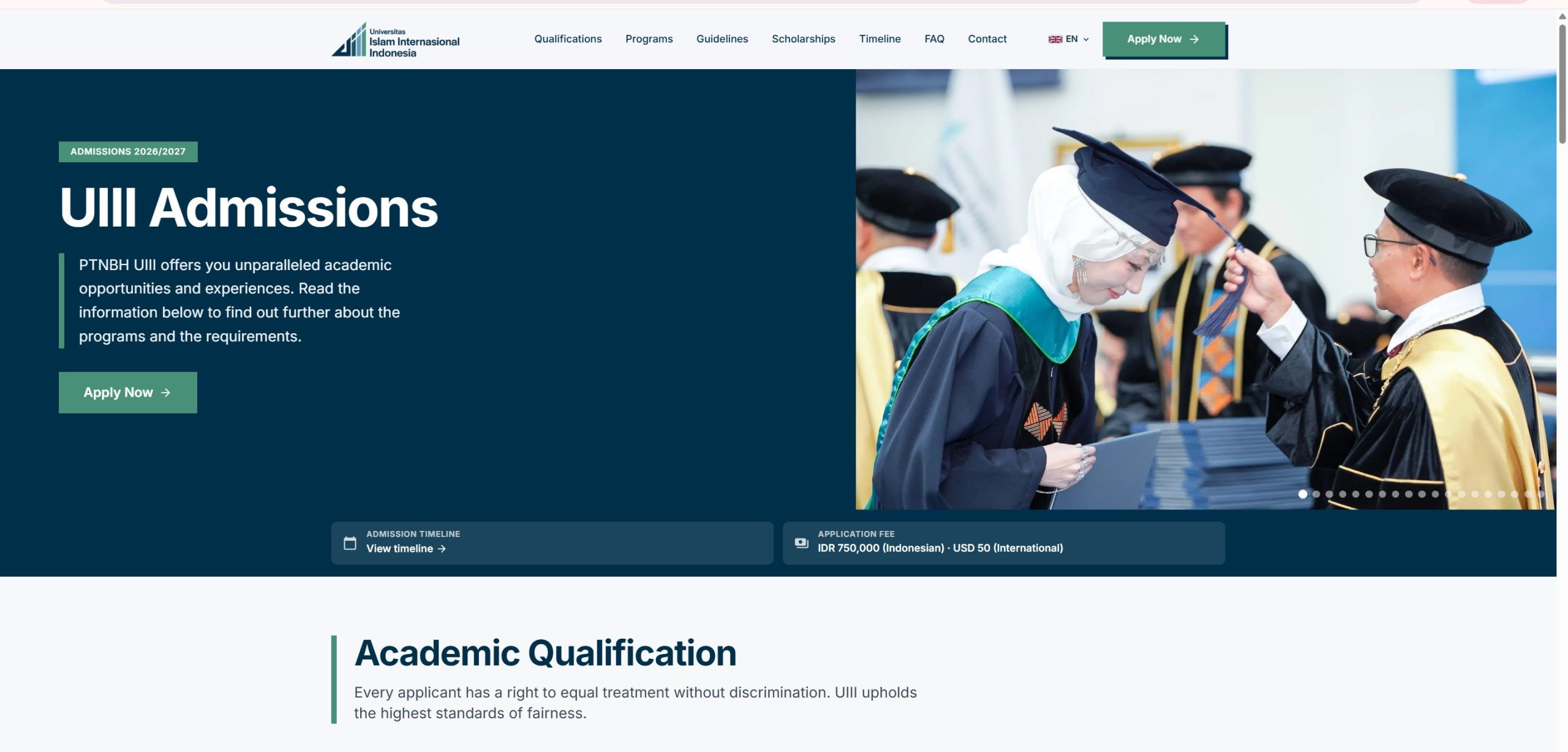
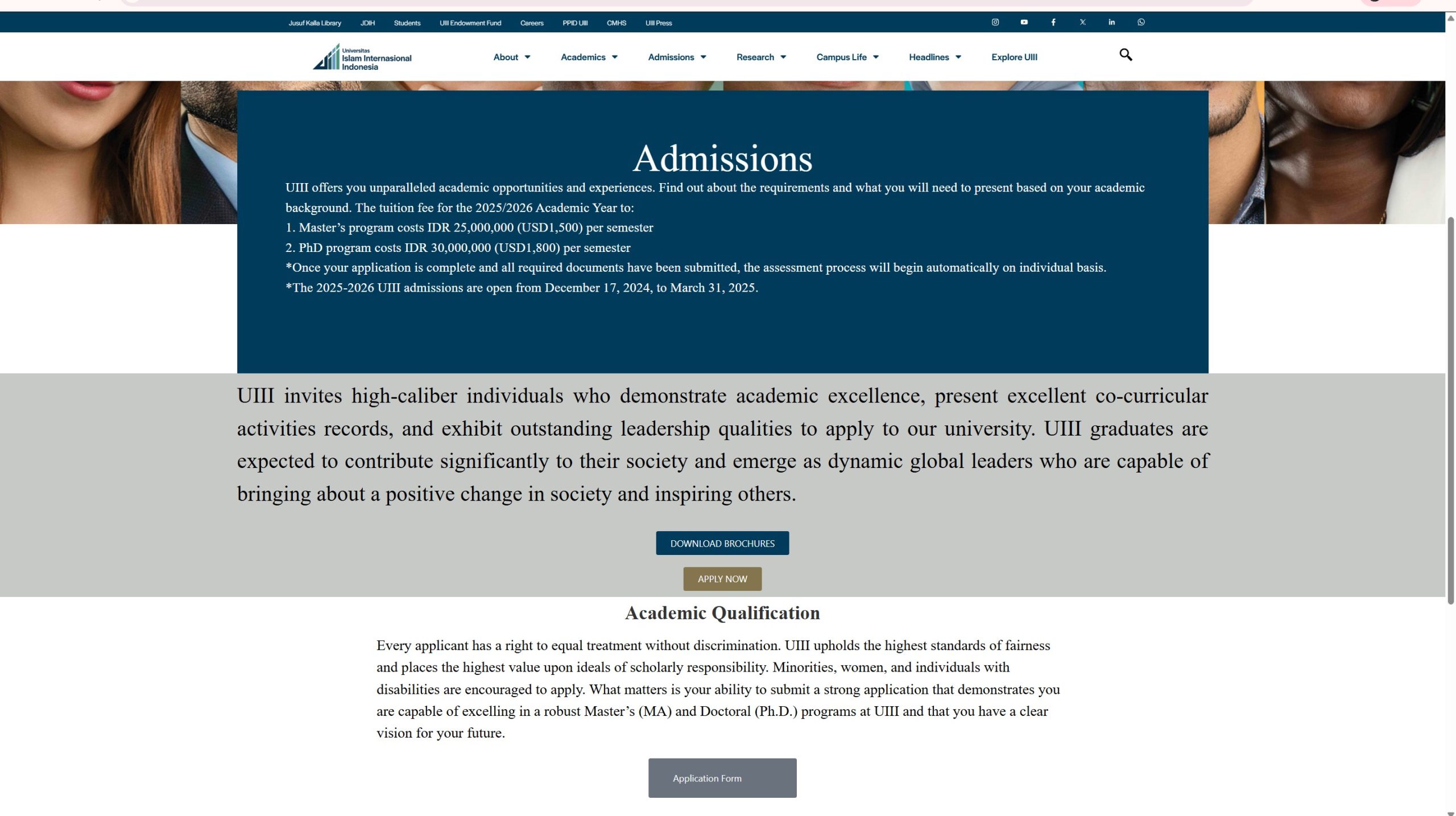
Public access: https://admissions.uiii.ac.id/home/en; https://uiii.ac.id/how-to-apply/
2. Positive Measures and Their Rationale
Equal treatment in selection does not by itself ensure equal access. The cost of applying and of language tests, the recognition of prior degrees and conditions in an applicant’s home country all shape who can enter the applicant pool. UIII’s positive measures direct additional support to defined groups so that they can compete on similar terms. They do not lower standards: every applicant must meet the same minimum grade point average (3.00 for master’s, 3.50 for doctoral programmes), the same language requirements and the same document review and interview (Art. 10–17).
2.1. Application fee waiver
The application fee is IDR 750,000 for Indonesian and USD 50 for international applicants (Art. 14(2)), and an applicant may request exemption with a reasoned application (Art. 14(3)). The admissions guide operationalises this as the Application Fee Waiver for applicants who demonstrate financial need: the applicant uploads the waiver form with the application and is notified of the decision by e-mail; an approved waiver covers the whole fee for that cycle. A fee that is trivial in a high-income economy can be a large share of monthly household income in a low-income country or for a low-income Indonesian family, and the waiver ensures that ability to pay does not decide who may be considered.
2.2. Fully funded scholarships
The UIII Scholarship is a bond-free full scholarship for master’s and doctoral students covering tuition, a monthly living allowance, a settlement allowance, health insurance, book and research allowances and, for international students, visa, study permit and return airfare. It is open to Indonesian and international candidates alike, gives priority to first-time master’s candidates and excludes those already funded by another award, so that full awards go to applicants who could not otherwise study. Since 2021 UIII has awarded 793 scholarships under ten schemes, 161 of them to the 2025 intake. Applicants below the scholarship’s English threshold may enrol on the self-funded scheme with an English matriculation class.
2.3. Targeted scholarship channels
1. PEMRI-UIII Scholarship, for outstanding students from Afghanistan, whose higher education system has been severely disrupted and whose women face acute restrictions on study.
2. Norway-UIII and Netherlands-UIII scholarships, which enable Afghan women to study for master’s and doctoral degrees.
3. INSANI-UIII Scholarship (Indonesian AID Scholarship for Islamic Community Development), for nationals of Algeria, Azerbaijan, Bangladesh, Burkina Faso, Iran, Iraq, Libya, the Maldives, Mauritania, Morocco, Mozambique, Palestine, Somalia, Sudan, Syria, Tunisia and Yemen, most of them low- or middle-income economies and several affected by protracted conflict. 4. Affirmative LPDP scheme of the Indonesia Endowment Fund for Education, which opens places at UIII for underprivileged Indonesian applicants, persons with disabilities and Papuan students.
Naming target countries and groups concentrates funded places where the gap between academic potential and access is widest, rather than leaving them to an open competition that applicants from well-resourced systems would predictably dominate.
2.4. Exemptions in the admissions regulation
The standard age limits of 35 years for master’s and 40 years for doctoral applicants may be waived for researchers, academics, teachers and lecturers, and in other cases decided by the Rector (Art. 10(2)(b) and 10(3)(b)), protecting mid-career candidates whose studies were delayed by work, caregiving or displacement. Native speakers and graduates of English- or Arabic-medium institutions are exempt from the corresponding language certificates (Art. 10 and 11(2)), and applicants changing discipline may be admitted on the strength of motivation, capability and relevance to the programme.
SDGs Relevance: Quality Education (4.3, 4.5, 4.b), Gender Equality (5.1), Reduced Inequalities (10.2, 10.3, 10.b)
3. Application, Monitoring and Review
Applications are accepted only through the admissions portal (admissions.uiii.ac.id), where each applicant’s record holds their nationality, gender, programme and any fee waiver request, so that the University can track the policy’s effects in every cycle. Article 22 requires the unit responsible for academic and student affairs to monitor and evaluate each admission cycle and to use the results in the following cycle, and Article 23 requires the selection committee to report on implementation and finances to the Vice Rector for Academic Affairs, Student Affairs and Human Resources after every cycle. The policy has been applied in every admission cycle since the first intake in 2021; the 2025/2026 cycle ran from 17 December 2024 to 31 March 2025, with the international deadline extended to 30 April 2025.
Table 2. Admissions equity data by cycle.
| Measure | 2025 |
|---|---|
| Fee waiver requests received / approved | 10 |
| Waiver recipients admitted | 7 |
| Applicants / admitted students by gender (women) | 86 |
| Admitted international students (countries) | 133 |
| Scholarships awarded to the intake | 161 |
4. Summary of Admissions Provisions
Table 3. Admissions provisions, target groups and public evidence.
| Provision | Target group | Logic | Public evidence |
|---|---|---|---|
| Rector’s Regulation No. 17/2021, Art. 3(d) | All applicants | No exclusion on grounds of religion, race, ethnicity, group, nationality, disability or minority status | jdih.uiii.ac.id/detail/235 |
| Equal-treatment statement | All applicants | Every applicant has a right to equal treatment without discrimination | admissions.uiii.ac.id/home/en |
| Encouragement clause | Minorities, women, individuals with disabilities | Explicit invitation to groups facing barriers to postgraduate study | uiii.ac.id/how-to-apply/ |
| Application fee waiver (Art. 14(3)) | Applicants in financial need | Removes the fee barrier (IDR 750,000 / USD 50) | admissions.uiii.ac.id/home/en |
| UIII Scholarship | Indonesian and international candidates | Bond-free full funding removes cost as a determinant of access | admissions.uiii.ac.id/home/en#scholarships |
| PEMRI, Norway and Netherlands schemes | Students and women scholars from Afghanistan | Access for a conflict-affected country and for women denied education | admissions.uiii.ac.id/home/en#scholarships |
| INSANI-UIII Scholarship | Nationals of 17 named countries | Funded places for low- and middle-income and conflict-affected countries | admissions.uiii.ac.id/home/en#scholarships |
| LPDP affirmative scheme | Underprivileged Indonesians, persons with disabilities, Papuans | Affirmative places for disadvantaged Indonesian groups | https://lpdp.kemenkeu.go.id/en/beasiswa/afirmasi/beasiswa-daerah-afirmasi-2025/ |
| Age and language exemptions (Art. 10– 11) | Mid-career academics; English-or Arabic-medium graduates | Prevents age and testing costs from excluding applicants | jdih.uiii.ac.id/detail/235 |
References
[1] Universitas Islam Internasional Indonesia. Rector’s Regulation No. 17 of 2021 on New Student Admissions. Depok, 1 December 2021. https://jdih.uiii.ac.id/detail/235
[2] Government of Indonesia. Government Regulation No. 23 of 2019 on the Statute of Universitas Islam Internasional Indonesia, Art. 15(3).
[3] UIII Admissions Portal. https://admissions.uiii.ac.id/home/en
[4] UIII. How to Apply. https://uiii.ac.id/how-to-apply/
[5] UIII. Admissions Guide 2025/2026. https://s.uiii.id/UIII-Admissions
[6] UIII. Admissions FAQ. https://uiii.ac.id/admissions/faq
[7] UIII. UIII Admissions 2022/2023. https://uiii.ac.id/news/headline/264/uiii-admissions-2022-2023
[8] Universitas Islam Internasional Indonesia. Rector’s Circular No. 1c/Rek/UIII/SE.01/1/2025 on Strengthening an Inclusive and Anti-Discriminatory Campus. https://jdih.uiii.ac.id/detail/474