

SDG 10.3 International Students from Developing Countries
Universitas Islam Internasional Indonesia
Universitas Islam Internasional Indonesia (UIII) was established by the Government of Indonesia as a postgraduate, English-medium international university with a public mandate to open postgraduate education to scholars from the Muslim world and the Global South on terms that do not depend on the wealth of the student or of the sending country. Hosting students from low- and lower-middle-income economies is therefore central to its purpose, in line with SDG Targets 10.a and 10.b.
In 2025, 186 of UIII’s 444 students, or 41.9 per cent, were international students from 24 low- or lower-middle-income countries, as classified by the World Bank, each holding a scholarship provided or administered by the University that covers tuition, accommodation, living costs and study materials (Table 1). They made up more than half of all master’s students. This document sets out their enrolment, the admission pathways and financial aid that bring them to UIII, and the academic and multicultural environment in which they study.
Table 1. International students from developing countries, 2025.
| Indicator | Value |
|---|---|
| 10.3.1 Number of students, 2025 | 444 |
| 10.3.2 Number of international students from developing countries receiving financial aid | 186 |
| Proportion of international students from developing countries | 41.9% |
1. Student Enrolment
1.1. Students by programme level
All UIII programmes are full-time, residential master’s and doctoral programmes, so each student counts as one full-time equivalent. UIII offers no bachelor’s programmes. International students from developing countries make up 50.8 per cent of master’s students and 22.7 per cent of doctoral students (Table 2 and Figure 1).
Table 2. International students from developing countries by programme level, 2025.
| Programme level | International students from developing countries | By faculty | All students | Share |
|---|---|---|---|---|
| Master’s | 154 | FOSS 55, FEB 46, FIS 32, FoE 16, FST 5 | 303 | 50.8% |
| Doctoral | 32 | FIS 15, FEB 8, FOSS 7, FoE 2 | 141 | 22.7% |
| Total | 186 | 444 | 41.9% |
FIS: Faculty of Islamic Studies; FOSS: Faculty of Social Sciences; FEB: Faculty of Economics and Business; FoE: Faculty of Education; FST: Faculty of Science and Technology.
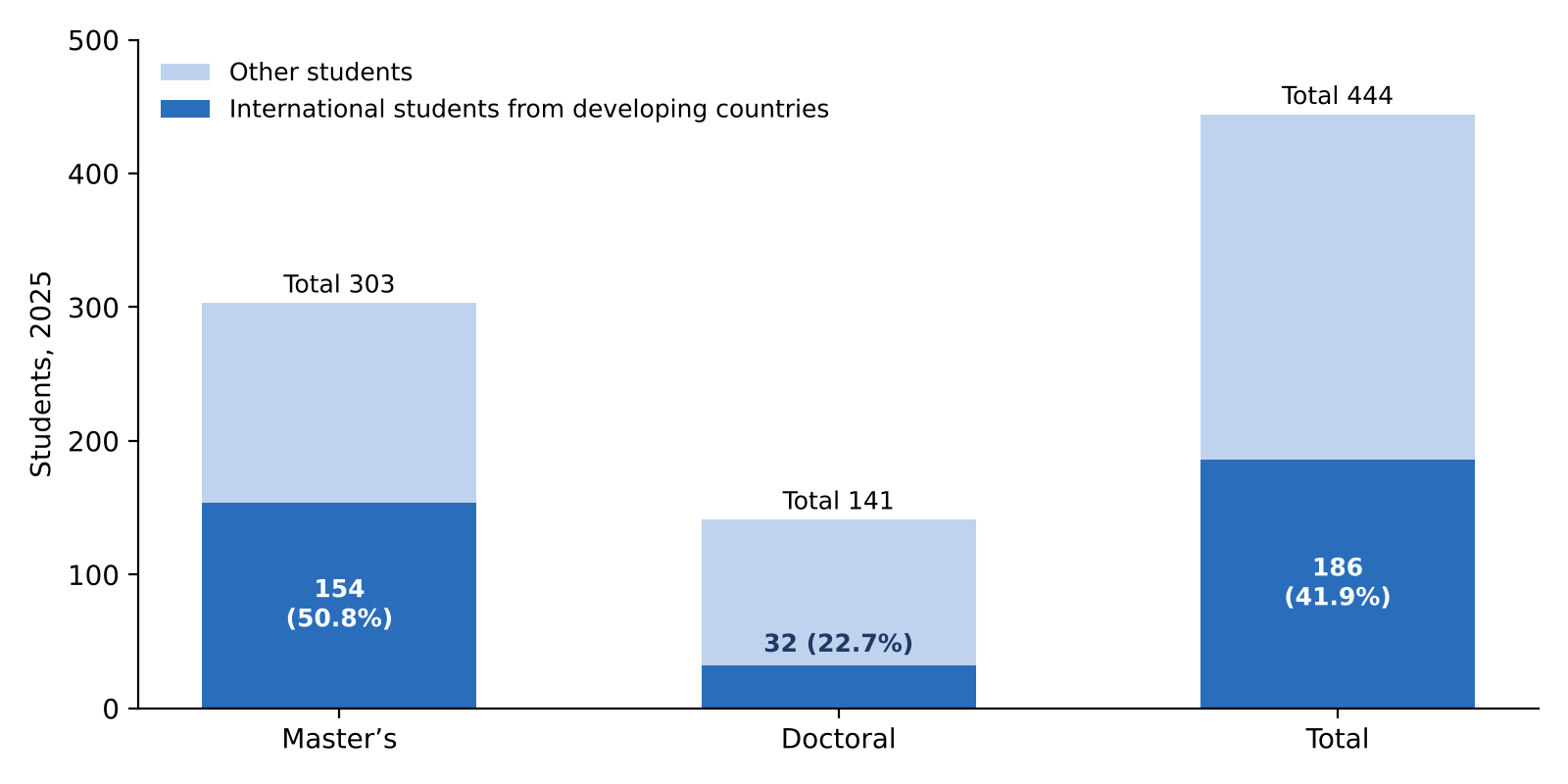
The master’s share reflects the design of the UIII Scholarship, which is awarded through a single application combining admission and funding and is prioritised for first-time master’s applicants. The doctoral share is lower because doctoral cohorts are smaller and a larger share of doctoral places is held by Indonesian lecturers funded through the national LPDP endowment as part of UIII’s domestic capacity-building role.
1.2. Students by programme
Table 3. International students from developing countries by faculty and programme, 2025.
| Faculty and programme | Master’s | Doctoral | Total |
|---|---|---|---|
| Social Sciences: Political Science | 27 | 7 | 34 |
| Social Sciences: Public Policy (Climate Change) | 28 | 0 | 28 |
| Economics and Business: Economics | 26 | 8 | 34 |
| Economics and Business: Finance (Sustainable Finance) | 20 | 0 | 20 |
| Islamic Studies: Islamic Studies, including Turath Islam | 32 | 15 | 47 |
| Education: Education | 16 | 2 | 18 |
| Science and Technology: Data Science | 5 | 0 | 5 |
| Total | 154 | 32 | 186 |
The cohort is spread across all five faculties. The largest master’s programmes for these students, Public Policy specialising in Climate Change (28) and Sustainable Finance (20), address development challenges that weigh most heavily on low- and lower-middle-income economies, and 15 doctoral candidates in Islamic Studies and 8 in Economics build advanced research capacity for their home countries.
1.3. Countries of origin
Table 4. Countries of origin of international students from developing countries, 2025.
| Country | World Bank income group | Master’s | Doctoral | Total |
|---|---|---|---|---|
| Pakistan | Lower-middle income | 41 | 9 | 50 |
| The Gambia | Low income | 29 | 2 | 31 |
| Nigeria | Lower-middle income | 21 | 7 | 28 |
| Afghanistan | Low income | 14 | 4 | 18 |
| Sierra Leone | Low income | 7 | 2 | 9 |
| Philippines | Lower-middle income | 4 | 2 | 6 |
| Tanzania | Lower-middle income | 6 | 0 | 6 |
| Ghana | Lower-middle income | 5 | 0 | 5 |
| India | Lower-middle income | 5 | 0 | 5 |
| Liberia | Low income | 4 | 0 | 4 |
| Bangladesh | Lower-middle income | 2 | 1 | 3 |
| Malawi | Low income | 3 | 0 | 3 |
| Yemen | Low income | 2 | 1 | 3 |
| Côte d’Ivoire | Lower-middle income | 0 | 2 | 2 |
| Egypt | Lower-middle income | 1 | 1 | 2 |
| Madagascar | Low income | 2 | 0 | 2 |
| Morocco | Lower-middle income | 2 | 0 | 2 |
| Palestine (West Bank and Gaza) | Lower-middle income | 1 | 0 | 1 |
| South Sudan | Low income | 1 | 0 | 1 |
| Tunisia | Lower-middle income | 0 | 1 | 1 |
| Uganda | Low income | 1 | 0 | 1 |
| Viet Nam | Lower-middle income | 1 | 0 | 1 |
| Zambia | Lower-middle income | 1 | 0 | 1 |
| Zimbabwe | Lower-middle income | 1 | 0 | 1 |
| Total: 24 countries | 9 low income, 15 lower-middle income | 154 | 32 | 186 |
Four countries, Pakistan (50), the Gambia (31), Nigeria (28) and Afghanistan (18), together supply 127 students, or 68.3 per cent of the cohort, the result of the PEMRI-UIII scheme for Afghan students, engagement with the embassies of Pakistan and Nigeria, and the West African network built through Indonesia’s diplomatic missions. Around this core are twenty countries with nine or fewer students each, seven of them with a single student; several, including Palestine, South Sudan, Tunisia, Uganda and Egypt at doctoral level, appeared for the first time in the 2025 intake.
By region, West Africa (79 students, 42.5 per cent) and South Asia (76, 40.9 per cent) together account for more than four-fifths of the cohort, followed by East and Southern Africa (15 students from seven countries), Southeast Asia (7), North Africa (5) and West Asia (4). Africa supplies 99 students (53.2 per cent), in line with Target 10.b’s emphasis on African countries. The nine low-income economies send 72 students (38.7 per cent) and the fifteen lower-middle-income economies 114 (61.3 per cent), and twelve of the 24 countries are on the United Nations list of Least Developed Countries. Of the 186 students, 133 are men and 53 women. All are enrolled in full degree programmes; UIII hosted no short-term exchange students from these countries in 2025.
SDGs Relevance: Quality Education (4.b), Reduced Inequalities (10.2, 10.a, 10.b), Partnerships for the Goals (17.9)
2. Admission Pathways for Students from Developing Countries
2.1. Scholarship-based admission as the default pathway
UIII treats the main barriers facing candidates from low- and lower-middle-income countries as financial and procedural rather than intellectual, and handles funding, admission and relocation as a single process. The 2025/2026 admission cycle ran from 17 December 2024 to 31 March 2025 through one online portal, and the application doubles as the application for the UIII Scholarship. Selection, consisting of administrative screening, desk review and an online interview, can be completed from the applicant’s home country. In response to demand from overseas candidates, UIII extended the international deadline to 30 April 2025, and the application fee of USD 50 may be waived on grounds of financial need.
English thresholds (master’s: TOEFL iBT 80, IELTS 6.5 or PTE 58; doctoral: TOEFL iBT 94, IELTS 7.0 or PTE 65) are waived for graduates of English-medium universities, which covers most applicants from anglophone Africa and South Asia, and the Turath Islam track admits candidates on the strength of their Arabic, opening a pathway for graduates of traditional religious institutions in Egypt, Morocco, Yemen and Palestine. After enrolment, international students can take Indonesian-language (BIPA) classes, academic writing workshops and one-to-one English consultations.
2.2. Targeted recruitment
1. Afghan students. Under a 2022 agreement between UIII and Indonesian AID (LDKPI), Afghan students receive travel support from Indonesian AID while UIII funds tuition and living costs. Afghanistan was among the four largest sending countries in 2025, with 18 students, including women doctoral candidates supported by the Netherlands-UIII scheme.
2. Outreach to Africa. On 26 February 2025 UIII met the incoming Indonesian Ambassador to Senegal, whose accreditation covers the Gambia, Guinea, Guinea-Bissau, Mali, Sierra Leone, Côte d’Ivoire and Cabo Verde, and agreed to build recruitment networks through Indonesian embassies in Nigeria, Cameroon, Ethiopia, Kenya and Mozambique.
3. Students from conflict-affected areas. In September 2025 UIII admitted a student from Gaza into the MA in Turath Islam with a full scholarship, and on 29 December 2025 the Ambassador of Palestine visited the campus to discuss further scholarship places.
4. Embassy engagement. Ambassadors and representatives of Afghanistan, Pakistan, Uzbekistan, Nigeria, Sudan and the Philippines attended the third UIII Commencement on 27 August 2025.
5. Pre-departure and arrival support. An online pre-departure session on 3 September 2025, attended by 160 of the 179 admitted students, covered visas, travel, accommodation, health and safety, and academic life; on arrival, international students receive airport pick-up, help with immigration reporting and orientation from the International Office.
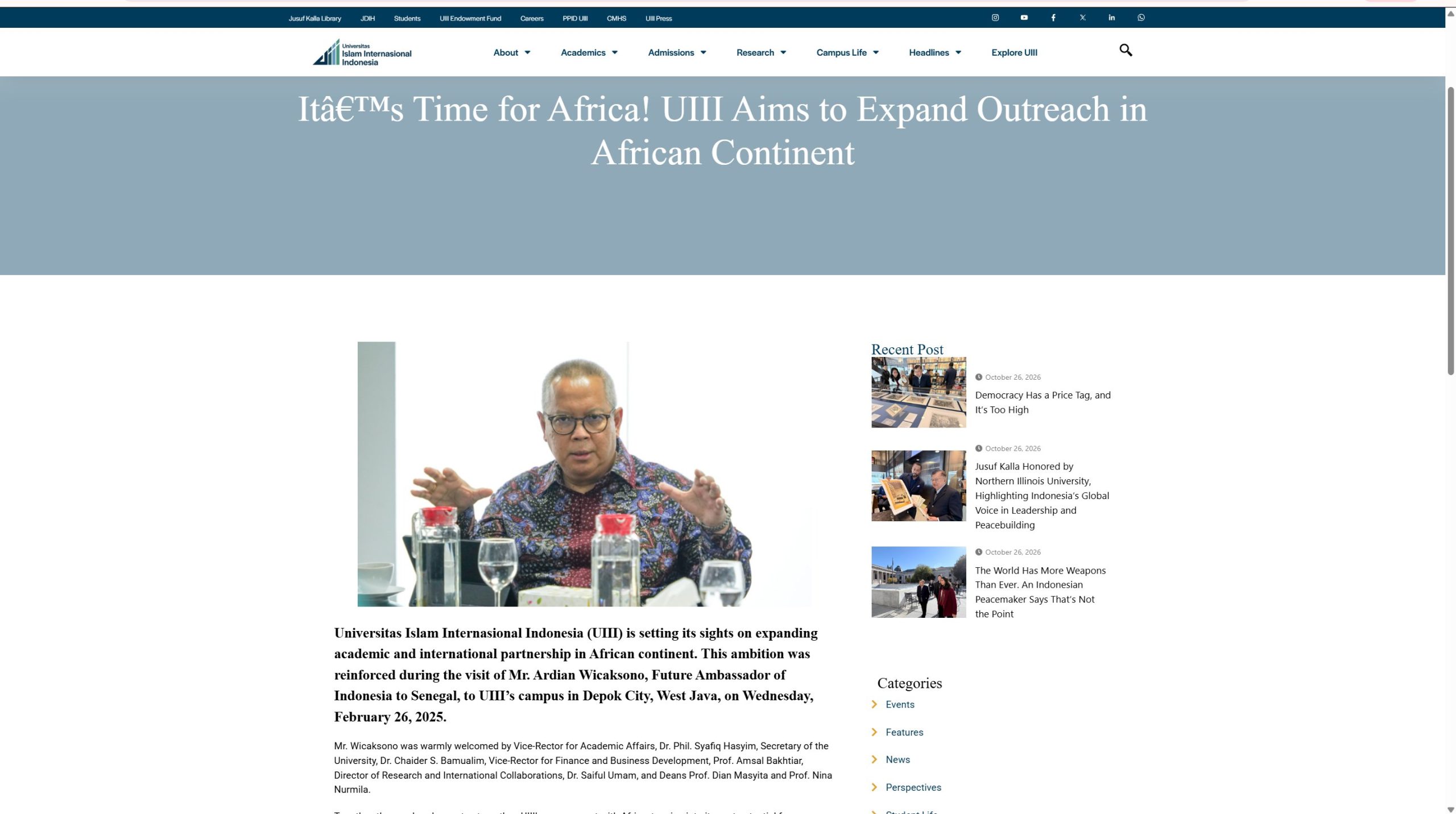
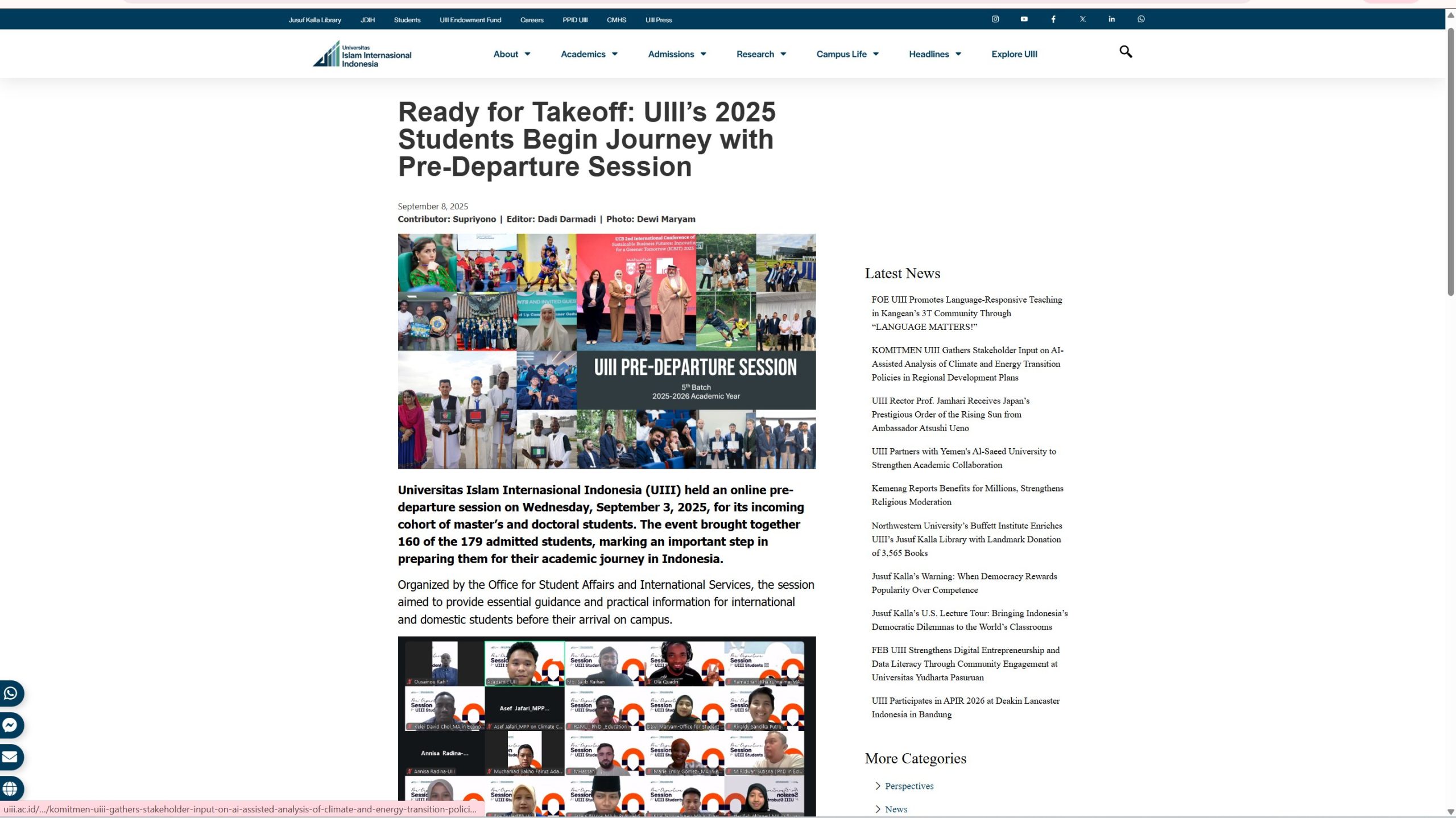
UIII news: https://uiii.ac.id/its-time-for-africa-uiii-aims-to-expand-outreach-in-african-continent/; https://uiii.ac.id/ready-for-takeoff-uiiis-2025-students-begin-journey-with-pre-departure-session/
2.3. Careers and post-graduation pathways
Most students from developing countries intend to return home to universities, ministries, civil society organisations and financial institutions. The UIII Alumni Association runs an alumni portal with a global job board and a tracer study of graduates’ destinations. During their studies, international students serve as volunteer BIPA instructors and officers of the International Students Association and faculty associations, and take part in professional programmes on campus, such as the eighth Certificate Course on International Humanitarian Law and Islamic Law with the International Committee of the Red Cross (6–10 October 2025), which included participants from Nigeria, Pakistan, Afghanistan, the Philippines, the Gambia and Malawi. Dual-degree tracks with the University of Edinburgh and SOAS University of London add an international credential; 14 of the 164 graduates of 2025 completed a dual degree.
SDGs Relevance: Quality Education (4.b), Reduced Inequalities (10.2, 10.b)
3. Financial Aid and Student Support
Every one of the 186 students holds a scholarship funded by UIII or administered by the University on behalf of the Government of Indonesia or a partner donor (Table 5). The UIII Scholarship covers tuition, accommodation, a monthly living allowance, health insurance, airfare and study allowances for the full programme; students in the on-campus dormitory have the accommodation fee of IDR 1,000,000 a month deducted from their monthly stipend of IDR 5,000,000, so that housing is secured without any out-of-pocket payment.
Table 5. Financial aid for international students from developing countries, 2025.
| Scheme | Description | Students |
|---|---|---|
| UIII Scholarship | University-funded full award for master’s (4 semesters) and doctoral (8 semesters) study; tuition waived (IDR 25,000,000 per semester for master’s, IDR 30,000,000 for doctoral) plus living allowance | 137 (125 master’s, 12 doctoral) |
| UIII Scholarship, Categories 2 and 3 | University-funded award for master’s students with a reduced benefit package covering tuition and core support | 21 master’s (18 Category 2, 3 Category 3) |
| UIII Partial Scholarship | Partial tuition and support for doctoral students | 2 doctoral |
| PEMRI-UIII Scholarship | Government of Indonesia scholarship for Afghan students: Indonesian AID funds travel, UIII funds tuition and living costs | 5 master’s, Afghanistan |
| LPDP-UIII Scholarship | Scholarship of the Indonesia Endowment Fund for Education and UIII covering registration, tuition, research, thesis, international seminar and emergency funds | 16 doctoral: Pakistan 7, Nigeria 3, Afghanistan 2, the Gambia 2, Côte d’Ivoire 1, Tunisia 1 |
| Norway-UIII Scholarship | Partner-funded master’s scholarship for students from Afghanistan | 3 master’s, Afghanistan |
| Netherlands-UIII Scholarship | Partner-funded doctoral scholarship for women scholars from Afghanistan | 2 doctoral, Afghanistan |
| Total | No self-funded student is counted | 186 (154 master’s, 32 doctoral) |
Nearly three-quarters of the cohort (137 students, 73.7 per cent) are funded entirely from UIII’s own budget through the full UIII Scholarship, a further 23 receive university-funded category or partial awards, and 26 are supported by schemes in which the Government of Indonesia or partner governments provide the funding while UIII provides the place, accommodation and administration. Because student visas in Indonesia do not permit employment, UIII sets the stipend at a level that makes paid work unnecessary.
3.1. Academic, psychosocial and cultural support
Every student is assigned an academic advisor at enrolment and a thesis or dissertation supervisor at the proposal stage. Orientation Week (15–19 September 2025) introduced the 2025 cohort, from 28 countries, to the academic system and the student code of conduct, with faculty sessions on academic ethics, cultural awareness and the prevention of sexual harassment. The SHARE 2025 thesis writing camp (2–3 June 2025) and the Language and Writing Class provide structured writing support. The Counseling and Mental Health Services offer individual and group counselling, psychological screening and referrals in a setting that respects diversity of culture, gender and background; its first psychoeducation series addressed relocation stress. The BIPA programme pairs international learners with volunteer language buddies, the International Students Association organises social activities, and the on-campus dormitory, health insurance, campus shuttle and bicycles, and the International Office support daily life.
SDGs Relevance: Quality Education (4.b, 4.5), Reduced Inequalities (10.2, 10.b)
4. Academic Collaboration and Multicultural Integration
International students from developing countries study within a calendar of academic exchange with visiting scholars and partner universities (Table 6) and a campus culture that brings Indonesian and international students together through shared daily life (Table 7).
Table 6. Academic exchange and joint learning involving international students, 2025.
| Date | Activity |
|---|---|
| 14–15 January | Decolonial writing workshop (British Academy-funded) with Dr Leon Moosavi (University of Liverpool) and Prof. Camila Prando (University of Brasília) |
| 19 February | Public lecture by Prof. Salamah Dawud, Rector of Al-Azhar University, on collaboration between Al-Azhar and UIII; talks on faculty and student |
| Date | Activity exchange |
| 25–27 February | Workshop on media and information literacy with BNPT, the Australian Government and Hedayah; two UIII students awarded Best Project |
| 17 March | Lecture by Prof. Stéphane Lacroix (Sciences Po), visiting professor at UIII |
| 7–8 May | Fourth Annual International Conference of the Faculty of Education, “Assessment and Equity in Education”, with keynotes from Deakin University and EdUHK |
| June | Fourth Summer Training on Qualitative and Quantitative Methods (STQ2M), Faculty of Social Sciences, opened by Prof. Yuhki Tajima (Georgetown University) |
| 15–17 July | SCRIPTS 2025 Summer Course on Islamic Manuscripts and Texts, with instructors from Sciences Po and the University of Edinburgh |
| 16–18 July | International conference “Religious Environmentalism in Action” with speakers from UNEP, the University of Wisconsin-Madison and Radboud University |
| 29–30 July | UIII-HCHF International Conference on Human Fraternity, concluding with the Jakarta Declaration on Human Fraternity |
| 19–20 August | Fourth Masterclass in Digital Humanities (Digital Islam), Faculty of Islamic Studies |
| 6–10 October | Eighth Certificate Course on International Humanitarian Law and Islamic Law with ICRC Jakarta and INSANIA |
| 8 October–26 November | Residency of Prof. Ayman Shihadeh (SOAS University of London) as Senior Fellow, Faculty of Islamic Studies |
| 29–31 October | AICIS+ 2025 Annual International Conference on Islam, Science and Society, hosted at UIII with the Ministry of Religious Affairs; four UIII students presented papers |
| November | Seventh World Indonesianist Congress, hosted by UIII with the Ministry of Foreign Affairs |
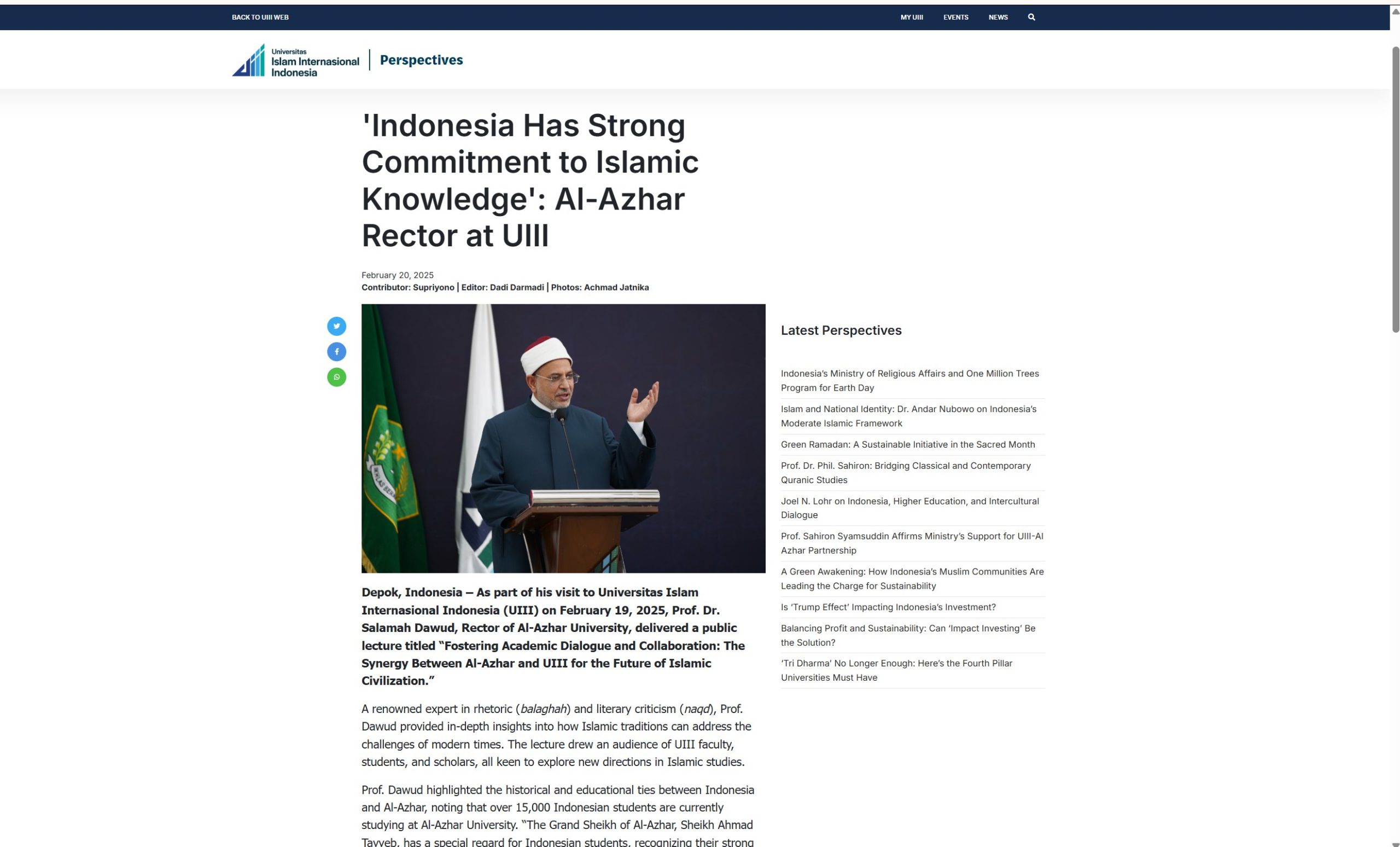
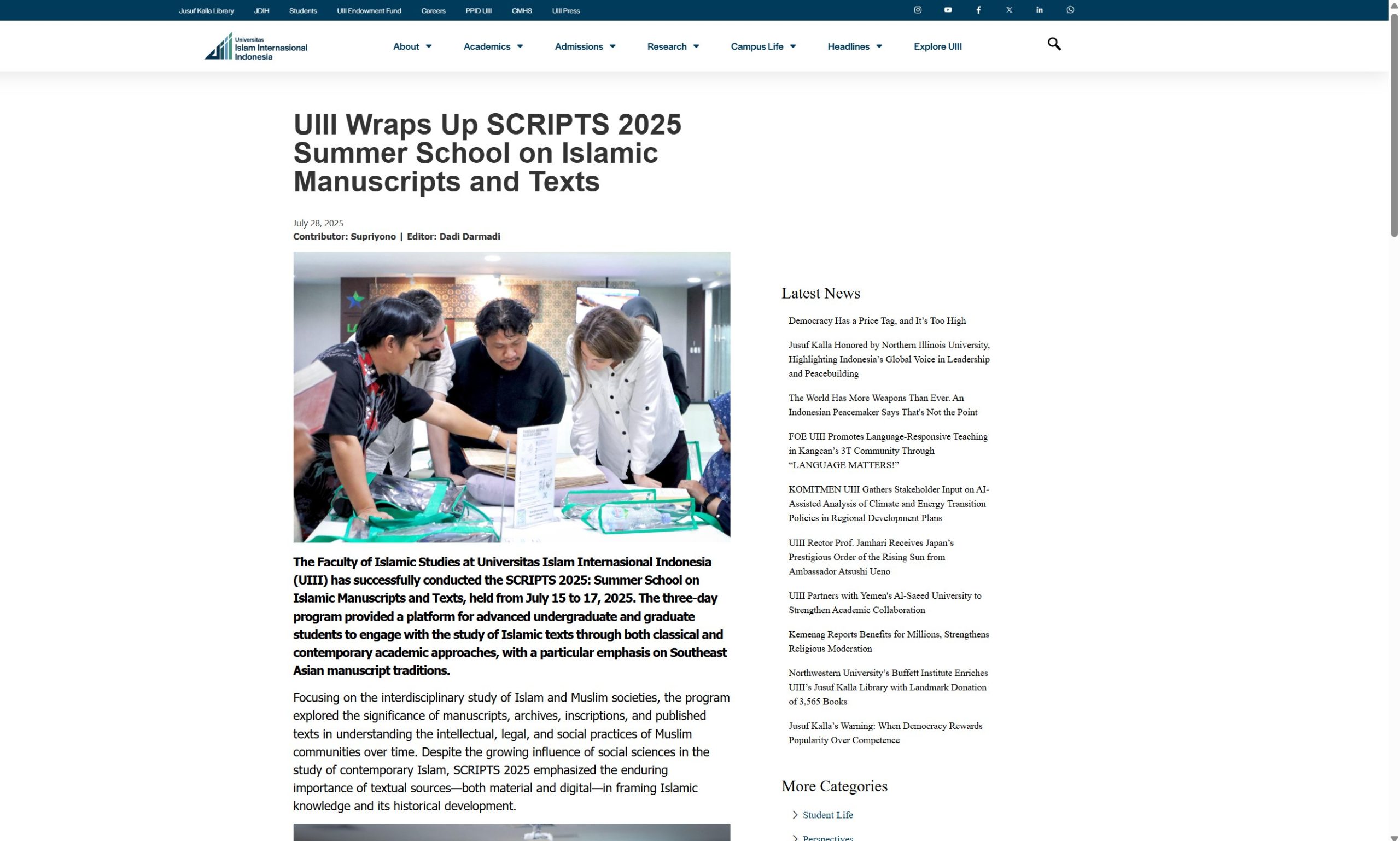
Table 7. Multicultural activities on campus, 2025.
| Date | Activity |
|---|---|
| 31 December 2024–1 January | “United as One” end-of-year festival with a multicultural bazaar and Reflection Night, organised by the Student Union, Climate Club and International Students Association |
| 23 February | Mixed Indonesian and international UIII team wins the Brimob football championship in Depok, captained by a student from the Gambia |
| March (Ramadan) | Daily communal iftar and tarawih at the campus mosque led by Indonesian and international imams; Green Ramadan programme |
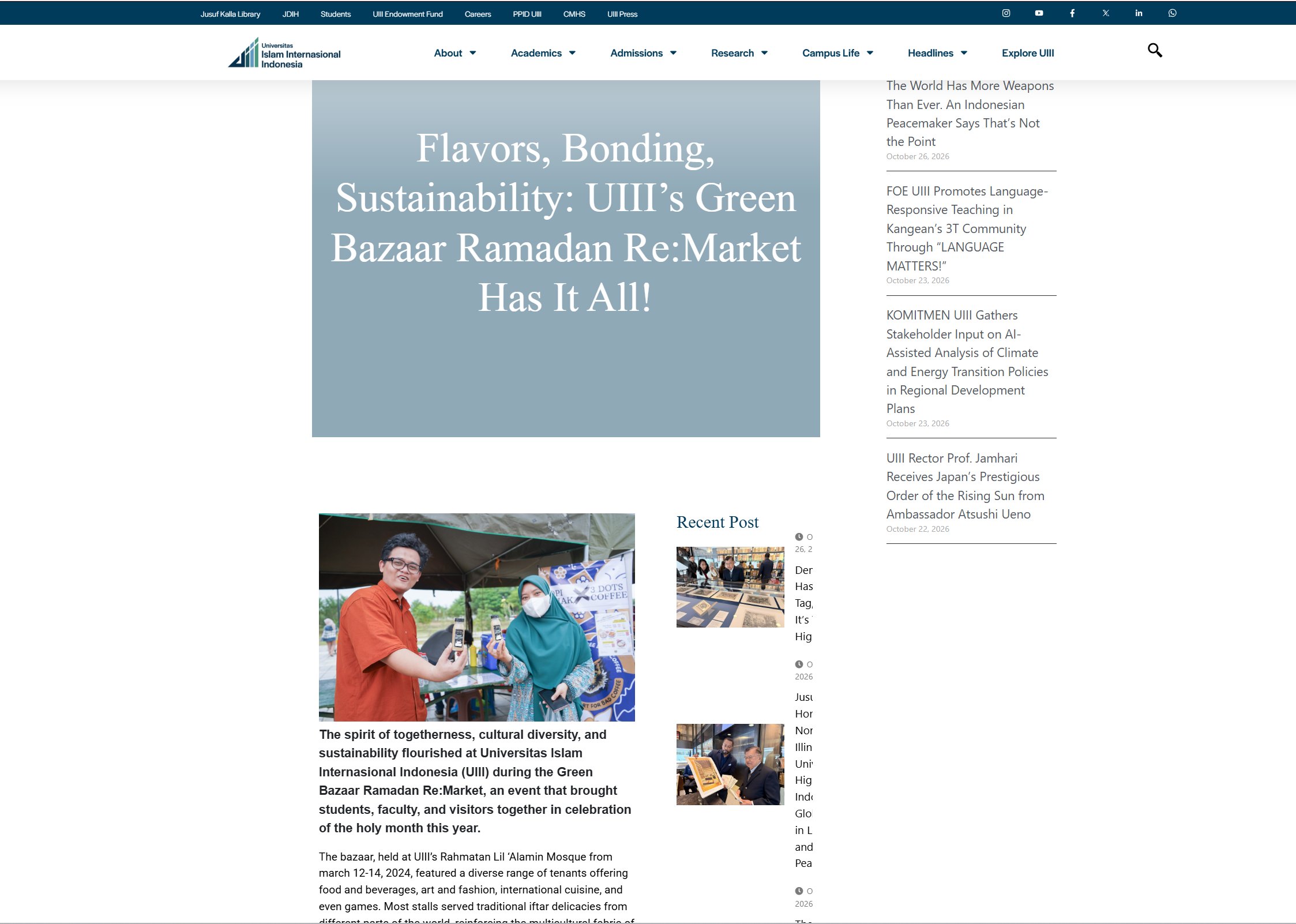
| 12–14 March | Green Bazaar “Ramadan Re:Market” at the campus mosque with international student vendors |
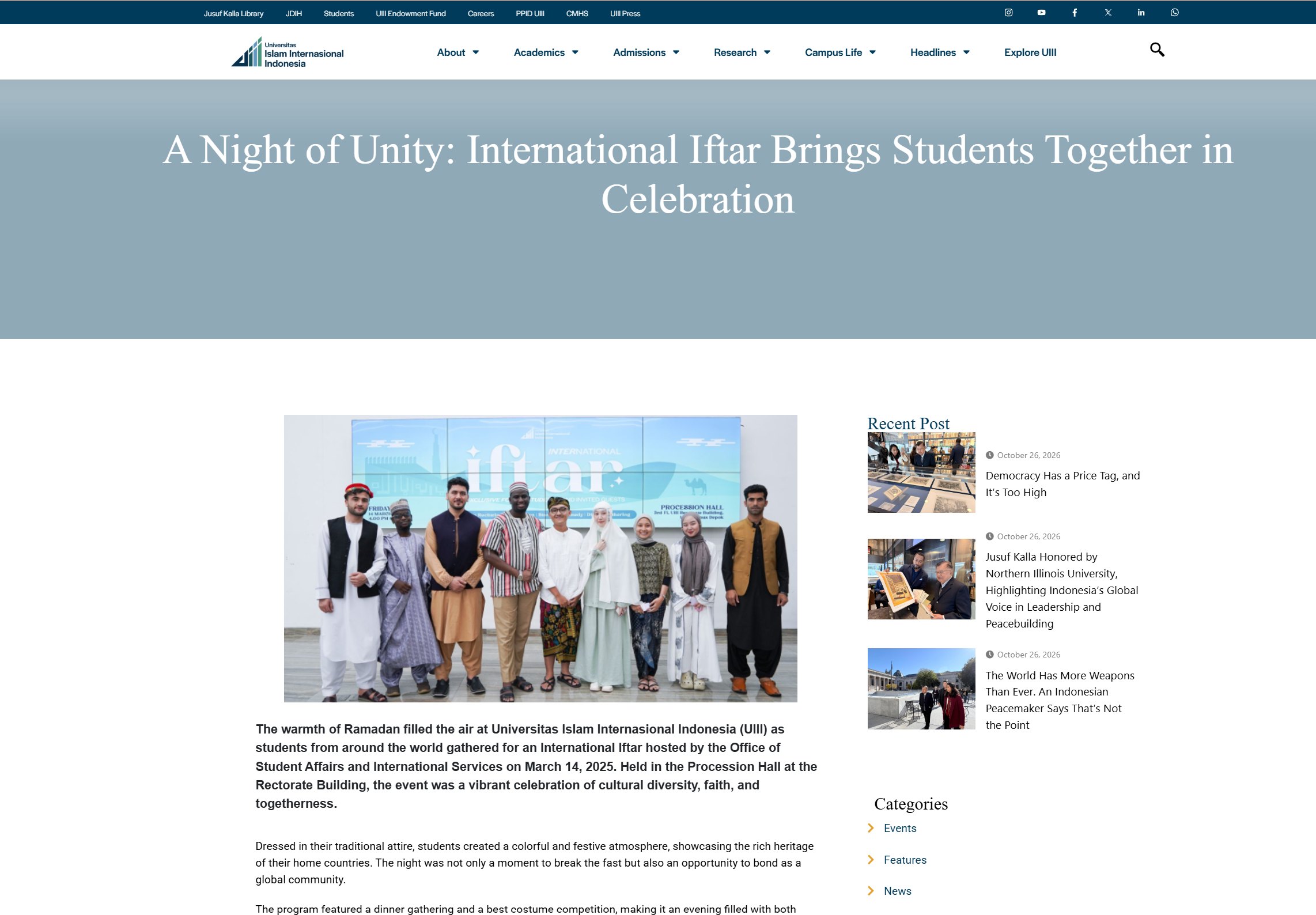
| 14 March | “A Night of Unity” International Iftar with a national costume competition |
| 18 March | Iftar and dialogue between the Vice Minister of Religious Affairs and international students |
| 2 April | Eid al-Fitr celebration on campus for students remaining in Indonesia |
| 7–8 June | Launch of the UIII Mountain Club with a first hike to Mount Gede |
| 22 August | Closing of the fourth batch of the BIPA volunteering programme |
| 15–19 September | Convocation and Orientation Week, welcoming new students from 28 countries |
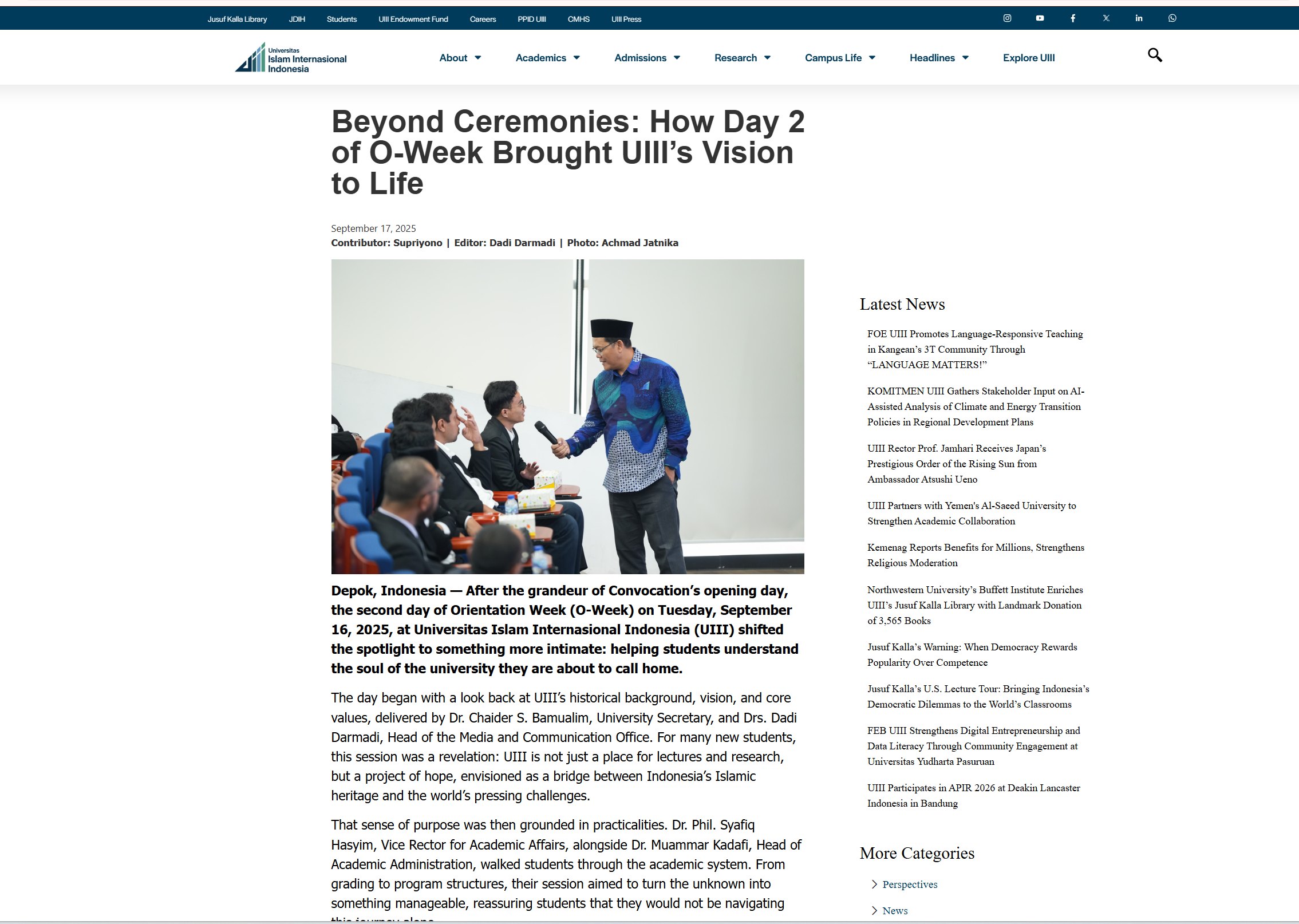
All programmes are taught in English to mixed cohorts, so every course brings comparative cases from South Asia, West Africa, the Middle East and Southeast Asia into the classroom. Ramadan, sports clubs and student associations give Indonesian and international students shared projects: Indonesian students volunteer as BIPA instructors and language buddies, and international students lead the International Students Association and sit on faculty student associations.
UIII news: https://uiii.ac.id/a-night-of-unity-international-iftar-brings-students-together-in-celebration/; https://uiii.ac.id/flavors-bonding-sustainability-uiiis-green-bazaar-ramadan-remarket-has-it-all/; https://uiii.ac.id/beyond-ceremonies-how-day-2-of-o-week-brought-uiiis-vision-to-life/
SDGs Relevance: Quality Education (4.7), Reduced Inequalities (10.2), Partnerships for the Goals (17.9)
5. Conclusion
In 2025, 186 of UIII’s 444 students (41.9 per cent) were international students from 24 low-or lower-middle-income countries, each supported by a scholarship provided or administered by the University covering tuition, accommodation, living costs and study materials. They made up more than half of all master’s students. Targeted recruitment through diplomatic and institutional partnerships, comprehensive financial aid, academic, psychosocial and language support, and a campus culture of daily multicultural integration make this enrolment a direct institutional contribution to Targets 10.a and 10.b.
6. Method
1. Number of students: all active master’s and doctoral students in 2025; all programmes are full-time, so headcount equals full-time equivalent.
2. International students: students whose citizenship at registration is not Indonesian.
3. Developing countries: low- and lower-middle-income economies in the World Bank country income classification applicable to 2025. International students from upper-middle-and high-income countries, such as Australia, Mexico and Türkiye, are not counted.
4. Financial aid: only students holding a registry-recorded scholarship funded or administered by UIII are counted; self-funded students are excluded.
References
[1] Universitas Islam Internasional Indonesia. Student registry, academic year 2025/2026; scholarship recipients by scheme.
[2] World Bank. Country and lending groups: income classification. https://datahelpdesk.worldbank.org/knowledgebase/articles/906519
[3] United Nations. List of Least Developed Countries.
[4] UIII. It’s Time for Africa: UIII Aims to Expand Outreach in African Continent. https://uiii.ac.id/its-time-for-africa-uiii-aims-to-expand-outreach-in-african-continent/
[5] UIII. Ready for Takeoff: UIII’s 2025 Students Begin Journey with Pre-Departure Session. https://uiii.ac.id/ready-for-takeoff-uiiis-2025-students-begin-journey-with-pre-departure-session/
[6] UIII. ‘Indonesia Has Strong Commitment to Islamic Knowledge’: Al-Azhar Rector at UIII. https://old.uiii.ac.id/perspectives/read/57854/indonesia-has-strong-commitment-to-islamic-knowledge-al-azhar-rector-at-uiii
[7] UIII. UIII Wraps Up SCRIPTS 2025 Summer School on Islamic Manuscripts and Texts. https://uiii.ac.id/uiii-wraps-up-scripts-2025-summer-school-on-islamic-manuscripts-and-texts/
[8] UIII. FOSS to Host 4th Summer Training on Qualitative and Quantitative Methods in June 2025. https://uiii.ac.id/foss-to-host-4th-summer-training-on-qualitative-and-quantitative-methods-in-june-2025/
[9] UIII. A Night of Unity: International Iftar Brings Students Together in Celebration. https://uiii.ac.id/a-night-of-unity-international-iftar-brings-students-together-in-celebration/
[10] UIII. Flavors, Bonding, Sustainability: UIII’s Green Bazaar Ramadan Re:Market Has It All! https://uiii.ac.id/flavors-bonding-sustainability-uiiis-green-bazaar-ramadan-remarket-has-it-all/
[11] UIII. Beyond Ceremonies: How Day 2 of O-Week Brought UIII’s Vision to Life. https://uiii.ac.id/beyond-ceremonies-how-day-2-of-o-week-brought-uiiis-vision-to-life/