

SDG 8.2.1 Employment Practice: Living Wage
Universitas Islam Internasional Indonesia
Universitas Islam Internasional Indonesia (UIII) is committed to decent work for every person it employs, in line with Sustainable Development Goal 8. Its remuneration rules, set by Rector’s Regulation No. 5 of 2025, pay all categories of lecturers and non-academic staff, permanent and contract, a monthly income built from a basic salary or wage and prescribed allowances, and they peg the wage of the lowest-qualified contract staff to the statutory minimum wage of Depok City, where the campus is located. UIII’s institutional assessment is that no employee was paid below either the Depok City Minimum Wage (UMK) or the local poverty line for a family of four in 2025.
Because Indonesia does not define an official living wage, this document follows the THE methodology and uses the local financial-poverty indicator for a family of four, expressed as an hourly wage, as the primary benchmark, with UMK as the statutory reference (Table 1). It sets out the benchmarks, the remuneration framework, the salary and allowance schedules, the prescribed pay of contract staff, anonymised payroll evidence for the lowest-paid employees in December 2025, and the policies that support decent work at UIII.
Table 1. Summary of the evidence for indicator 8.2.1, 2025.
| Item | Evidence | Result | Part |
|---|---|---|---|
| Primary benchmark | BPS poverty line for Depok City, 2025 (IDR 884,663 per capita per month) × 4 = IDR 3,538,652 per month | IDR 21,776.32 per hour at 162.5 hours a month | 1 |
| Statutory benchmark | Depok City Minimum Wage 2025, West Java Governor’s Decree No. 561.7/Kep.798-Kesra/2024 | IDR 5,195,721.78 per month (IDR 31,973.67 per hour) | 1 |
| Remuneration framework | Rector’s Regulation No. 5 of 2025 (6 January 2025), the only remuneration regulation in force in 2025 | Applies to all lecturers and non-academic staff | 2–5 |
| Lowest contract wage | Appendix II: staff with senior secondary education are paid the Depok UMK | 100% of UMK; 146.8% of the four-person reference | 5 |
| Lowest permanent pay (schedules) | Lowest basic salary + Class 1 performance, position and rice allowances | IDR 5,372,420 (103.4% of UMK; 151.8% of the reference) | 4 |
| Payroll, December 2025 | Lowest-paid employee in each of three classifications (anonymised) | 147.1%, 182.0% and 228.1% of the hourly reference; all at or above UMK | 6 |
1. The Indicator and Local Wage Benchmarks
1.1. What indicator 8.2.1 asks
Indicator 8.2.1 asks whether the university, as an employer, pays all staff and faculty at least the living wage. THE defines the living wage as the local living wage where the government sets one, and otherwise as the local financial-poverty indicator for a family of four, converted to an hourly wage. Points are awarded for paying the living wage, for providing evidence and for making the evidence public.
1.2. Benchmarks used in this document
Statistics Indonesia (BPS) puts the 2025 poverty line for Depok City at IDR 884,663 per capita per month, the highest of any city or regency in West Java. Multiplied by four, it gives IDR 3,538,652 per month for a household of four, which this document uses as the primary living-wage benchmark. The Depok City Minimum Wage (UMK) for 2025, set by West Java Governor’s Decree No. 561.7/Kep.798-Kesra/2024 after a 6.5 per cent increase, is IDR 5,195,721.78 per month, 47 per cent above the four-person reference; it is shown as the statutory benchmark that every employer in Depok must meet.
Table 2. Local wage benchmarks for Depok City, 2025.
| Benchmark | Monthly amount | Hourly equivalent (÷ 162.5 hours) | Use in this document |
|---|---|---|---|
| BPS poverty line per capita, Depok City, 2025 | IDR 884,663 | IDR 5,444.08 | Minimum basic-needs expenditure per person |
| Four-person poverty reference | IDR 3,538,652 | IDR 21,776.32 | Primary living-wage benchmark (per-capita line × 4) |
| Depok City Minimum Wage (UMK) 2025 | IDR 5,195,721.78 | IDR 31,973.67 | Statutory minimum wage |
Hourly equivalents use UIII’s standard working week of 37.5 hours, or 162.5 hours a month (37.5 × 52 ÷ 12). Lecturers’ working-time obligations differ by academic rank and appointment, so the conversion is a consistent comparison method rather than a statement that every lecturer works the same hours.
SDGs Relevance: No Poverty (1.2), Decent Work and Economic Growth (8.5)
2. Remuneration Framework
2.1. Rector’s Regulation No. 5 of 2025 on Salaries and Other Income for UIII Employees
Signed: Depok, 6 January 2025; in force from that date (Art. 30)
Replaces: Rector’s Regulation No. 8 of 2024 as amended by No. 2 of 2025 (Art. 29)
Scope: Lecturers and non-academic staff, civil servants (PNS) and non-civil-servant employees (PNPNS), permanent and non-permanent (Art. 1 and 4)
Status: The only remuneration regulation in force in 2025; not amended
The regulation defines monthly income as compensation paid at the end of each month according to an employee’s position (Art. 1(1)) and allowances as regular payments for the work performed (Art. 1(2)). Its basic salary scale (Appendix I) follows the civil-service salary scale of Government Regulation No. 5 of 2024, which it cites in its preamble; spot checks against the published tables match, for example IDR 1,685,700 for Grade I/a at service period 0 and IDR 6,373,200 for Grade IV/e at 32 years. The regulation also defines social security as protection that allows all employees to meet their basic needs for a decent life (Art. 1(5)).
2.2. Who receives which components
Remuneration components differ by employee category (Articles 4, 5, 9, 11 and 12), as Table 3 shows. These rules determine which minimum amounts can be compared with the benchmarks.
Table 3. Remuneration components by employee category.
| Employee category (Art. 4) | Basic salary or wage | Monthly allowances and other income | Basis |
|---|---|---|---|
| Permanent Indonesian lecturers and non-academic staff; seconded lecturers and staff | Basic salary (Appendix I) | Position, performance, academic or functional, family, holiday, rice, meal and other allowances; facilities; incentives; social security | Art. 5(1)(a), 9(2) |
| Permanent foreign lecturers | Per employment contract | Per employment contract | Art. 5(1)(b) |
| Candidate permanent lecturers and staff | 80% of basic salary | Performance allowance at 80% of the reference rate; position allowance equal to implementing Grade III; facilities, incentives, social security | Art. 5(1)(c), 11(2)–(3), 12(2) |
| Part-time lecturers (visiting and KDRP lecturers) | None | Teaching honorarium per session taught | Art. 4(5), 5(1)(d) |
| Non-permanent non-academic staff | Monthly wage (Appendix II) | Holiday and meal allowances, overtime, incentive, social security; thirteenth-month income and income-tax allowance only for staff appointed earlier, until their contracts end | Art. 5(1)(e), 8, 9(3)–(4), 22(3) |
Part-time lecturers are paid by session for teaching alongside their main employment elsewhere, and foreign lecturers by individual contract; neither group is paid on the scales compared below.
SDGs Relevance: Decent Work and Economic Growth (8.5, 8.8)
3. Basic Salary Scale
3.1. Basic salary is one component of monthly pay
Appendix I sets basic salary by grade (I–IV), sub-grade (a–e) and service period. Figure 1 and Table 4 compare the range of each grade with the benchmarks. The bars show the range of the scale, not the salary of a typical employee. For many grades, basic salary on its own is below UMK, because, as in the civil service, most of an employee’s monthly income comes from allowances that the regulation sets separately, above all the performance allowance. Basic salary alone is therefore not a measure of whether the benchmark is met; Parts 4 and 6 assess the full recurring package.
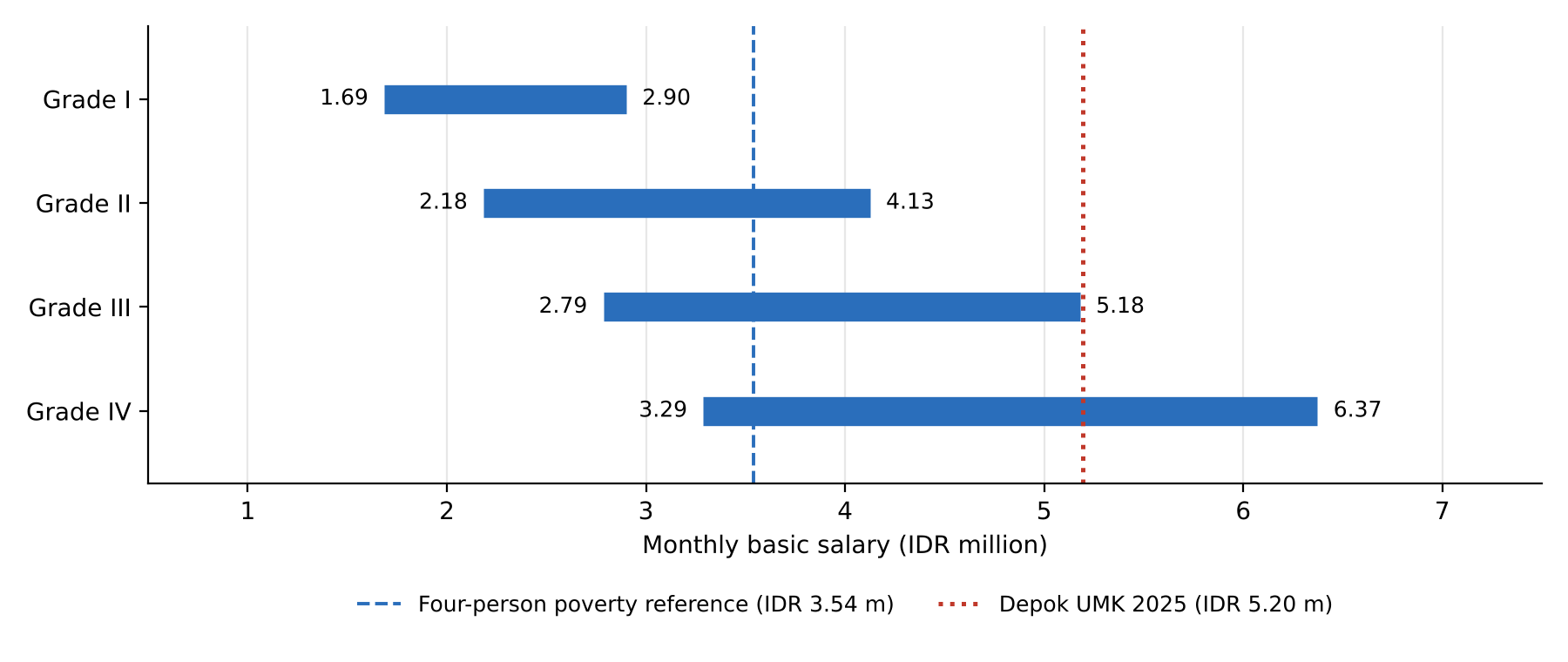
Table 4. Basic salary range by grade compared with the benchmarks.
| Grade | Monthly basic salary | % of four-person reference | % of UMK | Gap to UMK at the grade maximum |
|---|---|---|---|---|
| Grade I | IDR 1,685,700 – 2,901,400 | 47.6% – 82.0% | 32.4% – 55.8% | IDR 2,294,322 |
| Grade II | IDR 2,184,000 – 4,125,600 | 61.7% – 116.6% | 42.0% – 79.4% | IDR 1,070,122 |
| Grade III | IDR 2,785,700 – 5,180,700 | 78.7% – 146.4% | 53.6% – 99.7% | IDR 15,022 |
| Grade IV | IDR 3,287,800 – 6,373,200 | 92.9% – 180.1% | 63.3% – 122.7% | Above UMK |
Basic salary rises with length of service (Art. 7), so the lower values of each grade are entry points and the higher values reflect long service (Figure 2). In Grade IV, basic salary alone reaches UMK after 20 to 30 years of service, depending on the sub-grade (Table 5).
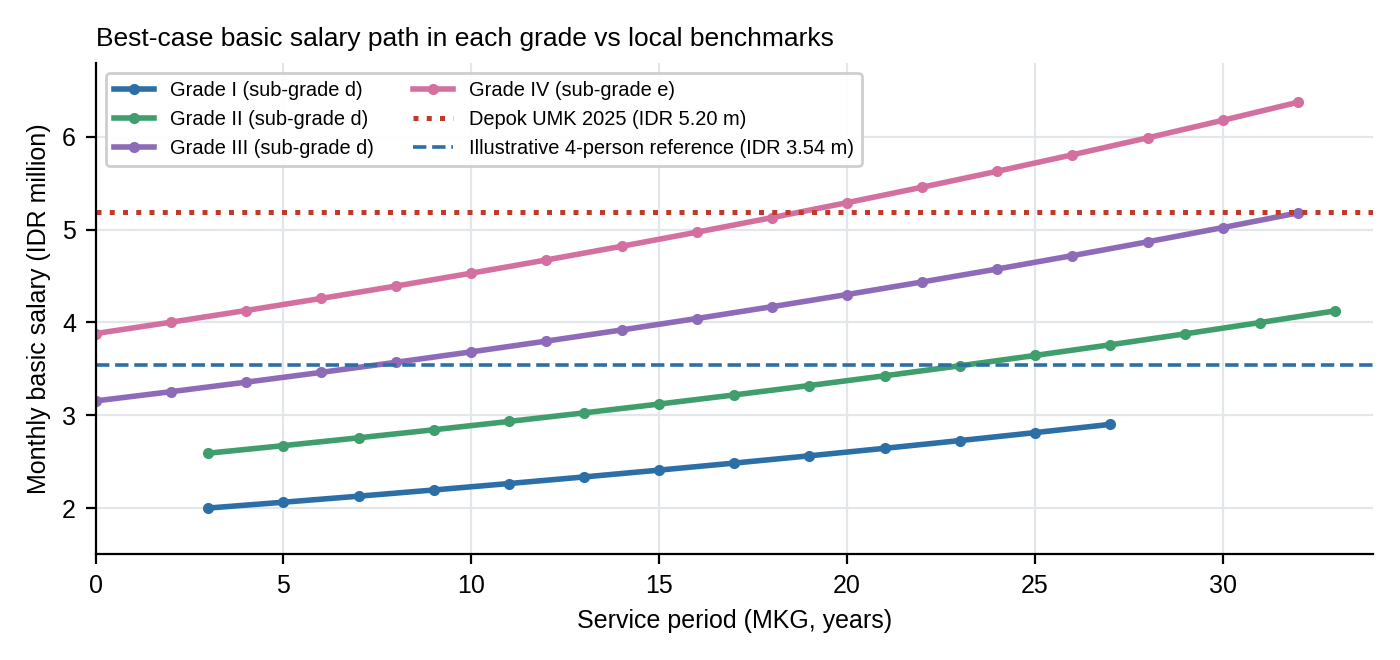
Table 5. Grade IV: service period at which basic salary alone first reaches UMK.
| Grade IV sub-grade | IV/a | IV/b | IV/c | IV/d | IV/e |
|---|---|---|---|---|---|
| First service period at or above UMK (years) | 30 | 28 | 26 | 22 | 20 |
| Basic salary at that point (IDR) | 5,235,000 | 5,289,800 | 5,345,200 | 5,236,300 | 5,291,200 |
4. Lowest Recurring Pay of Permanent and Candidate Staff
4.1. Method
The regulation prescribes recurring monthly components beyond basic salary for permanent, candidate and seconded staff (Art. 9(2)): a performance allowance by job class, paid every month (Art. 11(1), Appendix IV); an implementing-position allowance by grade, paid with basic salary (Art. 10(1), Appendix III-C); and a rice allowance (Art. 21, Appendix VI). Because the appendices do not map pay grades to job classes, this part pairs the lowest basic salary (Grade I, service period 0: IDR 1,685,700) and the lowest position allowance (Grade I: IDR 175,000) with each implementing job class. The result is a deliberately conservative low end, not a typical salary or a payroll result. Meal and holiday allowances, thirteenth-month income, overtime, incentives and transport allowance are excluded, because their amounts are set by separate rector’s regulations or decisions (Art. 15, 17–20, 26).
4.2. Results
Even at this constructed low end, every implementing job class is paid above UMK and far above the four-person reference (Figure 3 and Table 6). Class 2 and above exceed UMK on basic salary and performance allowance alone (107.5 per cent for Class 2). Class 5 and above receive a performance allowance of at least IDR 6,400,000 a month (123.2 per cent of UMK) before basic salary, and lecturers at the lowest rank receive a performance allowance of IDR 14,000,000 (269.5 per cent of UMK) before basic salary and the academic allowance.
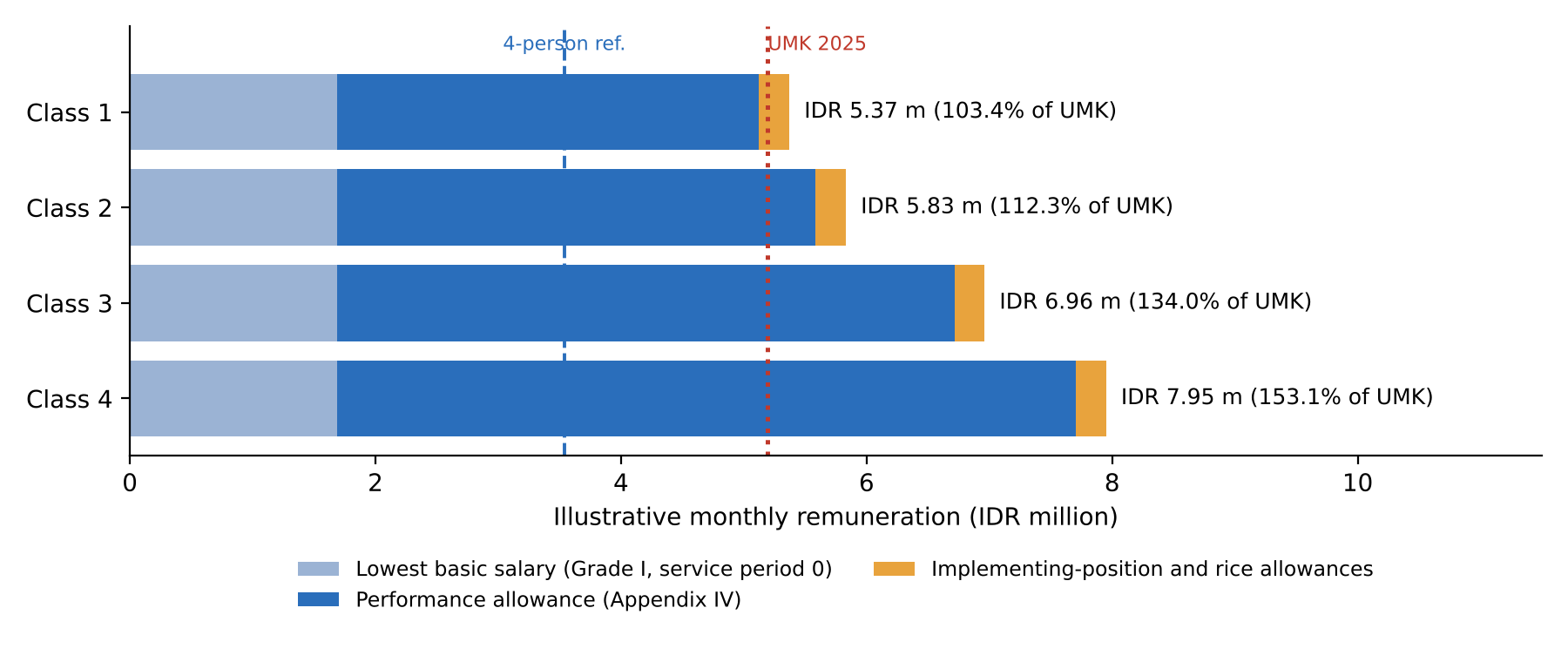
Table 6. Lowest recurring monthly pay by implementing job class under the schedules (IDR).
| Job class (Appendix IV) | Lowest basic salary | Performance allowance | Total with position and rice allowances | % of UMK | % of four-person reference |
|---|---|---|---|---|---|
| Class 1 – General operations manager | 1,685,700 | 3,439,300 | 5,372,420 | 103.4% | 151.8% |
| Class 2 – Operational services operator | 1,685,700 | 3,900,000 | 5,833,120 | 112.3% | 164.8% |
| Class 3 – Operational services manager; data and information processor; journalist | 1,685,700 | 5,029,300 | 6,962,420 | 134.0% | 196.8% |
| Class 4 – Operational services, protocol, legal, IT systems and broadcast-network administrators | 1,685,700 | 6,019,300 | 7,952,420 | 153.1% | 224.7% |
4.3. Scenarios that change the low end
Table 7 tests the rules that could lower or raise the low end: the family allowance, the reduced rates for candidate staff, and the reduced performance allowance for lecturers without a teaching certificate. None of them takes pay below UMK.
Table 7. Lowest recurring pay under alternative eligibility rules.
| Scenario | Components counted | Monthly (IDR) | Hourly (IDR) | % of UMK | % of ref. |
|---|---|---|---|---|---|
| Class 1, lowest point | Lowest basic salary; Class 1 performance allowance; position allowance Grade I; rice allowance | 5,372,420 | 33,061.05 | 103.4% | 151.8% |
| Same, with a spouse and two children | As above, plus family allowance of 14% of basic salary (Art. 16): IDR 235,998 | 5,608,418 | 34,513.34 | 107.9% | 158.5% |
| Candidate non-academic staff | 80% of lowest basic salary; 80% of the Class 4 performance allowance; position allowance Grade III; rice allowance (Art. 5(1)(c), 11(3), 12(2)) | 6,421,420 | 39,516.43 | 123.6% | 181.5% |
| Permanent lecturer without a teaching certificate | Performance allowance at 60% of the Assistant Professor rate (Art. 11(4)), before basic salary and other allowances | 8,400,000 | 51,692.31 | 161.7% | 237.4% |
The family allowance is paid to employees with a spouse or children, to one spouse only if both work at UIII (Art. 16(5)); it is shown because the benchmark assumes a household of four. Lecturers appointed before the regulation are exempt from the 60 per cent rule for three years (Art. 11(5)–(6)). The candidate row assumes that Class 4 is the highest implementing job class.
SDGs Relevance: No Poverty (1.2), Decent Work and Economic Growth (8.5)
5. Prescribed Pay of Non-Permanent Non-Academic Staff
Appendix II sets the monthly wage of full-time non-permanent non-academic staff, employed for urgent or incidental work (Art. 1(19)). Staff with senior secondary education or equivalent, the lowest-paid category in the regulation, are paid the Depok UMK as set by law, so their wage rises automatically whenever UMK is raised. Staff with bachelor’s (S1), master’s (S2) and doctoral (S3) degrees receive fixed amounts by years of experience, all above UMK (Figure 4 and Table 8).
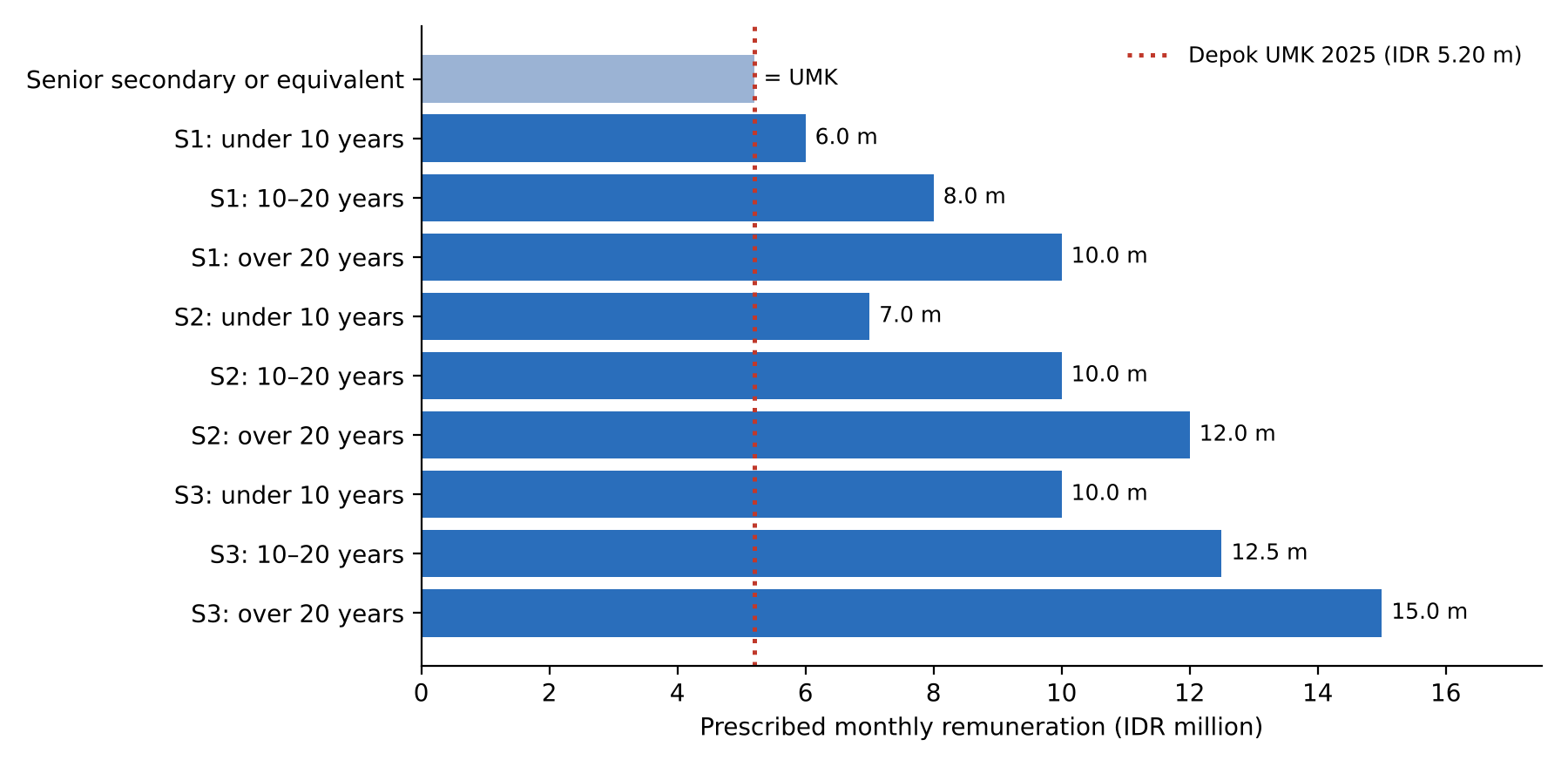
Table 8. Prescribed monthly pay of non-permanent non-academic staff, Appendix II.
| Qualification and experience | Monthly pay | Difference from UMK | % of UMK | % of four-person reference |
|---|---|---|---|---|
| Senior secondary education or equivalent | Depok UMK (IDR 5,195,722) | IDR 0 | 100.0% | 146.8% |
| S1, less than 10 years | IDR 6,000,000 | +IDR 804,278 | 115.5% | 169.6% |
| S1, 10 to 20 years | IDR 8,000,000 | +IDR 2,804,278 | 154.0% | 226.1% |
| S1, more than 20 years | IDR 10,000,000 | +IDR 4,804,278 | 192.5% | 282.6% |
| S2, less than 10 years | IDR 7,000,000 | +IDR 1,804,278 | 134.7% | 197.8% |
| S2, 10 to 20 years | IDR 10,000,000 | +IDR 4,804,278 | 192.5% | 282.6% |
| S2, more than 20 years | IDR 12,000,000 | +IDR 6,804,278 | 231.0% | 339.1% |
| S3, less than 10 years | IDR 10,000,000 | +IDR 4,804,278 | 192.5% | 282.6% |
| S3, 10 to 20 years | IDR 12,500,000 | +IDR 7,304,278 | 240.6% | 353.2% |
| S3, more than 20 years | IDR 15,000,000 | +IDR 9,804,278 | 288.7% | 423.9% |
Staff appointed before the regulation keep pay in line with their last income, and KDRP lecturers and staff are aligned with the income of their last position (Appendix II, rows 1 and 12); their pay cannot be compared with UMK from the regulation alone, but the payroll example in Part 6 includes a contract employee.
SDGs Relevance: Decent Work and Economic Growth (8.5, 8.8), Reduced Inequalities (10.4)
6. Payroll Evidence, December 2025
Source: December 2025 payslips, electronically signed by UIII; confidential, not reproduced
Selection: The lowest-paid employee in each of three classifications: contract staff (Employee A), permanent non-administrative staff (Employee B) and permanent administrative staff (Employee C)
Prepared by: Directorate of Human Resources, UIII; names, tax numbers and other identifiers removed
To show that the schedules are applied in practice, UIII Human Resources selected the lowest-paid employee in each classification. Employees B and C hold implementing positions. Table 9 sets out their recurring monthly pay; the payslips list no other recurring income. The attendance-based meal allowance (Art. 19) is not counted, because it is paid only for days worked, and employer-paid social security and other benefits are also excluded.
Table 9. Recurring monthly pay of the lowest-paid employees, December 2025 (IDR).
| Component | Employee A (contract) | Employee B (permanent, non-administrative) | Employee C (permanent, administrative) | Basis in the regulation |
|---|---|---|---|---|
| Wage or basic salary | 5,206,300 | 2,288,200 | 2,785,700 | Appendix II (A); Appendix I, Grade II/a, service period 3 (B); Grade III/a, service period 0 (C) |
| Position allowance | – | 180,000 | 185,000 | Appendix III-C, Grade II (B), Grade III (C) |
| Rice allowance | – | 72,420 | 72,420 | Appendix VI |
| Performance allowance | – | 3,900,000 | 5,029,300 | Appendix IV, Class 2 (B), Class 3 (C) |
| Recurring monthly pay | 5,206,300 | 6,440,620 | 8,072,420 | Sum of the components |
Table 10. Payroll examples compared with the benchmarks.
| Measure | Employee A | Employee B | Employee C |
|---|---|---|---|
| Recurring monthly pay (IDR) | 5,206,300 | 6,440,620 | 8,072,420 |
| Hourly equivalent, ÷ 162.5 (IDR) | 32,038.77 | 39,634.58 | 49,676.43 |
| % of the four-person reference (IDR 21,776.32 per hour) | 147.1% | 182.0% | 228.1% |
| % of UMK 2025 (IDR 5,195,721.78) | 100.2% | 124.0% | 155.4% |
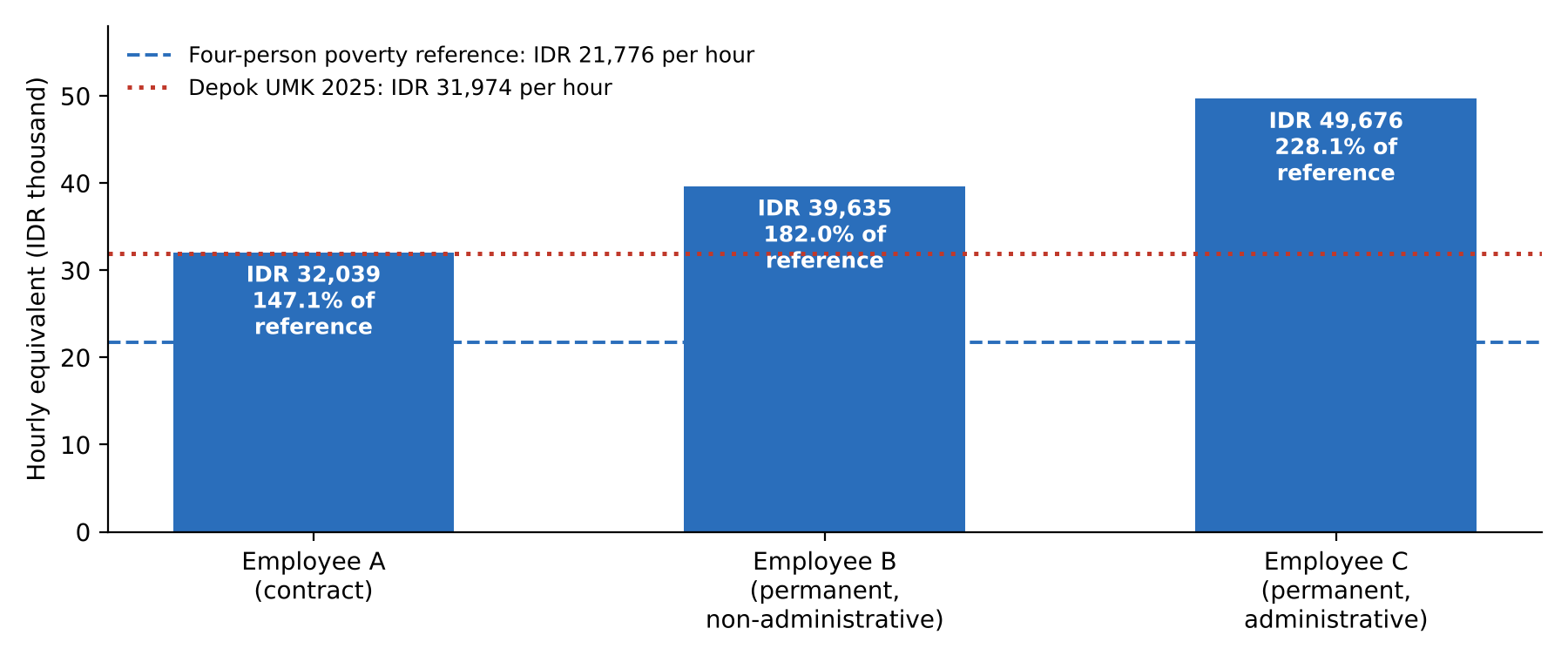
All three employees are paid well above the living-wage benchmark, at 147.1, 182.0 and 228.1 per cent of the hourly four-person reference, and at or above UMK. The permanent examples match the schedules exactly: Employee B’s pay is the Grade II/a basic salary at service period 3 with the Grade II position allowance, the rice allowance and the Class 2 performance allowance, and Employee C’s is the Grade III/a basic salary at service period 0 with the Grade III position allowance, the rice allowance and the Class 3 performance allowance. The contract example’s wage of IDR 5,206,300 is 100.2 per cent of UMK, consistent with the Appendix II rule that links the lowest contract wage to UMK. The examples show that a basic salary below UMK, as for Employees B and C, does not mean that pay is below UMK once the prescribed allowances are counted.
SDGs Relevance: No Poverty (1.2), Decent Work and Economic Growth (8.5)
7. Assessment Against the Living Wage
UIII pays its employees at least the living wage, defined for this indicator as the local poverty line for a family of four. The evidence is as follows:
1. Indonesia sets no official living wage. The four-person reference for Depok City in 2025 is IDR 3,538,652 a month, or IDR 21,776.32 an hour, and the statutory Depok UMK is IDR 5,195,721.78 a month, or IDR 31,973.67 an hour.
2. Rector’s Regulation No. 5 of 2025 sets the pay of every category of UIII employee. Its lowest wage, for contract staff with senior secondary education, is defined as the Depok UMK, which is 146.8 per cent of the four-person reference.
3. Under the schedules, the lowest possible recurring pay of a permanent employee, IDR 5,372,420, is 103.4 per cent of UMK and 151.8 per cent of the four-person reference; candidate staff and uncertified lecturers also remain above UMK.
4. The December 2025 payroll of the lowest-paid employee in each of three classifications ranges from 147.1 to 228.1 per cent of the hourly four-person reference, and every example is at or above UMK.
5. UIII’s institutional assessment is that no employee was paid below UMK or below the four-person reference in 2025.
8. Policies Supporting Decent Work
Decent work covers more than the level of pay. UIII’s regulations also provide social protection, support for families, gender-responsive and child-friendly workplace facilities and protection from discrimination (Table 11). The pay schedules in Appendices I–VI set amounts by grade, service period, job class and position and do not differ by gender.
Table 11. UIII policies supporting decent work.
| Policy | Provisions relevant to decent work | SDG targets |
|---|---|---|
| Rector’s Regulation No. 5/2025, Art. 1(5) and 27 | All employees receive health and employment social security, defined as protection that enables them to meet the basic needs of a decent life | 8.5, 8.8, 1.3 |
| Rector’s Regulation No. 5/2025, Art. 16–18 | Family allowance of 10% of basic salary for a spouse and 2% per child for up to two children, to age 21, or 25 if in education; holiday allowance; thirteenth-month income paid in June | 1.2, 8.5 |
| Rector’s Regulation No. 5/2025, Art. 22–24; Appendices VII–VIII | Income-tax allowance for most employees; separation pay of IDR 2,500,000 after two years of service; one month’s income on retirement; up to IDR 5,000,000 on a family death and IDR 3,000,000 for family hospitalisation over five days | 1.3, 8.5 |
| Rector’s Regulation No. 23/2023 on gender-responsive and child-friendly workplace facilities (1 September 2023) | Lactation rooms, child day care and health facilities (Art. 3); equal opportunity for women, including those who are married, pregnant, breastfeeding or caring for toddlers (Art. 4(2)); time to express breast milk in working hours without reduction of working time (Art. 4(3), 6) | 5.1, 5.4, 8.5 |
| Circular Letter No. 1c/Rek/UIII/SE.01/1/2025 on an inclusive and anti-discriminatory campus (2 January 2025) | Equal opportunity regardless of ethnicity, religion, race, gender, social status, physical ability or culture; a campus free of discrimination, harassment and bullying; accessible facilities; complaints handled by the counselling, disability-service and sexual-violence units, with sanctions (items 1, 2, 5–7) | 8.5, 8.8, 10.2, 10.3 |
9. Notes on Method
The BPS poverty line measures basic-needs expenditure per person; multiplying it by four gives a household reference, as the THE methodology prescribes where no living wage is defined, not an official household poverty line. UMK is a statutory minimum wage. Figures in Parts 3 to 5 are prescribed schedules, and the payroll examples in Part 6 are the lowest-paid employees in the classifications reviewed, not a census of every employee. Part-time lecturers paid per session and foreign lecturers on individual contracts are not covered by the comparisons.
Hourly figures use UIII’s standard 162.5-hour month. Lecturers’ working time varies by rank and appointment, so individual hourly rates were not recalculated for every employee.
10. Annex: Allowances at the Lowest-Paid Levels
This annex lists only the allowances that apply at the lowest-paid levels, the levels that matter for this indicator. Amounts depend on position and eligibility and should not be added together as if every employee received all of them.
Table A1. Allowances at the lowest-paid levels (IDR per month).
| Allowance | Amount |
|---|---|
| Implementing-position allowance (Appendix III-C): Grade I / II / III / IV | 175,000 / 180,000 / 185,000 / 200,000 |
| Rice allowance (Appendix VI) | 72,420 |
| Performance allowance, Class 1 – General operations manager (Appendix IV) | 3,439,300 |
| Performance allowance, Class 2 – Operational services operator | 3,900,000 |
| Performance allowance, Class 3 – Operational services manager; data and information processor; journalist | 5,029,300 |
| Performance allowance, Class 4 – Operational services, protocol, legal, IT systems and broadcast-network administrators | 6,019,300 |
| Lowest lecturer rank (Appendices IV-B and V) | Performance allowance 14,000,000; academic allowance 375,000 |
| Functional-position allowance, non-academic staff (Appendix III-B) | Follows civil-service rules; adjusted for non-civil-servant staff |
11. Public Evidence
Rector’s Regulation No. 5 of 2025 on Salaries and Other Income for UIII Employees: https://jdih.uiii.ac.id/detail/275
Rector’s Regulation No. 23 of 2023 and Circular Letter No. 1c/Rek/UIII/SE.01/1/2025: https://jdih.uiii.ac.id/detail/474
This document: https://sustainability.uiii.ac.id/
References
[1] Universitas Islam Internasional Indonesia. Rector’s Regulation No. 5 of 2025 on Salaries and Other Income for UIII Employees, articles and Appendices I–VIII. Depok, 6 January 2025.
[2] Government of Indonesia. Government Regulation No. 5 of 2024, the nineteenth amendment to Government Regulation No. 7 of 1977 on civil-servant salaries.
[3] Universitas Islam Internasional Indonesia. Rector’s Regulation No. 23 of 2023 on the Provision of Gender-Responsive and Child-Friendly Workplace Facilities. 1 September 2023.
[4] Universitas Islam Internasional Indonesia. Circular Letter No. 1c/Rek/UIII/SE.01/1/2025 on Strengthening an Inclusive and Anti-Discriminatory Campus. 2 January 2025.
[5] Badan Pusat Statistik Kota Depok. Garis Kemiskinan, Jumlah dan Persentase Penduduk Miskin Kota Depok, 2025. Reported in: Kemiskinan Depok Turun Jadi 2,31 Persen di 2025. https://depok.voa.co.id/berita/2579/kemiskinan-depok-turun-2025-data-bps/
[6] Government of West Java Province. Governor’s Decree No. 561.7/Kep.798-Kesra/2024 on the 2025 District and City Minimum Wages in West Java. Reported in: UMK Depok tahun 2025 naik 6,5 persen. Antara Megapolitan. https://megapolitan.antaranews.com/berita/325846/umk-depok-tahun-2025-naik-65-persen-menjadi-rp5195720
[7] Directorate of Human Resources, UIII. Calculations from the December 2025 payslips of three employees (anonymised; source payslips confidential).
[8] Times Higher Education. Impact Rankings Methodology, SDG 8: Decent Work and Economic Growth, indicator 8.2.1.