

SDG 8.2.4 Employment Practice: Commitment against Forced Labour, Modern Slavery, Human Trafficking and Child Labour
Universitas Islam Internasional Indonesia
Universitas Islam Internasional Indonesia (UIII), established by Presidential Regulation No. 57 of 2016 and governed by Government Regulation No. 23 of 2019 as a legal-entity state university (PTN-BH), is committed, as a body, to ensuring that no one works for it under compulsion. Forced labour, modern slavery, human trafficking and child labour describe situations in which a person cannot refuse or leave work because of threats, violence, coercion, deception, debt or abuse of power, or in which a child is put to work. UIII rejects all of these practices.
The commitment rests on Indonesian law, which prohibits each of these practices and binds UIII as a state institution, and on UIII’s own regulations, which turn it into employment practice (Table 1): open, merit-based recruitment; written employment agreements; working hours limited to 37.5 hours a week, with paid overtime; pay at or above the statutory minimum wage, with social security for all employees; and protection from coercion, harassment and abuse of authority, with channels for complaints and sanctions.
Table 1. Elements of UIII’s commitment against forced labour, modern slavery, human trafficking and child labour, 2025.
| Element | How UIII applies it | Instrument | Part |
|---|---|---|---|
| Legal prohibition | Indonesian law prohibits slavery, servitude, forced labour, trafficking in persons and the employment of children, and binds UIII as a state university | Constitution; Laws No. 39/1999, 13/2003, 21/2007, 35/2014; ILO Conventions 29, 105, 138 and 182 | 1 |
| Free and transparent recruitment | Vacancies announced publicly; registration, selection, announcement of results and appointment in set stages | Rector’s Regulation No. 4 of 2025 on the Personnel System, Chapter V | 2 |
| Written terms of employment | Every lecturer and staff member signs an agreement setting out rights, duties, hours, pay, benefits and duration | Rector’s Regulation No. 4 of 2025 | 2 |
| Limited working hours and paid overtime | 7.5 hours a day and 37.5 hours a week over five days; overtime pay and overtime meal allowance | Rector’s Circular No. 1/Rek/UIII/SE.01/1/2025; Rector’s Regulation No. 13 of 2021 | 3 |
| Fair pay and social security | Pay at or above the Depok minimum wage; health and employment social security for all employees | Rector’s Regulation No. 5 of 2025 | 4 |
| Protection from coercion and abuse | Prohibition of abuse of authority, violence, harassment and discrimination; complaint units; sanctions | Codes of ethics; Rector’s Regulation No. 12 of 2025; Rector’s Circular No. 1c/2025 | 5 |
1. National Legal Framework
Indonesian law prohibits each practice covered by this indicator and applies to all employers, including state universities. UIII, as a legal-entity state university, is fully subject to these laws, and its internal regulations are made under them (Table 2).
Table 2. Indonesian law against forced labour, modern slavery, human trafficking and child labour.
| Instrument | Relevant provisions |
|---|---|
| 1945 Constitution, Articles 27(2) and 28D(2) | Every citizen has the right to work and to a livelihood fit for human beings; everyone has the right to work and to fair and proper remuneration and treatment in employment |
| Law No. 39 of 1999 on Human Rights, Articles 20 and 38 | No one may be enslaved or held in servitude, and slavery, the slave trade and all similar practices are prohibited; everyone has the right to choose work freely and to fair conditions of employment |
| Law No. 13 of 2003 on Manpower, as amended by Law No. 6 of 2023 on Job Creation | Prohibits the employment of children (Art. 68) and the worst forms of child labour, including slavery and practices similar to slavery (Art. 74); limits working time to 40 hours a week (Art. 77); requires overtime pay (Art. 78) and wages not below the minimum wage |
| Law No. 21 of 2007 on the Eradication of Trafficking in Persons | Defines trafficking in persons and sets heavy criminal penalties for recruiting, transferring or holding people by threat, force, deception, debt bondage or abuse of power for exploitation |
| Law No. 35 of 2014 amending Law No. 23 of 2002 on Child Protection | Prohibits the economic and sexual exploitation of children |
| ILO Conventions | Forced Labour Convention, 1930 (No. 29), in force for Indonesia since 1950; Abolition of Forced Labour Convention, 1957 (No. 105), ratified by Law No. 19 of 1999; Minimum Age Convention, 1973 (No. 138), ratified by Law No. 20 of 1999; Worst Forms of Child Labour Convention, 1999 (No. 182), ratified by Law No. 1 of 2000 |
| UN Trafficking Protocol | Protocol to Prevent, Suppress and Punish Trafficking in Persons, Especially Women and Children, ratified by Law No. 14 of 2009 |
SDGs Relevance: Decent Work and Economic Growth (8.7, 8.8), Gender Equality (5.2), Peace, Justice and Strong Institutions (16.2)
2. Free, Transparent Recruitment and Written Terms of Employment
2.1. Open, merit-based recruitment
Instrument: Rector’s Regulation No. 4 of 2025 on the UIII Personnel System, Chapter V on the procurement of employees
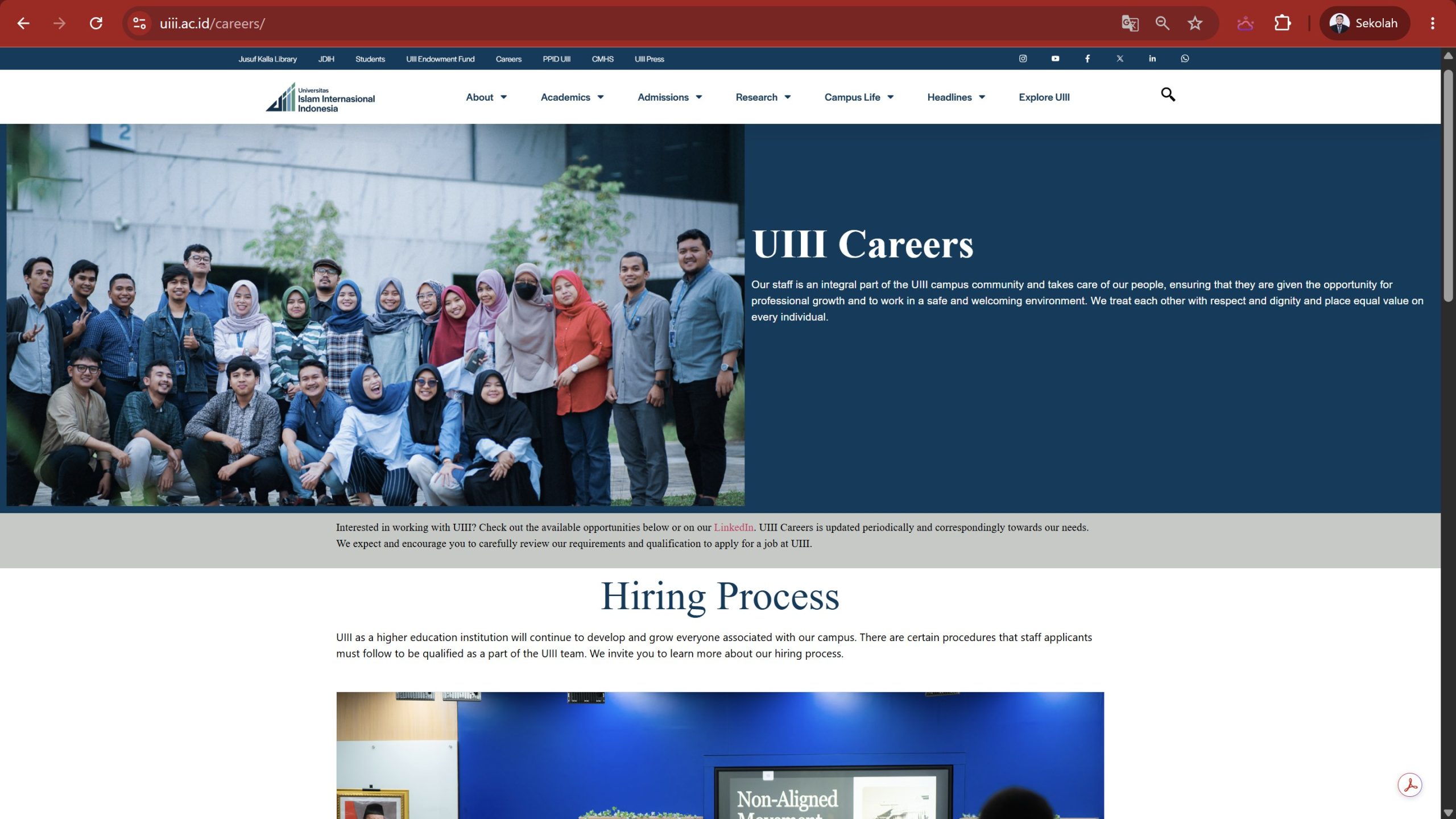
Public access: https://uiii.ac.id/careers/
Deceptive recruitment is a common route into forced labour and trafficking. Rector’s Regulation No. 4 of 2025 requires every recruitment of lecturers and administrative staff to follow set stages: announcement of the vacancy, registration, selection, announcement of the results and appointment. Vacancies and the hiring process are published on the UIII careers page, so candidates know the position, requirements and procedure before they apply.
2.2. Written employment agreements
Under the same regulation, every lecturer and staff member signs an employment agreement that sets out their rights and duties, working hours, basic salary or wage, allowances and the length of the contract. Employees therefore enter employment voluntarily, on terms they know in advance, and UIII does not retain employees’ original identity documents, such as passports or identity cards, which would restrict their freedom to leave.
SDGs Relevance: Decent Work and Economic Growth (8.7, 8.8)
3. Limited Working Hours and Paid Overtime
3.1. Working days and hours
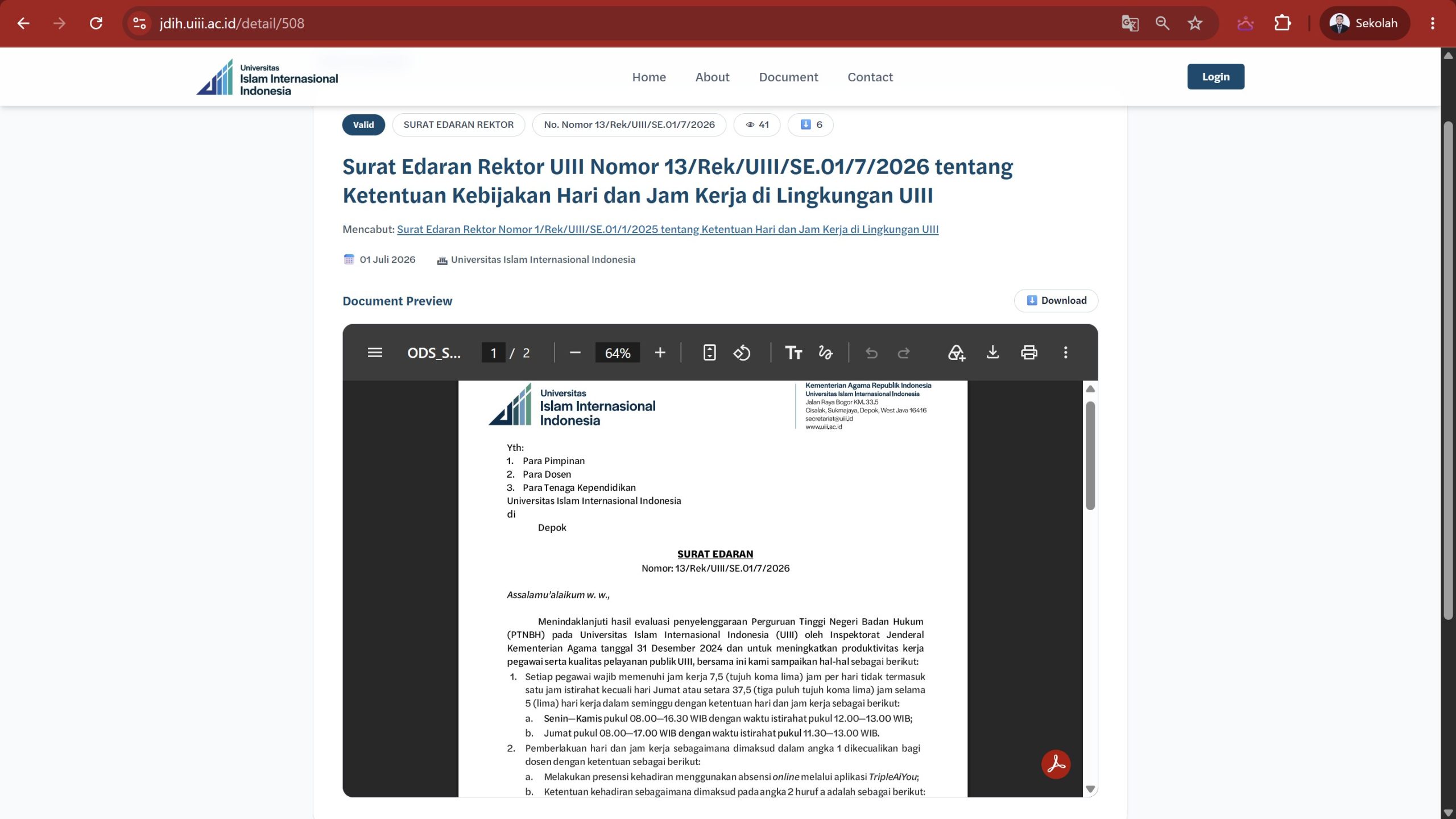
In force in 2025: Rector’s Circular No. 1/Rek/UIII/SE.01/1/2025 on Working Days and Hours at UIII
Current: Rector’s Circular No. 13/Rek/UIII/SE.01/7/2026, which replaces it (https://jdih.uiii.ac.id/detail/508)
Basis: Law No. 13 of 2003 as amended by Law No. 6 of 2023; Presidential Regulation No. 21 of 2023 on Working Days and Working Hours of Government Agencies and Civil Servants; Rector’s Regulation No. 4 of 2025 UIII employees work 7.5 hours a day, excluding a one-hour break, or 37.5 hours over a five-day week, below the 40-hour limit of the Manpower Law. The current circular, issued after an evaluation by the Inspectorate General of the Ministry of Religious Affairs, sets working hours from 08.00 to 16.30 on Monday to Thursday, with a break from 12.00 to 13.00, and from 08.00 to 17.00 on Friday, with a break from 11.30 to 13.00; lecturers follow separate rules suited to academic work.
3.2. Overtime
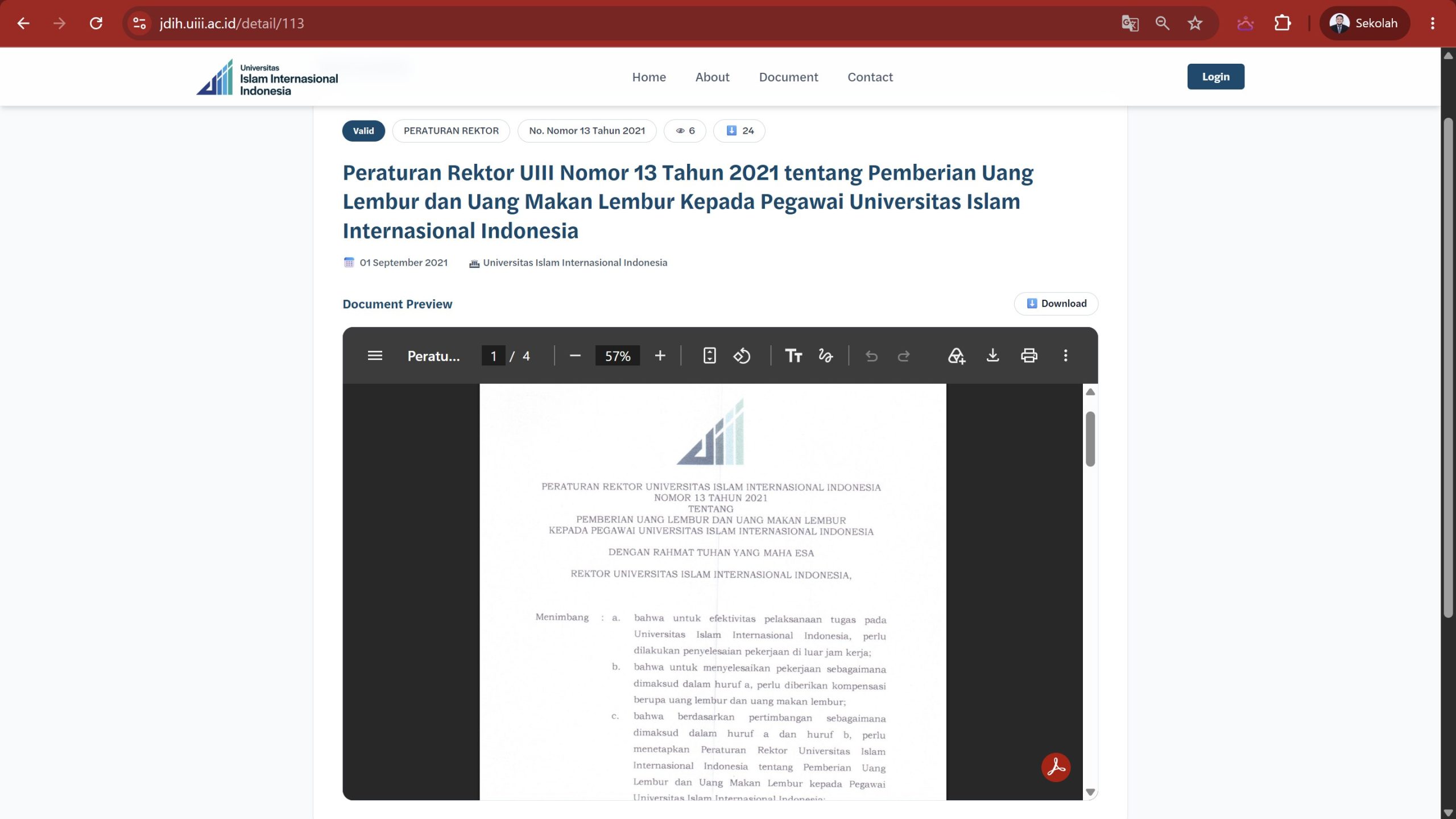
Instrument: Rector’s Regulation No. 13 of 2021 on Overtime Pay and Overtime Meal Allowance for UIII Employees (1 September 2021)
Public access: https://jdih.uiii.ac.id/detail/113
Employees who must complete work outside working hours are entitled to overtime pay and an overtime meal allowance. Overtime is therefore paid work assigned for a defined task, not unpaid extra hours.
SDGs Relevance: Decent Work and Economic Growth (8.5, 8.8)
4. Fair Pay and Social Security
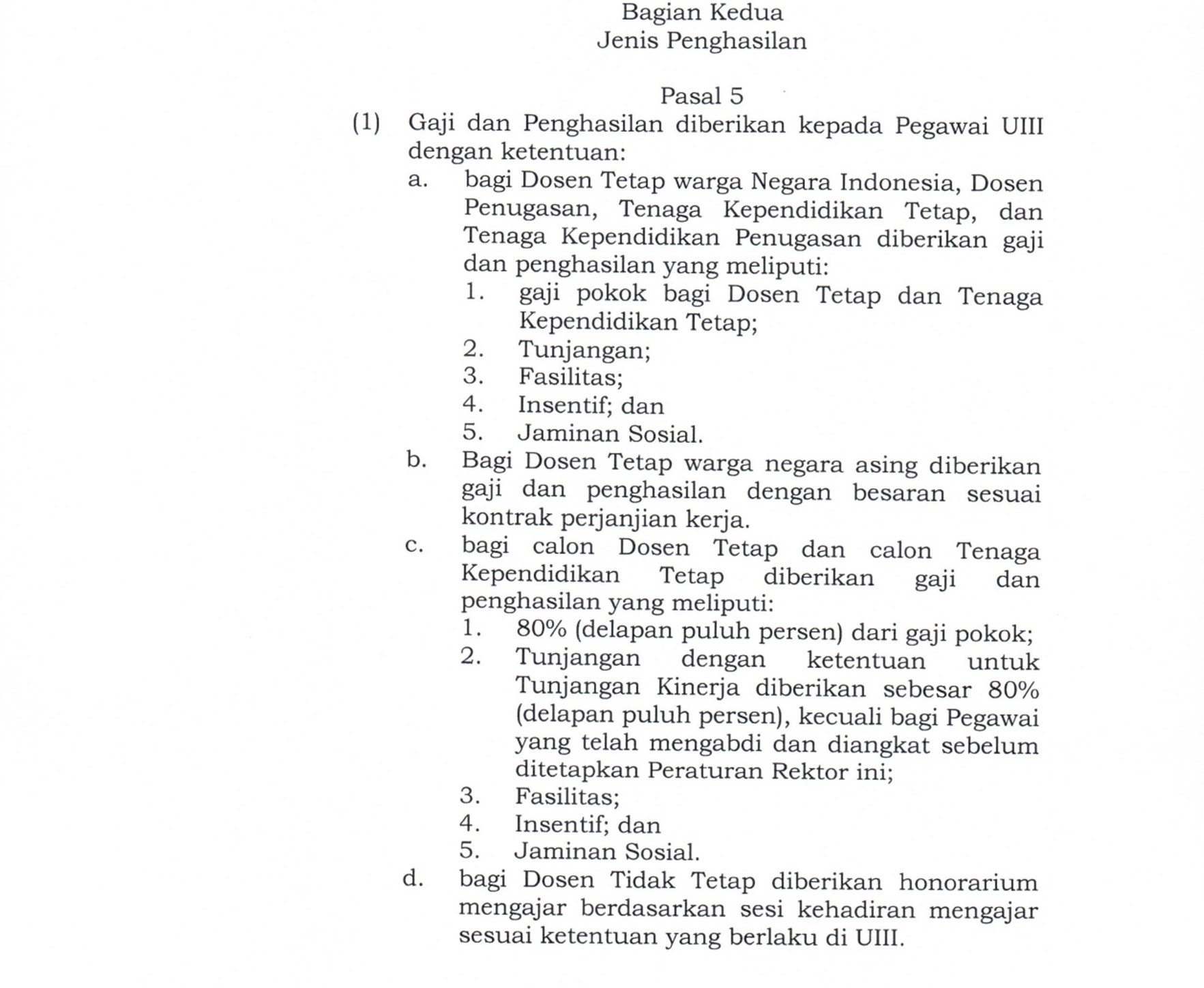
Instrument: Rector’s Regulation No. 5 of 2025 on Salaries and Other Income for UIII Employees (6 January 2025)
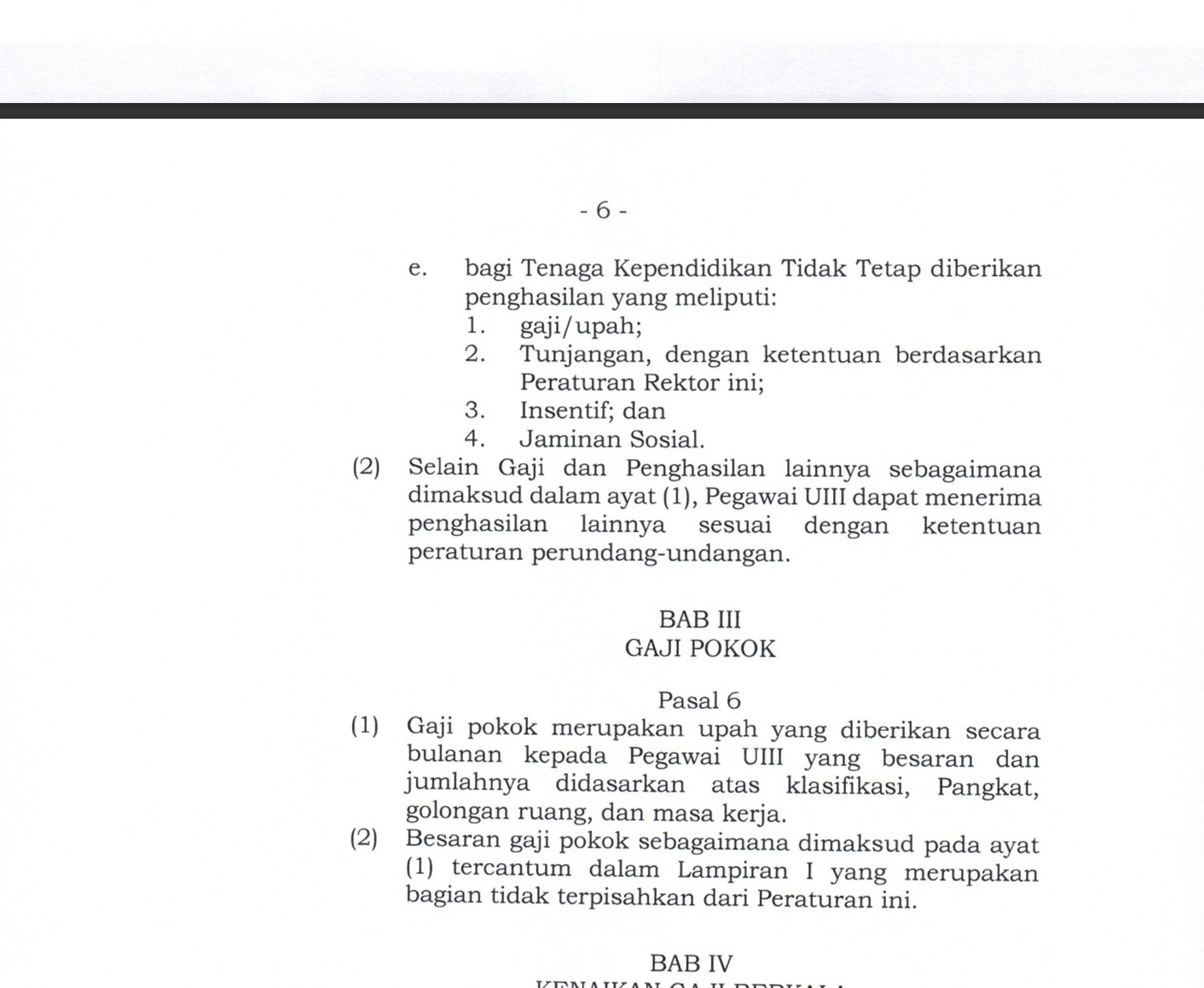
Rector’s Regulation No. 5 of 2025 defines the salary and income of every category of employee (Art. 5): permanent lecturers and staff receive a basic salary, allowances, facilities, incentives and social security; foreign lecturers are paid under their contracts; candidate employees receive 80 per cent of basic salary and of the performance allowance; part-time lecturers receive a teaching honorarium; and non-permanent staff receive a wage, allowances, incentives and social security. The lowest wage, for non-permanent staff with senior secondary education, is set at the Depok City Minimum Wage. Allowances include performance, position, family, holiday and rice allowances and thirteenth-month income, and all employees receive health and employment social security (Art. 27). UIII’s submission for indicator 8.2.1 shows that the lowest-paid employees received at least the minimum wage in 2025 and 147 to 228 per cent of the local poverty line for a family of four.
SDGs Relevance: No Poverty (1.3), Decent Work and Economic Growth (8.5)
5. Protection from Coercion, Harassment and Abuse of Authority
Modern slavery depends on the abuse of power over workers. UIII’s regulations prohibit such abuse and give employees safe channels to report it:
1. Codes of ethics. Rector’s Regulation No. 5 of 2023 (University code of ethics), Academic Senate Regulation No. 1 of 2023 (lecturers) and Rector’s Regulation No. 3 of 2023 (administrative staff) prohibit abuse of authority, arbitrary or retaliatory treatment, threats, violence and bullying, and provide for an ad hoc Code of Ethics Council and sanctions.
2. Sexual violence. Rector’s Regulation No. 12 of 2025 on the Prevention and Handling of Sexual Violence and Rector’s Decree No. 85/R/2025 on the task force for 2025–2027 ensure that relations between superiors and subordinates are not used to exploit, threaten or harass employees, with complaint, protection of victims and witnesses, and sanctions.
3. Anti-discrimination. Rector’s Circular No. 1c/Rek/UIII/SE.01/1/2025 (jdih.uiii.ac.id/detail/474) requires every lecturer and staff member to keep the workplace free from discrimination, violence, harassment, intimidation and bullying, names the Disability Services Unit, the Counseling and Mental Health Services Unit and the sexual-violence task force as complaint units, and imposes sanctions.
4. Gender-responsive workplace. Rector’s Regulation No. 23 of 2023 provides lactation rooms, child day care, health facilities and time for breastfeeding mothers during working hours without reducing their working time.
SDGs Relevance: Gender Equality (5.2), Decent Work and Economic Growth (8.7, 8.8), Peace, Justice and Strong Institutions (16.2)
6. Conclusion
Indonesian law prohibits forced labour, slavery, trafficking in persons and child labour, and UIII applies that law through its own personnel, working-time, overtime and pay regulations and its codes of ethics. Recruitment is open and staged, every employee works under a written agreement on known terms, working time is limited to 37.5 hours a week with paid overtime, pay is at least the statutory minimum wage with social security, and employees are protected from coercion, harassment and abuse of authority, with complaint channels and sanctions. Together these instruments ensure that everyone who works for UIII does so freely, for fair pay and in decent conditions.
7. Public Evidence
UIII careers page and hiring process: https://uiii.ac.id/careers/
Rector’s Circular No. 13/Rek/UIII/SE.01/7/2026 on working days and hours: https://jdih.uiii.ac.id/detail/508
Rector’s Regulation No. 13 of 2021 on overtime pay: https://jdih.uiii.ac.id/detail/113
Rector’s Circular No. 1c/Rek/UIII/SE.01/1/2025 on an inclusive and anti-discriminatory campus: https://jdih.uiii.ac.id/detail/474
Codes of ethics: https://jdih.uiii.ac.id/detail/127; https://jdih.uiii.ac.id/detail/87; https://jdih.uiii.ac.id/detail/129
Rector’s Regulations No. 4 and No. 5 of 2025, No. 12 of 2025 and No. 23 of 2023: https://jdih.uiii.ac.id/
References
[1] Universitas Islam Internasional Indonesia. Rector’s Regulation No. 4 of 2025 on the UIII Personnel System.
[2] Universitas Islam Internasional Indonesia. Rector’s Regulation No. 5 of 2025 on Salaries and Other Income for UIII Employees. 6 January 2025.
[3] Universitas Islam Internasional Indonesia. Rector’s Circular No. 1/Rek/UIII/SE.01/1/2025 on Working Days and Hours at UIII; replaced by Rector’s Circular No. 13/Rek/UIII/SE.01/7/2026. https://jdih.uiii.ac.id/detail/508
[4] Universitas Islam Internasional Indonesia. Rector’s Regulation No. 13 of 2021 on Overtime Pay and Overtime Meal Allowance for UIII Employees. 1 September 2021. https://jdih.uiii.ac.id/detail/113
[5] Universitas Islam Internasional Indonesia. Rector’s Regulation No. 5 of 2023 on the UIII Code of Ethics; Rector’s Regulation No. 3 of 2023 on the Code of Ethics for Administrative Staff; Academic Senate Regulation No. 1 of 2023 on the Lecturer Code of Ethics.
[6] Universitas Islam Internasional Indonesia. Rector’s Regulation No. 12 of 2025 on the Prevention and Handling of Sexual Violence; Rector’s Decree No. 85/R/2025.
[7] Universitas Islam Internasional Indonesia. Rector’s Circular No. 1c/Rek/UIII/SE.01/1/2025 on Strengthening an Inclusive and Anti-Discriminatory Campus. 2 January 2025.
[8] Universitas Islam Internasional Indonesia. Rector’s Regulation No. 23 of 2023 on Gender-Responsive and Child-Friendly Workplace Facilities. 1 September 2023.
[9] Government of Indonesia. 1945 Constitution; Law No. 39 of 1999 on Human Rights; Law No. 13 of 2003 on Manpower, as amended by Law No. 6 of 2023; Law No. 21 of 2007 on the Eradication of Trafficking in Persons; Law No. 35 of 2014 on Child Protection.
[10] Government of Indonesia. Law No. 19 of 1999 (ILO Convention No. 105); Law No. 20 of 1999 (ILO Convention No. 138); Law No. 1 of 2000 (ILO Convention No. 182); Law No. 14 of 2009 (UN Trafficking Protocol); Presidential Regulation No. 21 of 2023 on Working Days and Working Hours of Government Agencies and Civil Servants.
[11] Government of Indonesia. Presidential Regulation No. 57 of 2016 on the Establishment of UIII; Government Regulation No. 23 of 2019 on the Statute of UIII.