

SDG 8.2.3 Employment Practice: Policy on Ending Discrimination in the Workplace
Universitas Islam Internasional Indonesia
Universitas Islam Internasional Indonesia (UIII), established by Presidential Regulation No. 57 of 2016 and governed by Government Regulation No. 23 of 2019 as a legal-entity state university (PTN-BH) with an international character, has, as a body, a policy to end discrimination in the workplace. Its lecturers, staff and students come from many countries, faiths and backgrounds, and the University treats a working and learning environment free from discrimination, harassment and intimidation as a condition for teaching, research and service.
The policy is set out in binding instruments that are published on the University’s legal information portal, JDIH UIII (Table 1). Rector’s Circular Letter No. 1c/Rek/UIII/SE.01/1/2025 commits UIII to an inclusive and anti-discriminatory campus regardless of ethnicity, religion, race, gender, social status, physical ability, culture or minority status, and imposes sanctions for discrimination. The codes of ethics for the whole University, for lecturers and for administrative staff prohibit discrimination and bullying and oblige every employee to keep the workplace inclusive. These are backed by complaint and support units, a procedure for ethics cases, a regulation and task force on sexual violence, gender-responsive workplace facilities, a disability services unit and pay schedules that do not differ by gender.
Table 1. UIII policies on ending discrimination in the workplace in force in 2025.
| Instrument | Date | Applies to | Anti-discrimination content | Part |
|---|---|---|---|---|
| Rector’s Circular Letter No. 1c/Rek/UIII/SE.01/1/2025 on an Inclusive and Anti-Discriminatory Campus | 2 January 2025 | All lecturers, staff, students and work units | Equal opportunity regardless of ethnicity, religion, race, gender, social status, physical ability, culture or minority status; duty to prevent discrimination, harassment and bullying; complaint units; sanctions | 1 |
| Rector’s Regulation No. 5 of 2023 on the UIII Code of Ethics | 21 May 2023 | All members of the University | Non-discrimination as a core value; prohibition of discrimination; ethics council and sanctions | 2 |
| Academic Senate Regulation No. 1 of 2023 on the Lecturer Code of Ethics | 22 May 2023 | All lecturers and researchers | Respect for gender equality and human rights; a working environment free of bullying and sexual harassment | 2 |
| Rector’s Regulation No. 3 of 2023 on the Code of Ethics for Administrative Staff | 10 January 2023 | All administrative staff, civil servants and non-civil servants | Duty to create an inclusive workplace free from discrimination; prohibition of arbitrary treatment | 2 |
| Rector’s Regulation No. 12 of 2025 and Rector’s Decree No. 85/R/2025 | 2025 | All members of the University | Prevention and handling of sexual violence; task force for 2025–2027 | 4 |
| Rector’s Regulation No. 23 of 2023 | 1 September 2023 | Female lecturers and staff | Gender-responsive and child-friendly workplace facilities; equal opportunity for women | 5 |
| Rector’s Decree No. 40A/R/2025 | 2025 | Employees and students with disabilities | Disability Services Unit | 5 |
1. Commitment to an Inclusive and Anti-Discriminatory Campus
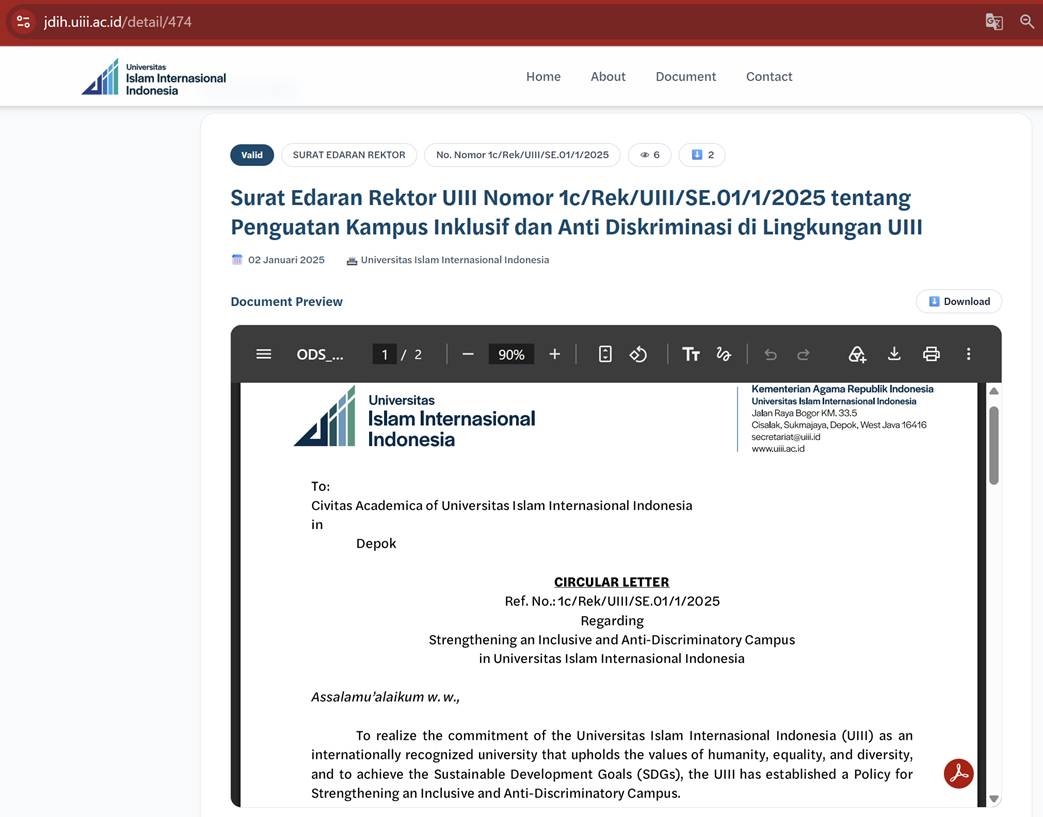
1.1. Rector’s Circular Letter No. 1c/Rek/UIII/SE.01/1/2025
Title: Strengthening an Inclusive and Anti-Discriminatory Campus in Universitas Islam Internasional Indonesia
Issued: Depok, 2 January 2025, signed by the Rector, Prof. Dr. Jamhari
Applies to: All lecturers, administrative staff, students and work units
Public access: https://jdih.uiii.ac.id/detail/474
The circular states that UIII, as an internationally recognised university that upholds humanity, equality and diversity, has adopted a policy for an inclusive and anti-discriminatory campus in support of the Sustainable Development Goals. It is binding on every work unit and member of the University and sets out seven instructions (Table 2): equal opportunity, access and services for all; a duty on every lecturer, staff member and student to keep the workplace free from discrimination, violence, harassment and bullying; inclusion in all services and continuing education on tolerance; guaranteed rights for vulnerable groups, including ethnic, religious and cultural minorities; accessible facilities; designated units to receive complaints; and sanctions for anyone proven to have discriminated.
Table 2. Instructions of Rector’s Circular Letter No. 1c/Rek/UIII/SE.01/1/2025.
| No. | Instruction |
|---|---|
| 1 | UIII is an inclusive campus that provides equal opportunities, access and services regardless of ethnicity, religion, race, gender, social status, physical ability, culture or other minority status |
| 2 | Every lecturer, staff member and student must keep learning, working and interacting environments free from discrimination, verbal and non-verbal violence, harassment, intimidation and bullying |
| 3 | All work units must develop disability-friendly programmes and services, integrate inclusion into academic and public services, and run continuing education on tolerance and anti-discrimination |
| 4 | UIII guarantees the rights of vulnerable groups, including women, underprivileged communities, people with disabilities, people from disadvantaged, frontier and outermost (3T) regions and developing countries, and ethnic, religious and cultural minorities |
| 5 | UIII provides disability-friendly facilities in all faculty buildings and work units |
| 6 | The Disability Services Unit, the Counseling and Mental Health Services Unit and the Task Force for the Prevention and Handling of Sexual Violence receive complaints, provide assistance and follow up cases |
| 7 | Sanctions under the applicable rules are imposed on anyone proven to have committed discrimination or violence |
SDGs Relevance: Decent Work and Economic Growth (8.5, 8.8), Gender Equality (5.1), Reduced Inequalities (10.2, 10.3), Peace, Justice and Strong Institutions (16.b)
2. Codes of Ethics Binding All Employees
Three codes of ethics, all published on JDIH UIII, make non-discrimination a duty of every employee. Rector’s Regulation No. 5 of 2023 is the general framework for the whole University, adopted under Article 61(7) of Government Regulation No. 23 of 2019 on the UIII Statute; the Academic Senate’s code governs lecturers and researchers; and Rector’s Regulation No. 3 of 2023 governs administrative staff, whether civil servants or not (Table 3). A fourth code, Rector’s Regulation No. 15 of 2021, applies the same standards to students.
Table 3. Codes of ethics and their anti-discrimination provisions.
| Code of ethics | Applies to | Anti-discrimination and anti-harassment provisions | Public access |
|---|---|---|---|
| Rector’s Regulation No. 5 of 2023 on the UIII Code of Ethics (21 May 2023) | All members of the University, including leaders | Integrity, professionalism, example and non-discrimination as basic values; prohibition of discriminatory acts (Art. 6(g)); procedure for forming a Code of Ethics Council | jdih.uiii.ac.id/detail/127 |
| Academic Senate Regulation No. 1 of 2023 on the Lecturer Code of Ethics (22 May 2023) | All lecturers and researchers | A safe, inclusive learning and working environment free from bullying and sexual harassment, upholding internationally recognised human rights (Art. 2(k)–(l)); respect for gender equality; prohibition of discrimination on grounds of ethnicity, religion, race, gender or social status; prohibition of threats, violence and bullying, including cyberbullying | jdih.uiii.ac.id/detail/87 |
| Rector’s Regulation No. 3 of 2023 on the Code of Ethics for Administrative Staff (10 January 2023) | All administrative staff, civil servants and non-civil servants | Duty to create an inclusive, friendly workplace free from discrimination; public-service ethics; prohibition of arbitrary or retaliatory treatment and abuse of authority; disciplinary procedure; confidentiality of complaints (Art. 11(5)) | jdih.uiii.ac.id/detail/129 |
Across the codes, discrimination based on ethnicity, religion, race, gender or social status is prohibited (Articles 4(c), 5(a), 6(c) of the codes and Article 6(g) of Rector’s Regulation No. 5 of 2023), as are threats and acts of violence (Article 6(h)) and bullying in person or in print, electronic and social media (Articles 4(o), 5(g), 6(k) and 7(e)). UIII applies zero tolerance to sexual harassment, discrimination, physical and psychological violence and bullying.
SDGs Relevance: Decent Work and Economic Growth (8.5, 8.8), Peace, Justice and Strong Institutions (16.b)
3. Complaints, Confidentiality and Enforcement
Discrimination and other ethical violations are handled through a formal, structured and accountable procedure, in which every complainant is protected:
1. Complaint. Any member of the University who witnesses or experiences a suspected violation may submit a written complaint with supporting evidence to the responsible unit or to one of the units named in the 2025 circular: the Disability Services Unit, the Counseling and Mental Health Services Unit (cmhs.uiii.ac.id) or the Task Force for the Prevention and Handling of Sexual Violence.
2. Confidentiality. The unit must examine every report and protect the confidentiality of the complainant and the information provided (Rector’s Regulation No. 3 of 2023, Art. 11(5); Rector’s Regulation No. 15 of 2021, Art. 13(4)).
3. Code of Ethics Council. Where a report or finding of a violation is made, the Rector forms an ad hoc Code of Ethics Council with an odd number of at least five members (a chair, a secretary and three members) to examine the case objectively.
4. Sanctions. Anyone proven to have committed discrimination or violence receives sanctions under the applicable code and regulations, in line with instruction 7 of the 2025 circular.
SDGs Relevance: Decent Work and Economic Growth (8.8), Peace, Justice and Strong Institutions (16.3, 16.b)
4. Prevention and Handling of Sexual Violence
Instruments: Rector’s Regulation No. 12 of 2025 on the Prevention and Handling of Sexual Violence at UIII; Rector’s Decree No. 85/R/2025 on the Task Force for the Prevention and Handling of Sexual Violence for 2025–2027
Unit: Task Force for the Prevention and Handling of Sexual Violence (Satgas PPKS)
Rector’s Regulation No. 12 of 2025 establishes an integrated system for preventing and handling sexual violence, based on non-discrimination and the protection of victims, with a complaint mechanism, examination of cases, protection of victims and witnesses, and sanctions. Rector’s Decree No. 85/R/2025 formed the task force for 2025–2027, with members from across the faculties. The task force has two duties: prevention, through awareness-raising, learning, stronger governance and campus culture; and handling, through services for victims, including accompaniment, protection and recovery, and action on perpetrators, from examination to counselling, therapy or other rehabilitation. Its secretary is Prof. Nina Nurmila, Ph.D., a former commissioner of the National Commission on Violence against Women (Komnas Perempuan).
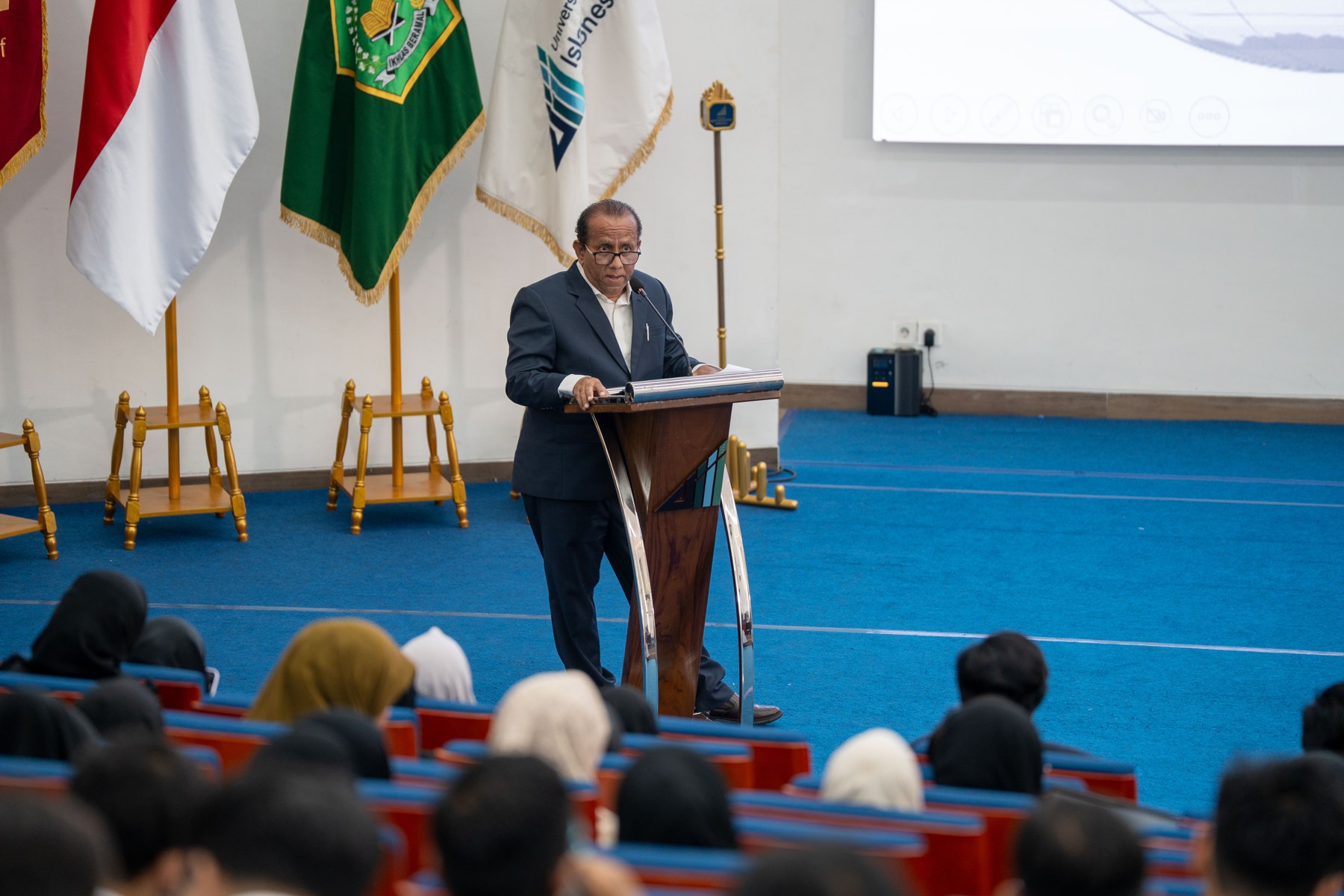
Following its establishment in 2025, the task force held a campus-wide awareness session on 26 January 2026 for all lecturers, administrative staff, students, security and cleaning officers, with Sondang Frishka Simanjuntak of Komnas Perempuan, Dr. Titin Ungsianik of the task force of Universitas Indonesia and Prof. Nina Nurmila as speakers, and continued the programme in the orientation of new students.
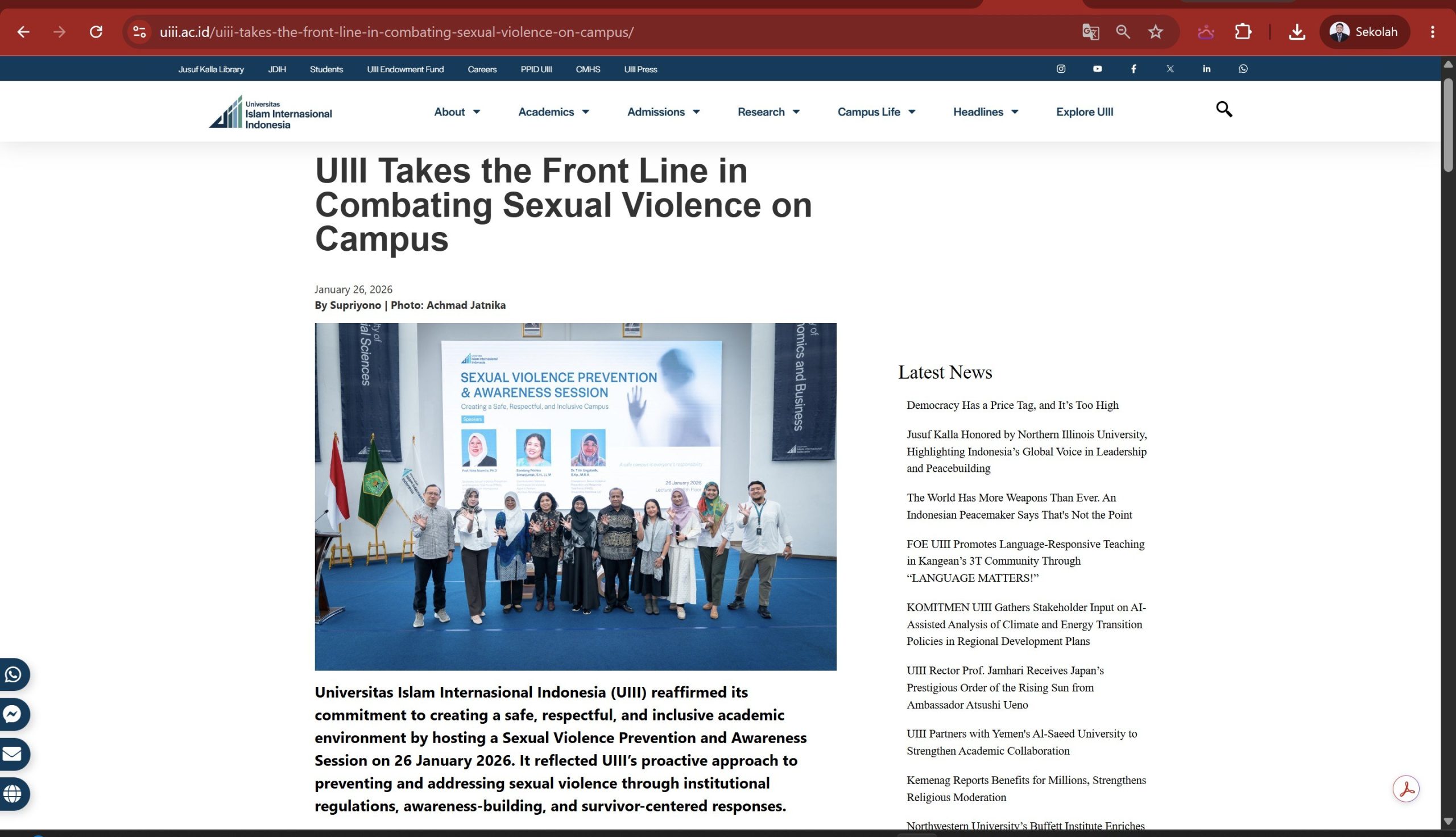
UIII news: https://uiii.ac.id/uiii-takes-the-front-line-in-combating-sexual-violence-on-campus/
SDGs Relevance: Gender Equality (5.1, 5.2), Decent Work and Economic Growth (8.8)
5. Equal Treatment of Women, Parents and People with Disabilities
5.1. Gender-responsive and child-friendly workplace
Rector’s Regulation No. 23 of 2023 (1 September 2023) requires UIII to provide gender-responsive and child-friendly work facilities, including lactation rooms, child day care and health facilities (Art. 3). It guarantees equal opportunity for women, including those who are married, of reproductive age, breastfeeding or caring for toddlers (Art. 4(2)), gives time to express breast milk during working hours (Art. 4(3)) and prohibits any reduction of working time on that account (Art. 6).
5.2. Equal pay schedules
Rector’s Regulation No. 5 of 2025 on Salaries and Other Income sets basic salary, allowances and wages by employee category, grade, service period, job class and position. Its schedules do not differ by gender, religion or nationality, so employees in the same position and grade receive the same scheduled pay.
5.3. Disability inclusion
Rector’s Decree No. 40A/R/2025 established the Technical Implementation Unit for Disability Services, which receives complaints and supports employees and students with disabilities. The campus provides accessible toilets with grab bars and turning space for wheelchairs, tactile guiding paths along pedestrian corridors, lifts with Braille and low-level buttons in all multi-storey buildings, ramps at building entrances, and lactation and child-care rooms.
SDGs Relevance: Gender Equality (5.1, 5.4), Decent Work and Economic Growth (8.5), Reduced Inequalities (10.2)
6. National Legal Framework
As a state university, UIII applies its policies within Indonesian law on equal treatment at work. Law No. 13 of 2003 on Manpower gives every worker equal opportunity to obtain employment without discrimination (Art. 5) and the right to equal treatment without discrimination from the employer (Art. 6); Indonesia ratified the ILO Discrimination (Employment and Occupation) Convention, 1958 (No. 111) by Law No. 21 of 1999 and the Equal Remuneration Convention, 1951 (No. 100) by Law No. 80 of 1957; and Law No. 8 of 2016 protects the rights of persons with disabilities, including in employment.
7. Public Evidence
Anti-Discrimination in Campus
UIII's commitment to total rejection of all forms of discrimination is explicitly affirmed through the Rector's Circular Letter Number 1c/Rek/UIII/SE.01/1/2025 (Public Access: https://jdih.uiii.ac.id/detail/474) dated January 2, 2025 concerning 'Strengthening an Inclusive and Anti-Discriminatory Campus in International Islamic University of Indonesia' signed by the Rector of UIII.
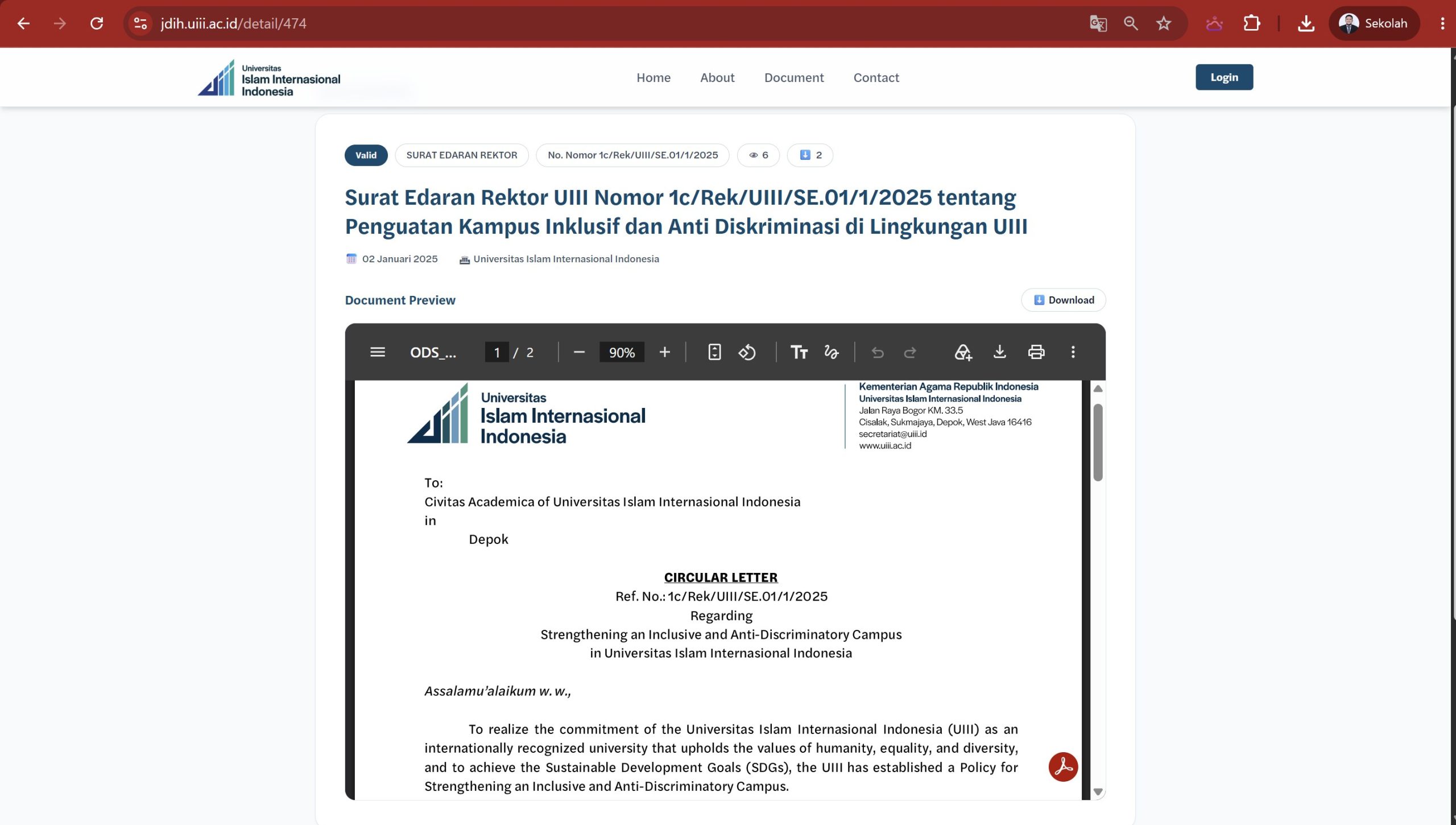
The Rector's Letter is a binding guide for all work units and the academic community, which emphasizes:
1) UIII's full commitment to providing a safe, fair, and welcoming campus space for all campus residents regardless of ethnicity, religion, race, gender, social status, or disability.
2) It is the obligation of every lecturer, education staff, and students to create a work and learning environment that is free from all forms of discrimination, verbal and nonverbal violence, harassment, intimidation, and bullying.
3) The mandate for work units to organize dissemination, education, and programs to prevent discrimination and violence on an ongoing basis.
4) Preparation of complaint and handling operational units: UPT Services for Disability, UPT Counseling and Mental Health Guidance Services, and PPKS UIIII Task Force.
5) The imposition of strict sanctions according to the rules that apply to anyone who is proven to have committed acts of discrimination or violence.
UIII Internal Regulation regarding the Enforcement of the UIII Code of Ethics
In the context of anti-discrimination enforcement within UIII, UIII has established internal regulations regarding ethical enforcement. The enforcement of ethics and anti-discrimination policies at UIII is comprehensively regulated through 4 (four) main regulations that complement each other:
Table 4. List of Anti-Discrimination Policies at UIII
| Regulation Number | About | Key Focus of Anti-Discrimination & Ethics |
|---|---|---|
| UIII Academic Senate Regulation No. 1 of 2023 https://jdih.uiii.ac.id/detail/87 | UIII Lecturer Code of Ethics | Firm commitment to anti-sexual harassment, prohibition of bullying, respect for gender equality and human rights, and adherence to research ethics & academic freedom |
| UIII Rector's Regulation No. 5 of 2023 https://jdih.uiii.ac.id/detail/127 | UIII Code of Ethics (All Campus Residents) | The basic values of integrity, professionalism, exemplary, non-discrimination, as well as general procedures for the formation of the Code of Ethics Council |
| UIII Rector's Regulation No. 3 of 2023 https://jdih.uiii.ac.id/detail/129 | Code of Ethics for UIII Education Personnel | Public service ethics standards, unity, prohibition of arbitrary/revenge, and disciplinary enforcement procedures |
| UIII Rector's Regulation No. 15 of 2021 https://jdih.uiii.ac.id/detail/111 | UIII Student Code of Ethics | The right to assistance (psychological, legal, medical), protection from bullying/violence, discrimination, prohibition of acts of violence/threats, and the flow of case handling |
Anti-Discrimination Policy through the Prevention and Handling of Sexual Violence at UIII
Strengthening anti-discrimination and violence through the Task Force for the Prevention and Handling of Sexual Violence through UIII Rector's Regulation No. 12 of 2025 concerning the Prevention and Handling of Sexual Violence (PPKS) in the UIII Environment (Public Access: https://jdih.uiii.ac.id/detail/400) and the Decree of the Rector of UIII No. 85/R/2025 concerning the Establishment of the Task Force for the Prevention and Handling of Sexual Violence for the 2025-2027 Period (Public Access: https://jdih.uiii.ac.id/detail/445). The PPKS Task Force is part of UIII which functions as a center for the Prevention and Handling of Sexual Violence. The UIII PPKS Task Force was also formed to prevent, handle, and follow up on various cases of sexual violence in order to create a safe, inclusive, and free academic environment from the threat of sexual violence. The UIII PPKS Task Force has 2 (two) tasks, namely PREVENTION TASKS Through Socialization, Learning, Governance Strengthening, Cultural Strengthening, and other activities that support the prevention of sexual violence and HANDLING TASKS. Through service activities for victims (such as assistance, protection, and victim recovery) and enforcement of perpetrators (such as examinations to counseling, therapy, and/or other rehabilitation programs).
Gender Mainstreaming & Conducive Workplace
Rector Regulation Number 23 of 2023 stipulates the obligation to provide gender-responsive work facilities and child care in the UIII environment (Public Access: https://jdih.uiii.ac.id/detail/463). This regulation is operationalized through the provision of hygienic lactation rooms, daycare services/daycare rooms, health service facilities, and the provision of flexible working hours for female workers in the reproductive/lactating period.
Counseling and Mental Health Services
Counseling and Mental Health Services (CMHS) is a mental health counseling platform dedicated to supporting the wellbeing of UIII students and Civitas Academica. CMHS provide professional counseling services that are accessible, affordable, and confidentially guaranteed. CMHS was established based on the Rector’s Decree Number 40A/R/2025 concerning the Formation of the Technical Implementation Unit for Counseling and Mental Health Services at UIII (Public Access: https://jdih.uiii.ac.id/detail/461) and the UIII Rector’s Decree Number 69B/R/2025 concerning Internal Counselors for Counseling and Mental Health Services at UIII (Public Access: https://jdih.uiii.ac.id/detail/462). These two policies serve as the foundation for the management of CMHS at UIII, with the aim of ensuring the well-being of the mental health of students and staff at the university.
References
[1] Universitas Islam Internasional Indonesia. Rector’s Circular Letter No. 1c/Rek/UIII/SE.01/1/2025 on Strengthening an Inclusive and Anti-Discriminatory Campus. 2 January 2025. https://jdih.uiii.ac.id/detail/474
[2] Universitas Islam Internasional Indonesia. Rector’s Regulation No. 5 of 2023 on the UIII Code of Ethics. 21 May 2023.
[3] Academic Senate of UIII. Regulation No. 1 of 2023 on the Lecturer Code of Ethics. 22 May 2023.
[4] Universitas Islam Internasional Indonesia. Rector’s Regulation No. 3 of 2023 on the Code of Ethics for Administrative Staff. 10 January 2023.
[5] Universitas Islam Internasional Indonesia. Rector’s Regulation No. 15 of 2021 on the Student Code of Ethics. 21 November 2021.
[6] Universitas Islam Internasional Indonesia. Rector’s Regulation No. 12 of 2025 on the Prevention and Handling of Sexual Violence; Rector’s Decree No. 85/R/2025 on the Task Force for 2025– 2027.
[7] Universitas Islam Internasional Indonesia. Rector’s Regulation No. 23 of 2023 on Gender-Responsive and Child-Friendly Workplace Facilities. 1 September 2023.
[8] Universitas Islam Internasional Indonesia. Rector’s Decree No. 40A/R/2025 on the Technical Implementation Unit for Disability Services.
[9] Universitas Islam Internasional Indonesia. Rector’s Regulation No. 5 of 2025 on Salaries and Other Income for UIII Employees. 6 January 2025.
[10] Government of Indonesia. Government Regulation No. 23 of 2019 on the Statute of Universitas Islam Internasional Indonesia; Presidential Regulation No. 57 of 2016.
[11] Government of Indonesia. Law No. 13 of 2003 on Manpower; Law No. 21 of 1999 ratifying ILO Convention No. 111; Law No. 80 of 1957 ratifying ILO Convention No. 100; Law No. 8 of 2016 on Persons with Disabilities.
[12] Supriyono. UIII Takes the Front Line in Combating Sexual Violence on Campus. UIII news, 26 January 2026.
[13] Universitas Islam Internasional Indonesia. Laporan UI GreenMetric UIII Tahun 2026: Setting and Infrastructure; Governance and Digitalization.