

SDG 4.3.3 Vocational Training Events (Lifelong Learning)
Universitas Islam Internasional Indonesia
As an educational body, Universitas Islam Internasional Indonesia (UIII) hosts executive education programmes and vocational training on its campus in Depok that are open to the general public, that is, to people who are not enrolled at the University. These activities are run by the faculties and their research centres, with support from the Directorate of Research and Cooperation, and are coordinated institutionally through the UIII Training Center, which offers short courses, training, workshops, public dialogues and online discussions for students, professionals and academics from other institutions [1].
In 2025 (January–December) UIII hosted at least ten such events. They fall into two groups: ad hoc training delivered once for a specific audience, and programmed training that recurs in planned annual editions or runs as a structured multi-session course. Participants included finance and ESG professionals, regulators, secondary-school teachers and pupils, researchers, NGO and government staff, and young community leaders. Some programmes charged a cost-recovery fee and others were free of charge, as shown in Table 1.
Table 1. Executive education and vocational training hosted by UIII and open to the public, 2025 (at a glance)
| No | Programme | Organiser | Date (2025) | External participants | Fee |
|---|---|---|---|---|---|
| A. Ad hoc training | |||||
| 1 | SCRIPTS 2025: Summer Course on Islamic Manuscripts and Texts | Faculty of Islamic Studies | 15–17 July | Students, scholars and manuscript enthusiasts from Indonesia and abroad | IDR 500,000 (public) |
| 2 | STEM Trails Workshop on Math Trails with MathCityMap | Faculty of Education, with UNNES, USK and Math Trails Lab | 25 July | Secondary mathematics teachers from Depok | Free |
| 3 | Executive Training Program on IFRS S1/S2, Climate Risk and GHG Emissions | UIII Sustainability Center (FEB), with IAMI and ASASTA Group | 22–24 July | 16 professionals from banks, energy firms, SKK Migas and universities | Fee-based |
| 4 | Training on Research Methods in Islamic Economics and Finance | Faculty of Economics and Business | 4 October | About 27 students, researchers, NGO and government staff, community leaders | Free |
| 5 | Interfaith Dialogue Training for Peace for Young Leaders in Greater Jakarta | COMPOSE, Faculty of Social Sciences | 27–28 October | 25 young leaders aged 20–35 from Greater Jakarta | Free |
| B. Programmed training | |||||
| 6 | Entrepreneurship Training and Business Model Canvas Workshop (13 sessions) | Faculty of Economics and Business | Final pitching 9 January | 32 pupils of Sekolah Terbuka Madani, Depok | Free |
| 7 | 4th Summer Training on Qualitative and Quantitative Methods (STQ2M), 18 modules | Faculty of Social Sciences | 30 June – 28 August | Students, researchers, lecturers and policy analysts | IDR 550,000 per module (public) |
| 8 | Masterclass in Digital Humanities 2025 | Faculty of Islamic Studies | 19–20 August | 26 participants from various cities and institutions | Not stated |
| 9 | 8th Certificate Course on International Humanitarian Law and Islamic Law | Faculty of Islamic Studies, with ICRC and INSANIA | 6–10 October | Academics, researchers and students of seven nationalities | Not stated |
| 10 | Ecological Finance Psychology for Youth (four sessions) | Faculty of Economics and Business | 17 November | Grade 12 pupils of SMK Bina Taqwa Depok | Free |
1. Ad hoc training
UIII held at least five one-off trainings for external participants in 2025, including executive education for finance professionals.
1.1. Ad Hoc Training 1: SCRIPTS 2025 – Summer Course on Islamic Manuscripts and Texts
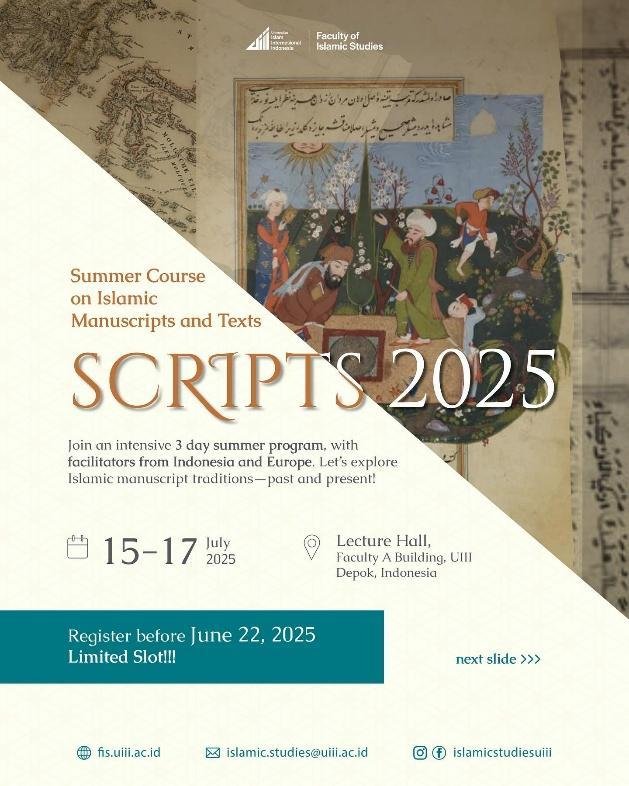
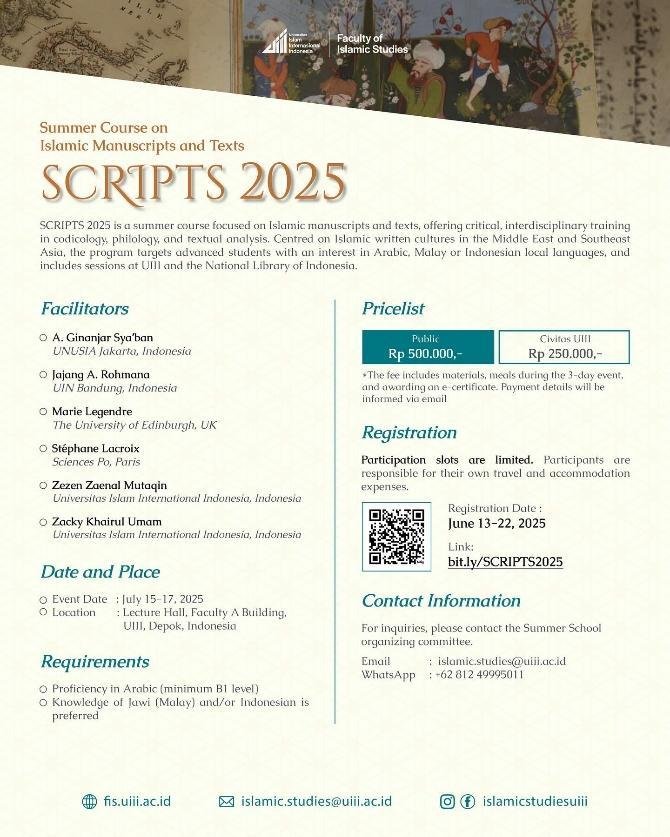
The Faculty of Islamic Studies (FIS) at Universitas Islam Internasional Indonesia (UIII) successfully convened SCRIPTS 2025: Summer Course on Islamic Manuscripts and Texts from July 15 to 17, 2025. Designed as an intensive three-day interdisciplinary program, the course brought together advanced students, scholars, and manuscript enthusiasts from across Indonesia and abroad to explore the rich written cultures of the Muslim world—spanning early Middle Eastern codices to classical Southeast Asian Malay-Jawi traditions.
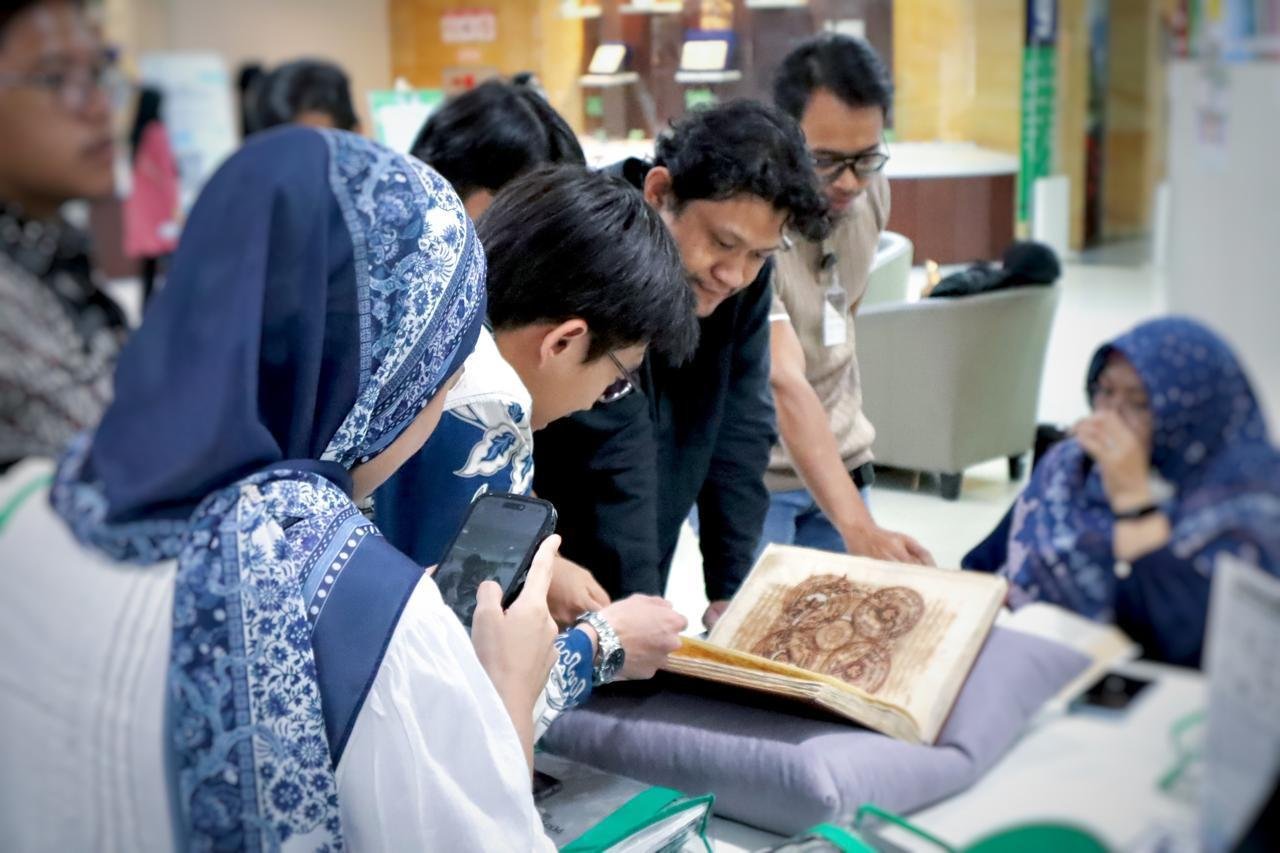
The course took place at two primary venues: classroom lectures and analytical workshops were held at the Lecture Hall, Faculty A Building, UIII Campus, Depok, followed by an experiential field visit to the National Library of Indonesia (Perpusnas RI) on Jalan Medan Merdeka Selatan, Jakarta.
Open registration ran from June 13 to 22, 2025, offering accessible pricing at IDR 500,000 for the general public and IDR 250,000 for the UIII community. The fee covered training materials, meals during the three-day event, and official e-certificates. To ensure high engagement, applicants were required to demonstrate proficiency in Arabic (minimum B1 level) alongside working knowledge of Jawi (Malay) or Indonesian.
Curriculum, Facilitators, and Educational Fieldwork
Convened by Zacky Khairul Umam (UIII), SCRIPTS 2025 combined codicology, philology, legal text analysis, and social science approaches to examine both historical manuscripts and printed Islamic textual heritage. The program featured a distinguished lineup of international and Indonesian scholar-facilitators:
Zacky Khairul Umam (Universitas Islam Internasional Indonesia)
Zezen Zaenal Mutaqin (Universitas Islam Internasional Indonesia)
Marie Legendre (University of Edinburgh, United Kingdom)
Stéphane Lacroix (Sciences Po, Paris, France)
A. Ginanjar Sya’ban (UNUSIA Jakarta, Indonesia)
Jajang A. Rohmana (UIN Sunan Gunung Djati Bandung, Indonesia)
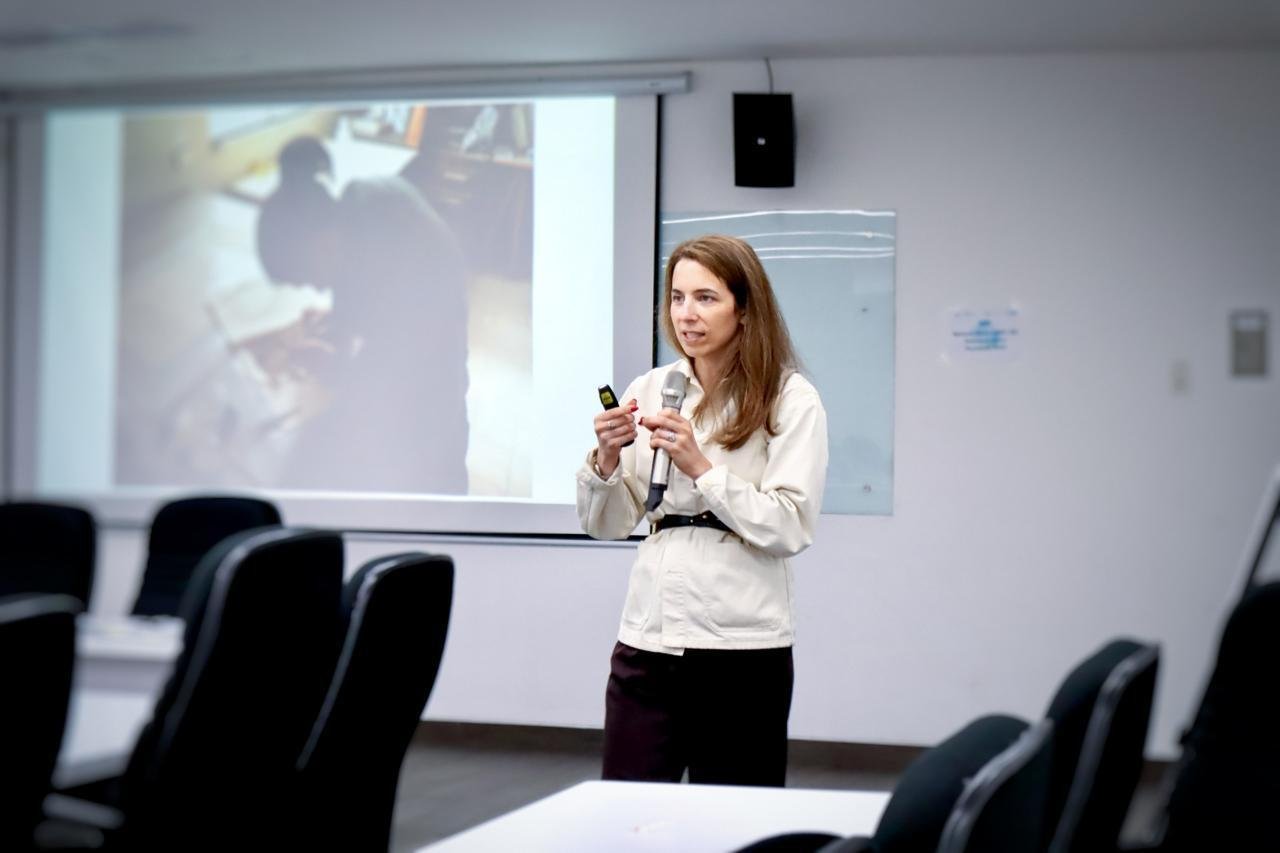
A central highlight of the summer course was the guided study session at the National Library of Indonesia (Perpusnas RI), where participants examined rare, original Islamic manuscript collections preserved in Arabic, Jawi, and regional Indonesian scripts. Guest lecturer Dr. Marie Legendre highlighted the value of this direct encounter with primary sources, noting the historical richness of the collections and the high level of engagement demonstrated by the international cohort.
Participant Feedback & Program Outlook
The course received strong praise from participants for its academic rigor and practical relevance. Program convener Zacky Khairul Umam emphasized that SCRIPTS is structured as a sustainable academic initiative to bridge classical manuscript studies with contemporary humanities scholarship, establishing UIII as a regional hub for textual heritage studies in Southeast Asia.
Public access: https://uiii.ac.id/?p=31197
1.2. Ad Hoc Training 2: STEM Trails Workshop on Math Trails with MathCityMap
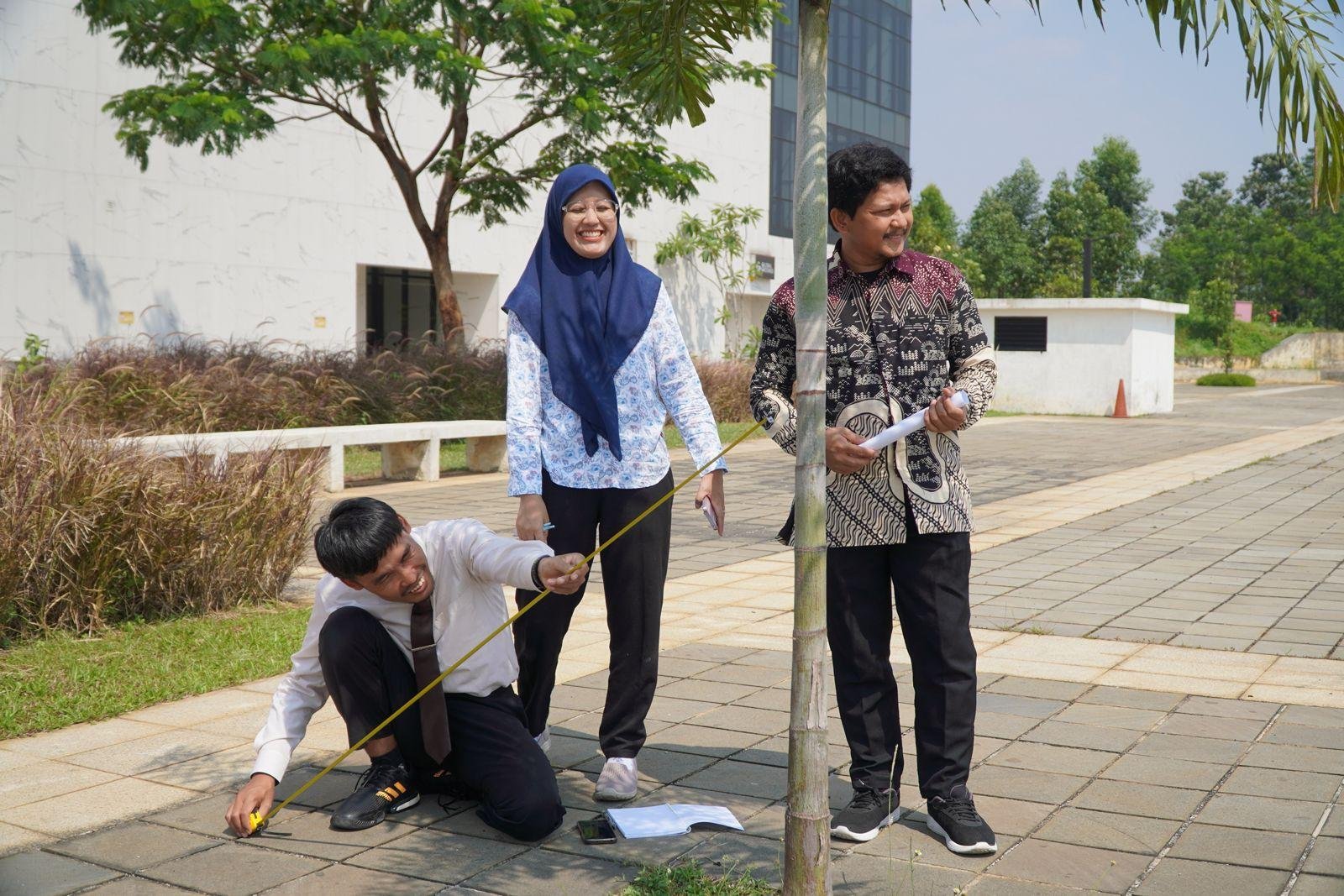
On Friday, July 25, 2025, the Faculty of Education (FoE) at Universitas Islam Internasional Indonesia (UIII) hosted a hands-on teacher training workshop titled “STEM Trails with Socio-Scientific Issues”. Organized in strategic collaboration with Universitas Negeri Semarang (UNNES), Universitas Syiah Kuala (USK), and the Math Trails Lab community, the program targeted secondary mathematics teachers from schools across Depok.
The workshop formed an integral component of the nationwide Reset Kolaborasi Indonesia (RKI) project, an inter-university initiative involving 24 State Universities with Legal Entities (PTN-BH) across Indonesia to drive collaborative research and educational innovation.
Outdoor Pedagogical Methodology & Digital Tools
Led by Dr. Destina Wahyu Winarti (lecturer at UIII’s Faculty of Education and event organizer), the program aimed to transform traditional classroom-based mathematics into an interactive outdoor learning experience:
Integration of MathCityMap: Guest speaker Adi Nurcahyo (UNNES) introduced MathCityMap—a digital platform originally developed in Frankfurt, Germany—which uses mobile technology and GPS to convert public spaces, parks, and historic sites into real-world mathematical problem-solving routes (math trails).
Socio-Scientific Issue-Based Tasks: Teachers were trained to design mathematical tasks connected to local societal and environmental issues, enabling students to apply quantitative analysis to real-life community challenges.
Fieldwork & Group Problem-Solving: Participating teachers actively completed live math trails across campus and urban environments. Novita Andriani (teacher at SMAIT Al Haraki Depok) noted that the field tasks required active debate, peer correction, and collaborative problem-solving.
Participant Impact & Vision
The training received enthusiastic feedback from local educators. Febriyansyah, a mathematics teacher at SMP Pesantren Cendekia Amanah, highlighted the value of learning alongside regional trainers and expressed hope for extending the STEM trails methodology to remote schools in Eastern Indonesia.
Dr. Destina emphasized that taking mathematics outdoors through digital tools achieves a dual goal: deepening students' conceptual understanding of mathematics while simultaneously raising awareness about pressing community and socio-scientific issues.
Public access: https://foe.uiii.ac.id/math-meets-adventure-teachers-turn-into-math-explorers-at-stem-trails-workshop-at-uiii/
1.3. Ad Hoc Training 3: Executive Training Program on IFRS S1/S2, Climate Risk, and GHG Emissions
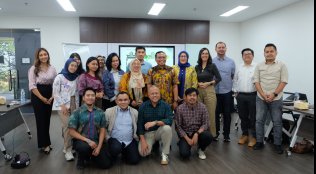
The UIII Sustainability Center (USC) under the Faculty of Economics and Business (FEB) at Universitas Islam Internasional Indonesia, in strategic partnership with the Institute of Management Accountants of Indonesia (Ikatan Akuntan Manajemen Indonesia / IAMI) and ASASTA Group, successfully convened the Executive Training Program on IFRS Sustainability Reporting and Greenhouse Gas (GHG) Emission from July 22 to 24, 2025. Designed as an intensive three-day professional upskilling course, the program brought together executive professionals, financial regulators, corporate leaders, and academic researchers to enhance institutional capacity in global sustainability reporting standards and greenhouse gas accounting.
The course took place at Classroom 9, Faculty B Building, UIII Campus, Depok. Registration fee structures were arranged based on participant categories—covering training materials, specialized notebooks, official e-certificates, and full daily catering throughout the three-day event. The training specifically targeted decision-makers and ESG practitioners from energy corporations, financial institutions, state-owned enterprises, government agencies, and higher education institutions.
Curriculum, Facilitators, and Executive Participants
Convened to support corporate readiness for low-carbon transition and net-zero targets, the program combined theoretical analysis of International Sustainability Standards Board (ISSB) frameworks with practical computational exercises. The curriculum was delivered by a distinguished team of expert academic scholars and ESG industry practitioners:
Dr. Taridi Ridho, CESFi, CRGP, CSRS, CSRA (Universitas Islam Internasional Indonesia)
Ersa Tri Wahyuni, Ph.D., CPMA (Expert Academic & Practitioner)
Yohanes Handoko Aryanto, S.E., M.BA., CSRS (Sustainability Specialist)
Yudiandra Yuwono, S.T., M.Res. (Climate Scenario Analyst)
Ir. Muhammad Suryadi, M.T. (GHG Accounting Specialist)
A central highlight of the executive course was hands-on training in climate risk scenario analysis and computational exercises covering Scope 1, Scope 2, and Scope 3 GHG emissions. The program engaged 16 high-level professionals, including representatives from SKK Migas (Alfian), PT Bajradaya Sentranusa (Doddy Benyamin Pangaribuan, Feri Setiawan), PT BRI Multifinance Indonesia (Eva Cristyani BR Tarigan), PT Karya Tetangga Tuku (Novian Nuliangga), PT Lestari Dua Alam / DAUN+ (Rafiandi Dyaa Sudiro), PT Bank Jateng (Hendyta Cinthia N M, Jazzy Anastassia Kinsky, Tisna Dedi Utama, Tita Narulita, Yan Hanugrah Harnomo, Zea Boga Elnas), Universitas Trisakti (Dr. Idrianita Anis, Regina Jansen Arsjah), Universitas Padjadjaran (Azka Azkia), and Universitas Gunadarma (Ari Purwanti).
Participant Feedback & Program Outlook
The course received strong praise from participants for its practical relevance, interactive scenario simulations, and high-level networking value. Post-event survey evaluations revealed that 100% of respondents were willing to recommend the program to industry colleagues, with 92.9% reporting that the training provided substantial benefits for their respective corporate and academic operations. The UIII Sustainability Center aims to continue offering advanced executive modules in green finance and climate disclosures, establishing UIII as a premier hub for professional sustainability education in Indonesia.
1.4. Ad Hoc Training 4: Interfaith Dialogue Training for Peace for Young Leaders in Greater Jakarta
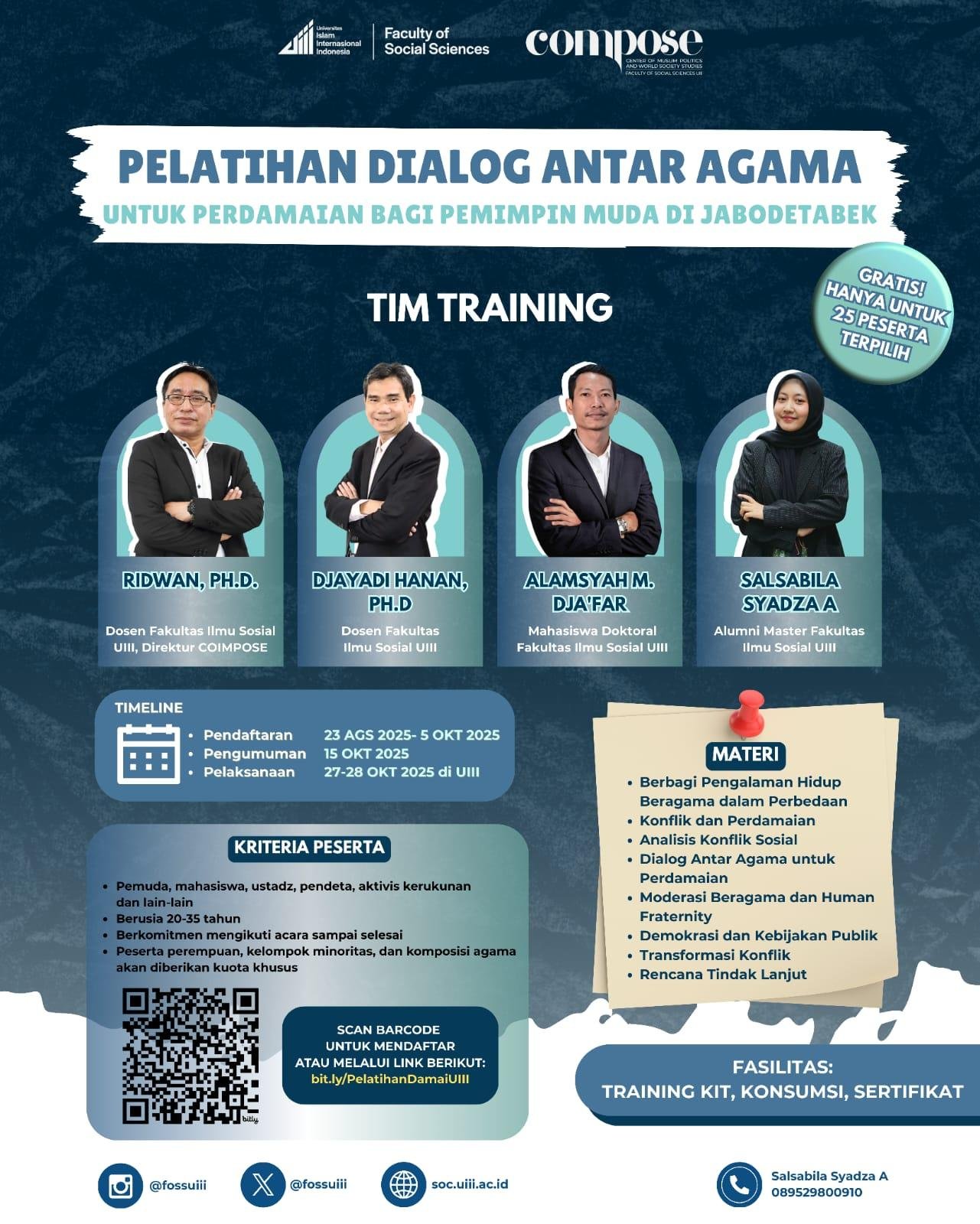
The Center of Muslim Politics and World Society (COMPOSE) under the Faculty of Social Sciences (FOSS) at Universitas Islam Internasional Indonesia (UIII), with support from the UIII Directorate of Research and Cooperation, convened the “Interfaith Dialogue Training for Peace for Young Leaders in Greater Jakarta” (Pelatihan Dialog Antar Agama untuk Perdamaian bagi Pemimpin Muda di Jabodetabek) on October 27–28, 2025. Designed as a two-day intensive experiential learning program, the training aimed to equip young interfaith leaders with practical skills in conflict transformation, peacebuilding, and social cohesion.
The training took place at the UIII Campus, Depok. An open registration call ran from August 23 to October 5, 2025, with selection results announced on October 15, 2025. The program was offered completely free of charge, fully providing participants with training kits, meals, official e-certificates, and publication mentoring. To foster inclusivity, special quota allocations were dedicated to female leaders, religious minority representatives, and diverse faith compositions across Greater Jakarta (aged 20–35 years).
Curriculum, Facilitators, and Community Impact
Convened to advance UIII’s vision as a regional hub for interfaith dialogue in Southeast Asia, the program utilized an experiential learning model involving hands-on practice, group reflection, and strategic action planning. The curriculum was delivered by a distinguished multidisciplinary training team:
Ridwan, Ph.D. (Director of COMPOSE & Lecturer, Faculty of Social Sciences, UIII)
Assoc. Prof. Djayadi Hanan, Ph.D. (Lecturer, Faculty of Social Sciences, UIII)
Alamsyah M. Dja'far (PhD Candidate, Faculty of Social Sciences, UIII)
Salsabila Syadza Az Zahra (Alumna, MA in Political Science, Faculty of Social Sciences, UIII)
The training engaged 25 selected young leaders representing various religious communities, youth activists, university students, clerics (ustadz), and pastors (pendeta) from across the Jabodetabek area. The comprehensive curriculum covered eight key modules:
Sharing Lived Experiences of Religious Diversity (Berbagi Pengalaman Hidup Beragama dalam Perbedaan)
Understanding Conflict and Peace (Konflik dan Perdamaian)
Social Conflict Analysis (Analisis Konflik Sosial)
Interfaith Dialogue for Peacebuilding (Dialog Antar Agama untuk Perdamaian)
Religious Moderation and Human Fraternity (Moderasi Beragama dan Human Fraternity)
Democracy and Public Policy (Demokrasi dan Kebijakan Publik)
Conflict Transformation (Transformasi Konflik)
Post-Training Action Plan (Rencana Tindak Lanjut)
Participant Feedback & Program Outlook
The training marks the second major community engagement initiative led by COMPOSE FoSS UIII in 2025, following its regional conference and KAICIID curriculum review in July. Program Director Ridwan, Ph.D., emphasized that preparing young interfaith leaders with practical conflict analysis and dialogue skills is essential for long-term regional stability. As an academic and practical output, all 25 participants were guided to author reflective essays, contributing toward an upcoming book on interfaith dialogue to be published by UIII Press, building upon the center's previous publication success on inclusive leadership.
Public access: https://uiii.ac.id/call-for-participants-compose-uiii-to-hold-interfaith-dialogue-training-for-young-leaders-in-greater-jakarta/
1.5. Ad Hoc Training 5: Training on Research Methods in Islamic Economics and Finance
On 4 October 2025 the Faculty of Economics and Business (FEB), as part of its community engagement and with support from the UIII Directorate of Research and Cooperation, held a one-day Training on Research Methods in Islamic Economics and Finance on the UIII campus in Depok. An open call for participants ran from 11 to 20 September 2025 and the selected participants were announced on 23 September 2025. The call was addressed to undergraduate and postgraduate students, researchers, NGO staff, government personnel and community leaders, and about 27 participants were selected [8].
The training was free of charge and participants received certificates. It covered quantitative and qualitative research methods, the Autoregressive Distributed Lag (ARDL) model for time-series data, Structural Equation Modelling (SEM) for cross-section data, systematic literature review and bibliometric analysis, with hands-on practice and guidance on writing research for publication. It was delivered by Rininta Nurrachmi, Ph.D. (FEB lecturer), with Nurshifa Vathia (Master’s student in Finance) and Muhammad Yusuf Fakhri.
Public access: https://feb.uiii.ac.id/call-for-participants-feb-uiii-to-hold-training-on-research-methods-in-islamic-economics-finance/
2. Programmed training in 2025
UIII's main programmed training is the Summer Training on Qualitative and Quantitative Methods (STQ2M), held every year since 2022 and open to researchers, lecturers and policy analysts from other institutions. The Faculty of Economics and Business (FEB) also ran two multi-session series for local schools.
2.1. Programmed Training 1: Entrepreneurship Training and Business Model Canvas Workshop
The Faculty of Economics and Business (FEB) at Universitas Islam Internasional Indonesia (UIII) conducted a community service initiative focused on youth empowerment and entrepreneurial development. The program spanned 13 structured training sessions and culminated in a final Business Model Canvas (BMC) pitching competition held at Faculty B, UIII Campus, Depok, on Thursday, January 9, 2025.
The workshop engaged 32 students in grades 10 to 12 from Sekolah Terbuka Madani, located in Kukusan, Beji, Depok. Designed and implemented by the FEB UIII community service team—led by Master’s student Syamsi Mustofa Singgih Prayogo alongside team members Jajang and Fauziyah Adzimatinur—the 12 preliminary training sessions aimed to equip high school students with practical skills to structure, refine, and execute abstract business ideas using the Business Model Canvas framework.
Program Structure, Mentorship, and Final Pitching
During the final 13th session at UIII, the 32 participants were divided into six competitive groups to pitch their structured business models before a panel of academic judges. The program was supervised by Associate Professor M. Luthfi Hamidi, Ph.D. (Head of the MA in Economics Program at FEB UIII), who served as a lead judge alongside FEB graduate students who mentored the participants throughout the project.
The final pitching event was also attended by key educational leaders from the community, including Damsir Besari (Principal of Sekolah Terbuka Madani) and senior teaching staff Mrs. Fatimah and Mrs. Nurul.
At the conclusion of the presentations, three top-performing group concepts were selected based on project feasibility, innovation, and presentation quality, receiving seed funding awards:
First Place (IDR 1,000,000): Awarded to Group 3 (Grade 10 female students) for their business proposal, "Digital Invitation".
Second Place (IDR 750,000): Awarded to Group 2 (Grade 12 female students) for their project, "E-book".
Third Place (IDR 500,000): Awarded to Group 5 (Grade 10 male students) for their concept, "Rice Bowl".
Complementary Campus & Library Experience
In addition to the intensive business pitching sessions, the visiting students were invited to tour the Jusuf Kalla Library at UIII. The guided educational tour introduced students to modern academic library management, digital learning resources, and state-of-the-art study spaces, highlighting UIII’s broader commitment to community outreach, lifelong learning, and academic inspiration for local youth.
Public access: https://feb.uiii.ac.id/uiii-boosts-youth-entrepreneurship-with-business-model-canvas-workshops/
2.2. Programmed Training 2: The 4th Summer Training on Qualitative and Quantitative Methods (STQ2M) 2025
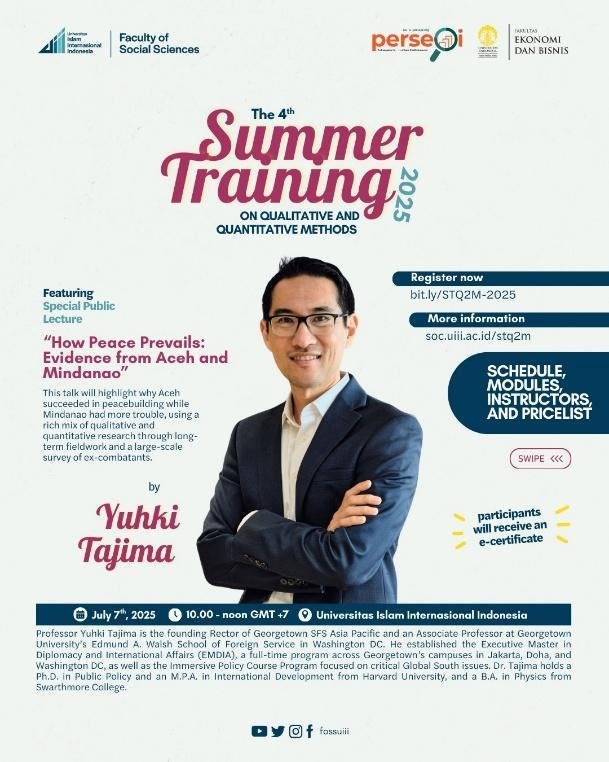
The Faculty of Social Sciences (FOSS) at Universitas Islam Internasional Indonesia (UIII) successfully hosted the 4th Summer Training on Qualitative and Quantitative Methods (STQ2M) from June 30 to August 28, 2025. Organized annually since 2022, STQ2M has established itself as a cornerstone for methodological excellence in Indonesia, serving as a hub for students, researchers, lecturers, and policy analysts from universities, think tanks, and government institutions.
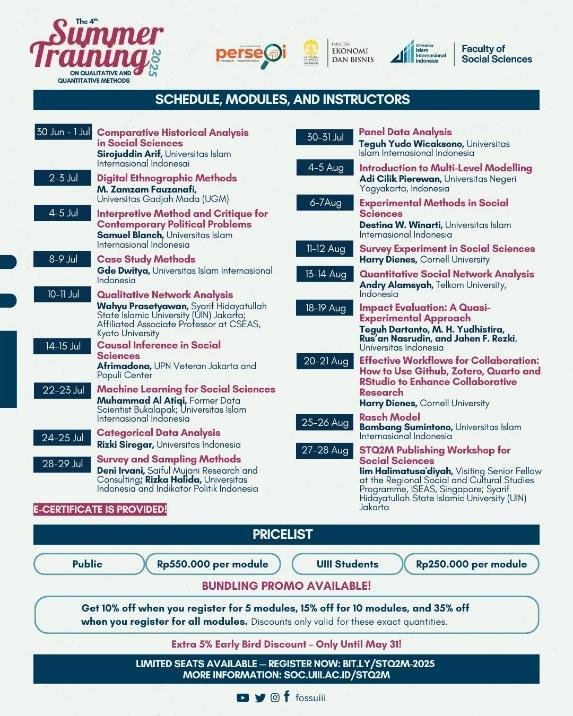
The 2025 edition expanded its curriculum to 18 comprehensive modules delivered over 9 weeks, offering rigorous training across qualitative, quantitative, and computational research methodologies. The program was priced accessibly at IDR 550,000 per module for the general public and IDR 250,000 per module for UIII students, with bundling discounts and early-bird incentives. Participants who completed the training received e-certificates, module materials, and official merchandise.
Key Highlights & Special Lectures
Opening Public Lecture (July 7, 2025): The training kicked off with a special public lecture delivered by Professor Yuhki Tajima (Georgetown University) titled "How Peace Prevails: Evidence from Aceh and Mindanao." The lecture highlighted why Aceh succeeded in peacebuilding while Mindanao faced ongoing challenges, drawing upon a rich mix of qualitative fieldwork and statistical surveys with hundreds of ex-combatants.
Featured Climate Change Module (August 1–2, 2025): A flagship module on "The Political Economy of Climate Change" was led by Hayley Pring, a post-doctoral research fellow at Nuffield College, Oxford University, and Skoll ECR Fellow at Said Business School. The module explored cooperation dilemmas, carbon pricing, mitigation strategies, and global-to-local climate policy dynamics using quantitative and computational tools.
Complete Schedule, Modules, and Instructors (18 Modules)
The 2025 STQ2M curriculum featured an elite lineup of international and national scholars:
Comparative Historical Analysis in Social Sciences (June 30 – July 1, 2025). Instructor: Sirojuddin Arif (Universitas Islam Internasional Indonesia)
Digital Ethnographic Methods (July 2–3, 2025). Instructor: M. Zamzam Fauzanafi (Universitas Gadjah Mada / UGM)
Interpretive Method and Critique for Contemporary Political Problems (July 4–5, 2025). Instructor: Samuel Blanch (Universitas Islam Internasional Indonesia)
Case Study Methods (July 8–9, 2025). Instructor: Gde Dwitya (Universitas Islam Internasional Indonesia)
Qualitative Network Analysis (July 10–11, 2025). Instructor: Wahyu Prasetyawan (UIN Syarif Hidayatullah Jakarta & CSEAS, Kyoto University)
Causal Inference in Social Sciences (July 14–15, 2025). Instructor: Afrimadona (UPN Veteran Jakarta & Populi Center)
Machine Learning for Social Sciences (July 22–23, 2025). Instructor: Muhammad Al Atiqi (Former Data Scientist Bukalapak / Universitas Islam Internasional Indonesia)
Categorical Data Analysis (July 24–25, 2025). Instructor: Rizki Siregar (Universitas Indonesia)
Survey and Sampling Methods (July 28–29, 2025). Instructors: Deni Irvani (Saiful Mujani Research and Consulting / SMRC) & Rizka Halida (Universitas Indonesia & Indikator Politik Indonesia)
Panel Data Analysis (July 30–31, 2025). Instructor: Teguh Yudo Wicaksono (Universitas Islam Internasional Indonesia)
Introduction to Multi-Level Modelling (August 4–5, 2025). Instructor: Adi Cilik Pierewan (Universitas Negeri Yogyakarta)
Experimental Methods in Social Sciences (August 6–7, 2025). Instructor: Destina W. Winarti (Universitas Islam Internasional Indonesia)
Survey Experiment in Social Sciences (August 11–12, 2025). Instructor: Harry Dienes (Cornell University)
Quantitative Social Network Analysis (August 13–14, 2025). Instructor: Andry Alamsyah (Telkom University)
Impact Evaluation: A Quasi-Experimental Approach (August 18–19, 2025). Instructors: Teguh Dartanto, M. H. Yudhistira, Rus'an Nasrudin, and Jahen F. Rezki (Universitas Indonesia)
Effective Workflows for Collaboration: How to Use GitHub, Zotero, Quarto, and RStudio to Enhance Collaborative Research (August 20–21, 2025). Instructor: Harry Dienes (Cornell University)
Rasch Model (August 25–26, 2025). Instructor: Bambang Sumintono (Universitas Islam Internasional Indonesia)
STQ2M Publishing Workshop for Social Sciences (August 27–28, 2025). Instructors: Iim Halimatusa'diyah (ISEAS – Yusof Ishak Institute, Singapore) & Syarif Hidayatullah (UIN Syarif Hidayatullah Jakarta)
Public access: https://soc.uiii.ac.id/stq2m/
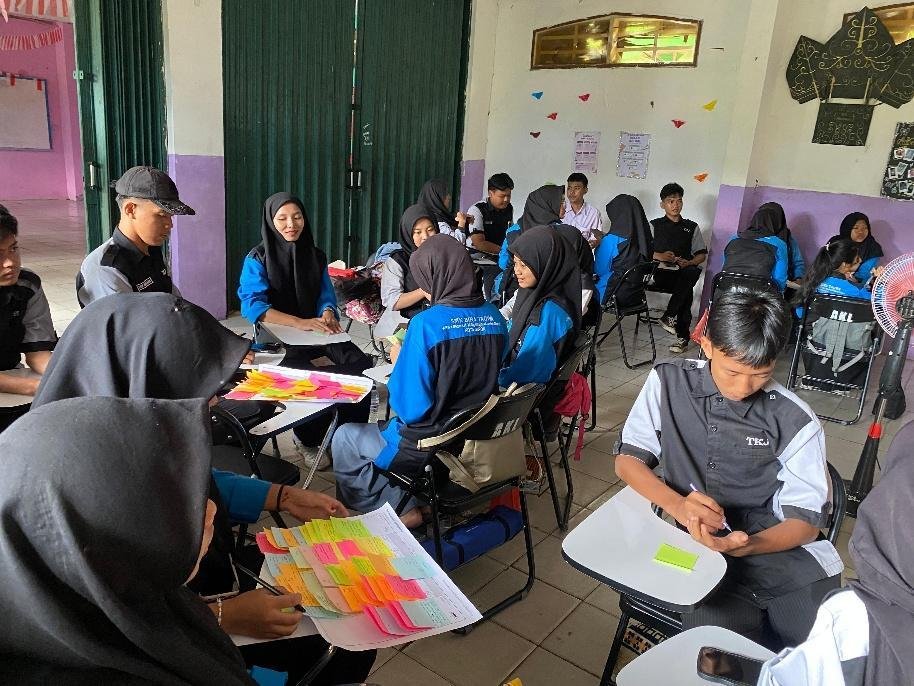
2.3. Programmed Training 3: Ecological Finance Psychology for Youth
The Faculty of Economics and Business (FEB) at Universitas Islam Internasional Indonesia (UIII) successfully carried out a targeted community engagement program titled “Ecological Finance Psychology for Youth: Taking Small Steps on the Path to Sustainable Lifestyle”. Designed to foster long-term behavioral change among young people, the program integrated psychological awareness, financial literacy, and environmental education.
The training engaged 12th-grade students at SMK Bina Taqwa Depok across four interactive sessions on November 17, 2025. The initiative was led by Hanafi Sofyan Guciano, Ph.D., alongside Master of Finance student Syamsi Mustofa Singgih Prayogo, utilizing a Participatory Action Research (PAR) approach to promote emotional dialogue, personal reflection, and practical skill-building.
Program Methodology, Curriculum, and Impact
The curriculum was structured to help high school students understand how personal emotions, spending habits, and ecological footprints are deeply interconnected:
The Environmental Psychology Canvas: Participants utilized this specialized reflective tool to map their daily lifestyles, linking emotional triggers and financial decision-making with environmental sustainability.
Interactive Eco-Finance Dialogues: Through storytelling, educational games, and group discussions, students analyzed how impulsive spending and reliance on single-use consumer products carry direct ecological consequences.
Financial Literacy & Debt Prevention: Beyond ecological mindfulness, Dr. Hanafi emphasized building foundational financial literacy to empower the younger generation to avoid high-risk financial traps, such as predatory online lending (pinjaman online).
During the closing session, top-performing students and active discussion leaders were awarded student savings account prizes (tabungan pelajar), symbolizing the practical integration of financial responsibility with environmental stewardship.
Participant Feedback & Program Vision
The training received enthusiastic feedback from school participants. Fadillah Rizqi Handayani, a 12th-grade student at SMK Bina Taqwa, shared:
"I have just realized the importance of financial management and environmentally friendly behavior for my life and the future of the earth. This training is very essential for students in applying a sustainable lifestyle."
Dr. Hanafi Sofyan Guciano highlighted the broader vision of the initiative, noting that when youth realize their daily financial choices directly influence the planet, sustainability transforms from an abstract burden into a meaningful, empowering habit of daily life.
2.4. Programmed Training 4: Masterclass in Digital Humanities 2025
The Faculty of Islamic Studies (FIS) holds an annual Masterclass in Digital Humanities, a programme it has run since UIII’s first masterclass in the field. The 2025 edition, themed “[Re]searching Digital Islam in Contemporary Indonesia” and convened by Bhirawa Anoraga, took place on 19–20 August 2025 in the Lecture Hall, Faculty A Building, and brought together 26 participants from various cities and institutions [9].
Over two days participants were trained in research approaches to digital religion: social media and Indonesia’s Islamic field; precarity, piety and neoliberal digital culture; sonic Islam and the climate crisis through multisensory ethnography; affect and everyday digital Islam; the place of ethnography in digital Islam research; and Islamic web series and women’s piety. Facilitators included Martin Slama (Austrian Academy of Sciences), Diatyka Widya Permata Yasih (Universitas Indonesia), Muhammad Zamzam Fauzanafi (Universitas Gadjah Mada), Najib Kailani (UIN Sunan Kalijaga), Ahmad Nuril Huda (BRIN) and Andina Dwifatma (Universitas Katolik Indonesia Atma Jaya), with opening remarks by Prof. Yanwar Pribadi, Dean of FIS.
Public access: https://fis.uiii.ac.id/activities/masterclass-digital-humanities-digital-islam-uiii-2025-3225/
2.5. Programmed Training 5: The 8th Certificate Course on International Humanitarian Law and Islamic Law
From 6 to 10 October 2025 the Faculty of Islamic Studies, in collaboration with the International Committee of the Red Cross (ICRC) Jakarta and INSANIA, hosted the 8th Certificate Course on International Humanitarian Law and Islamic Law on the UIII campus. Now in its eighth edition, the course is a recurring professional certificate programme for academics, researchers and students from across Indonesia and abroad; the 2025 cohort came from seven countries: Indonesia, Nigeria, Pakistan, Afghanistan, the Philippines, the Gambia and Malawi [10].
Through lectures, discussions and case studies led by international experts, participants examined how Islamic jurisprudence and international humanitarian law can address the ethical and legal dimensions of contemporary armed conflict. The course was opened by Prof. Yanwar Pribadi (Dean, FIS), Martin de Boer (Head of the ICRC Regional Delegation for Indonesia and Timor-Leste) and Prof. Jamhari (Rector of UIII).
Public access: https://uiii.ac.id/uiii-icrc-and-insania-strengthens-global-humanitarian-dialogue-through-the-8th-certificate-course/
SDGs Relevance: Quality Education (4.3, 4.4, 4.7), Decent Work and Economic Growth (8.6), Climate Action (13.3), Peace, Justice and Strong Institutions (16.7)
References
[1] UIII. UIII Training Center. https://uiii.ac.id/uiii-training-center/
[2] UIII. “UIII Wraps Up SCRIPTS 2025 Summer School on Islamic Manuscripts and Texts”, July 2025. https://uiii.ac.id/?p=31197
[3] Faculty of Education, UIII. “Math Meets Adventure: Teachers Turn Into Math Explorers at STEM Trails Workshop at UIII”, July 2025. https://foe.uiii.ac.id/math-meets-adventure-teachers-turn-into-math-explorers-at-stem-trails-workshop-at-uiii/
[4] UIII Sustainability Center, Faculty of Economics and Business. Programme documentation, attendance list and participant evaluation, Executive Training Program on IFRS Sustainability Reporting and GHG Emission, 22–24 July 2025 (internal record).
[5] UIII. “Call for Participants: COMPOSE UIII to Hold Interfaith Dialogue Training for Young Leaders in Greater Jakarta”, 8 September 2025. https://uiii.ac.id/call-for-participants-compose-uiii-to-hold-interfaith-dialogue-training-for-young-leaders-in-greater-jakarta/
[6] Faculty of Economics and Business, UIII. “UIII Boosts Youth Entrepreneurship with Business Model Canvas Workshops”, 21 January 2025. https://feb.uiii.ac.id/uiii-boosts-youth-entrepreneurship-with-business-model-canvas-workshops/
[7] Faculty of Social Sciences, UIII. Summer Training on Qualitative and Quantitative Methods (STQ2M) 2025. https://soc.uiii.ac.id/stq2m/
[8] Faculty of Economics and Business, UIII. “Call for Participants: FEB UIII to Hold Training on Research Methods in Islamic Economics & Finance”, September 2025. https://feb.uiii.ac.id/call-for-participants-feb-uiii-to-hold-training-on-research-methods-in-islamic-economics-finance/
[9] Faculty of Islamic Studies, UIII. “Exploring Transformations of Digital Islam: Insights from UIII’s Masterclass in Digital Humanities 2025”, 22 August 2025. https://fis.uiii.ac.id/activities/masterclass-digital-humanities-digital-islam-uiii-2025-3225/
[10] UIII. “UIII, ICRC and INSANIA Strengthen Global Humanitarian Dialogue through the 8th Certificate Course”, 7 October 2025. https://uiii.ac.id/uiii-icrc-and-insania-strengthens-global-humanitarian-dialogue-through-the-8th-certificate-course/