

THE Sustainability Impact Ratings
Evidence Document — SDG 10: Disability Support Services
1. INSTITUTIONAL OVERVIEW: CMHS AS A DISABILITY SUPPORT UNIT
1.1 Legal and Structural Framework
Universitas Islam Internasional Indonesia (UIII) has established the Counseling and Mental Health Services (CMHS) as a dedicated Unit Pelaksana Teknis (UPT) — a formally constituted support unit operating under rector authority — through Keputusan Rektor UIII Nomor 40/R/2025 (Rector's Decree No. 40/R/2025), dated 28 May 2025. This decree formally establishes the UPT Layanan Bimbingan Konseling dan Kesehatan Mental (CMHS) under the supervision of the Vice-Rector for Academic Affairs, Student Affairs, and Human Resources. CMHS is tasked with formulating operational plans, technical policies, service standards and procedures, managing and delivering counseling and mental health services, and reporting directly to the Rector. CMHS provides professional psychological support and structured group-based psychoeducation programmes to the entire UIII academic community, including students, academic staff, and administrative personnel.
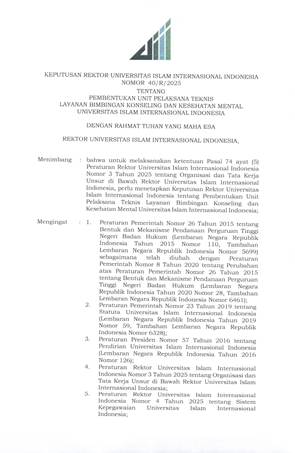
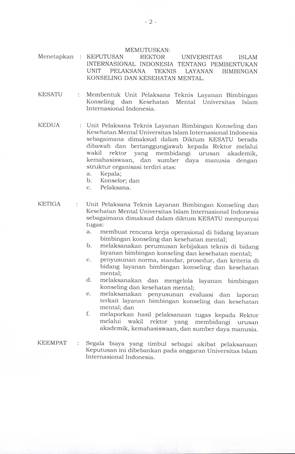

SK No. 40/R/2025 — UPT Layanan Bimbingan Konseling dan Kesehatan Mental (CMHS)
The establishment of CMHS reflects UIII's recognition that psychosocial disabilities — as defined under the United Nations Convention on the Rights of Persons with Disabilities (UN CRPD) and the World Health Organization (WHO) International Classification of Functioning, Disability and Health (ICF) — constitute a significant and often underserved category of disability in higher education settings. Mental health conditions such as anxiety disorders, depression, PTSD, and other psychological impairments qualify as psychosocial disabilities when they substantially limit an individual's participation in academic and social life.
1.2 Professional Counseling Team
CMHS is staffed by certified professional counselors and clinical psychologists with academic credentials:
- Dr. Lukman Nul Hakim — Professional Counselor (Konselor Profesional)
- Assoc. Prof. Charyna Ayu Rizkyanti, Ph.D — Professional Counselor (Konselor Profesional)
1.3 Individual Counseling Services
CMHS offers a comprehensive range of evidence-based individual counseling modalities:
- Cognitive Behavioral Therapy (CBT) — addressing negative thought patterns and maladaptive behaviors
- Acceptance and Commitment Therapy (ACT) — building psychological flexibility and value-driven action
- Solution-Focused Therapy (SFT) — goal-oriented brief counseling approach
- Crisis Counseling — immediate psychological support for acute mental health situations
- Career Counseling — integration of mental health support with academic and professional development
2. INDIVIDUAL COUNSELING SERVICES
At the core of CMHS's disability support provision is a professional individual counseling service that offers confidential, one-on-one psychological support to any member of the UIII academic community. Sessions are conducted by certified counselors and clinical psychologists using internationally recognized, evidence-based therapeutic approaches.
All services are provided with strict confidentiality, ensuring that students and staff with psychosocial disabilities can seek support without fear of stigma or academic consequence. Sessions are available both in-person on campus and via online platforms, removing geographic and mobility barriers to access.
2.1 Therapeutic Modalities
| Modality | Description |
|---|---|
| Cognitive Behavioral Therapy (CBT) | Identifies and restructures negative thought patterns and maladaptive behaviors that contribute to psychological distress |
| Acceptance and Commitment Therapy (ACT) | Builds psychological flexibility and encourages value-driven action, particularly effective for anxiety and chronic stress |
| Solution-Focused Therapy (SFT) | A goal-oriented brief counseling approach that focuses on building solutions rather than dwelling on problems |
| Crisis Counseling | Immediate psychological intervention for students or staff experiencing acute mental health crises or emotional emergencies |
| Career Counseling | Integrates mental health support with academic and professional development, addressing performance anxiety and career-related stress |
2.2 Service Access
| Appointment Booking | WhatsApp: +62 851 1102 1730 | Email: cmhs@uiii.ac.id |
| Session Format | In-person (on-campus) and online (remote sessions) |
| Platform Access | 24/7 digital access via cmhs.uiii.ac.id |
| Eligibility | Open to all UIII students, academic staff, and administrative staff |
| Confidentiality | All sessions are strictly confidential in accordance with professional counseling ethics |
3. PSYCHOEDUCATION WORKSHOP PROGRAMME (2025)
In 2025, CMHS launched its inaugural Psychoeducation Sessions — a structured group-based educational programme designed to complement individual counseling by reaching a broader segment of the UIII academic community. These sessions adopt a promotive and preventive approach to mental health, building psychological literacy, reducing stigma, and equipping participants with practical skills to recognize and respond to psychosocial challenges.
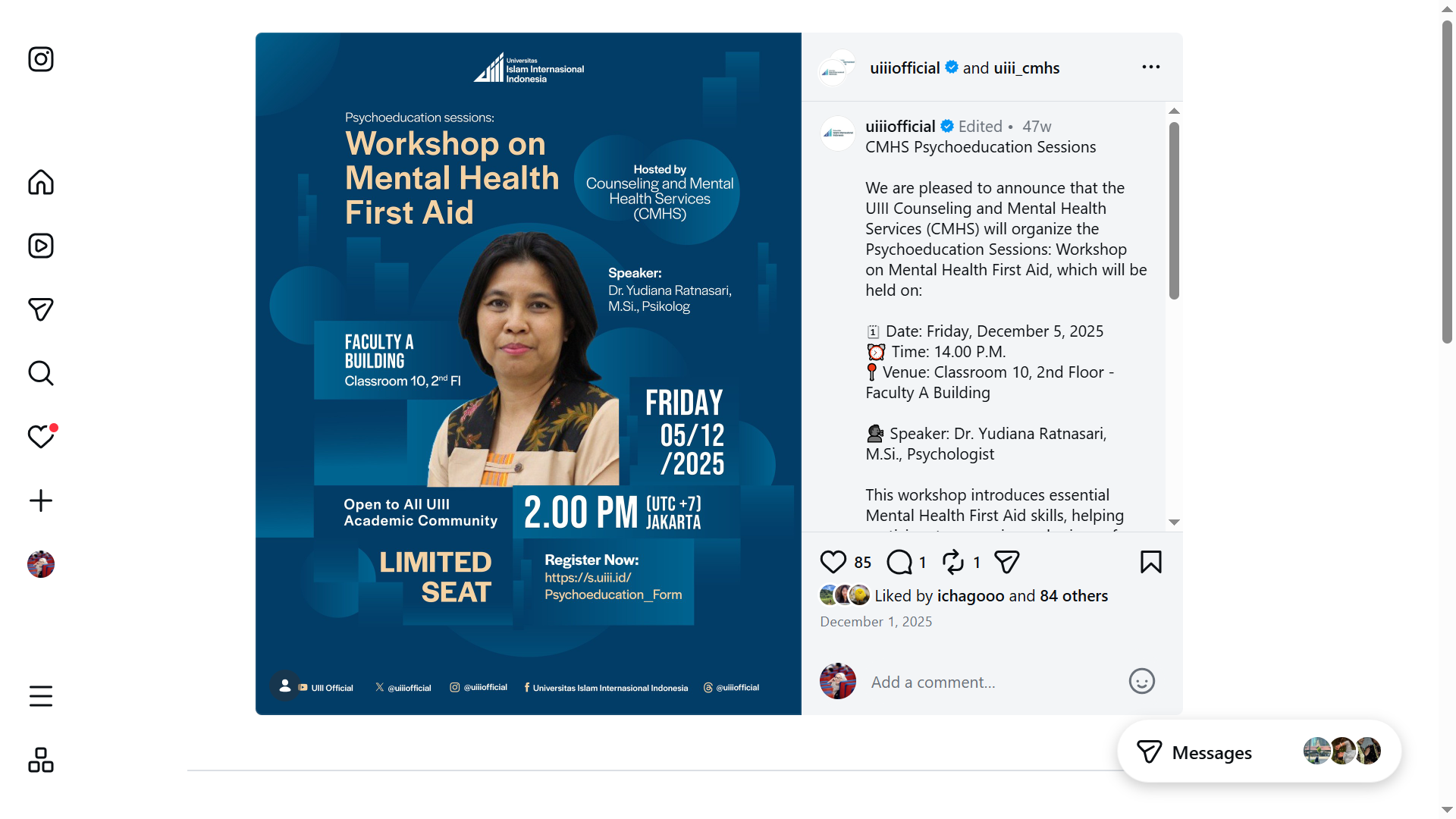
The sessions are open to all members of the UIII academic community across all faculties, with participation quotas capped at 10 individuals per faculty to ensure an intimate, effective, and well-organized learning environment. Registration is conducted online via the UIII psychoeducation registration platform.
3.1 Psychoeducation Session #1: Workshop on Mental Health First Aid
| Date & Time | Friday, December 5, 2025 | 14:00 WIB (UTC+7) |
| Venue | Classroom 10, 2nd Floor, Faculty A Building, UIII Campus |
| Speaker | Dr. Yudiana Ratnasari, M.Si., Psikolog (Universitas Indonesia) |
| Organized by | Counseling and Mental Health Services (CMHS), UIII |
| Open to | All UIII academic community — students and staff of all faculties |
3.2 Workshop Background and Rationale
Mental Health First Aid (MHFA) is a globally recognized framework developed to empower non-clinical members of a community to recognize, understand, and appropriately respond to early signs of mental health distress in others. In a university setting — where students frequently encounter academic pressure, transition challenges, and social adjustment difficulties — the capacity to identify and respond to psychosocial distress is a critical institutional competency.
This workshop was specifically designed to address a key gap: while CMHS provides professional individual counseling, many students in need of support do not initially seek professional help due to stigma, lack of awareness, or uncertainty about where to turn. By training the broader campus community in MHFA principles, UIII extends its support ecosystem beyond the counseling room and into the everyday social fabric of campus life.
3.3 Workshop Content and Methodology
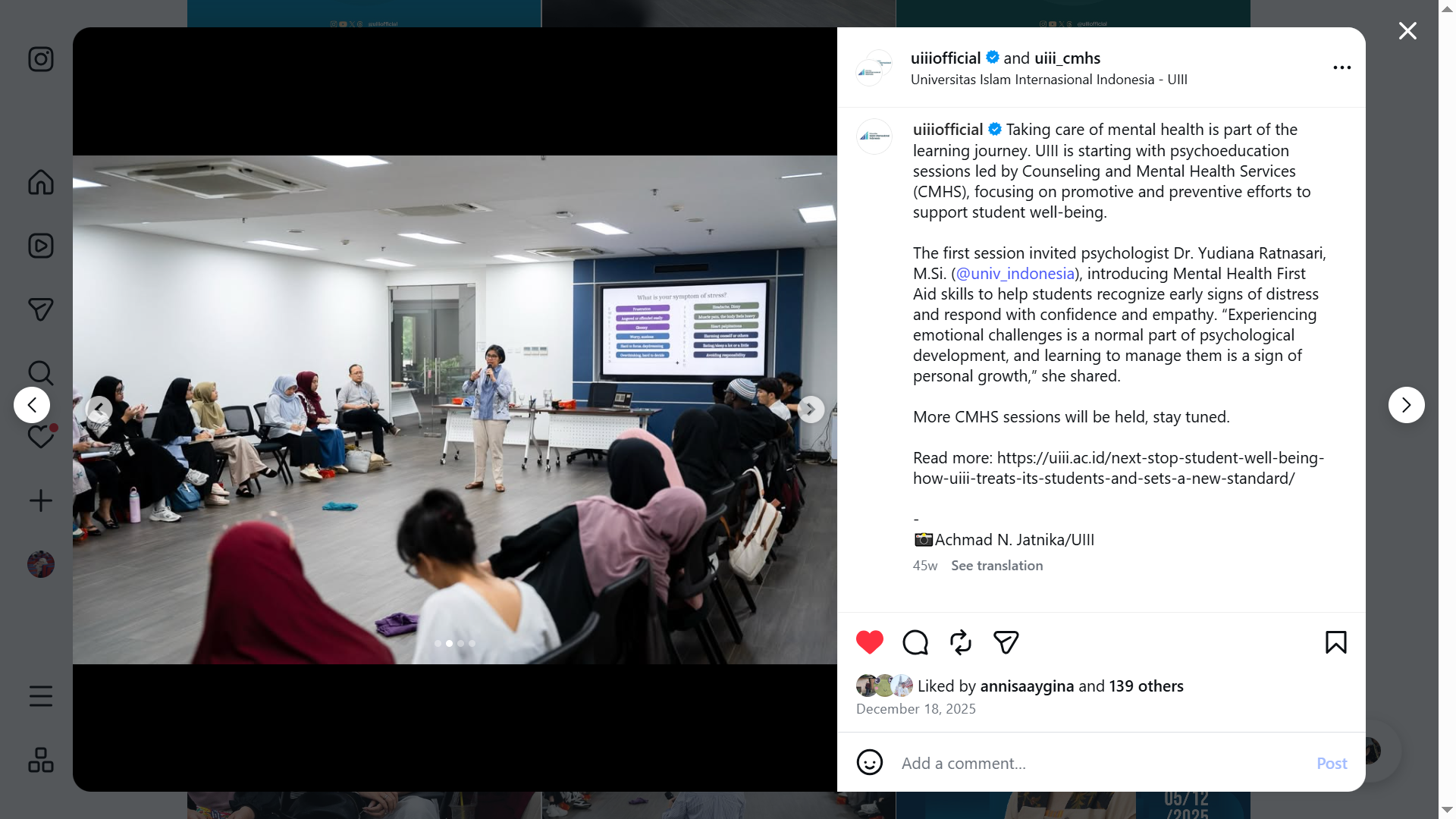
The session introduced participants to the foundational principles of Mental Health First Aid, structured around three core competencies:
A. Recognizing Signs of Psychological Distress
Participants were trained to identify early warning signs of common psychosocial conditions prevalent in academic environments, including anxiety, depression, and acute stress responses. The training emphasized distinguishing between temporary emotional difficulty and patterns that may indicate a need for professional support.
B. Responding with Empathy and Confidence
A central focus of the session was on how to approach a peer or colleague who may be struggling — using active listening, non-judgmental language, and empathetic communication techniques. Dr. Yudiana emphasized a key message that resonated throughout the session: "Experiencing emotional challenges is a normal part of psychological development, and learning to manage them is a sign of personal growth." This framing actively works to destigmatize psychological distress within the UIII community.
C. Appropriate Referral to Professional Support
Participants learned the process of connecting individuals in distress to appropriate professional support through CMHS, including awareness of available services (individual counseling, crisis intervention), access channels (WhatsApp, email, online booking), and the importance of maintaining confidentiality throughout the referral process.
3.4 Key Learning Outcomes
- Identify early warning signs of psychological distress — including anxiety, depression, and acute stress — in academic settings
- Apply the core principles of Mental Health First Aid in peer and colleague interactions
- Communicate with empathy, active listening, and non-judgmental language when supporting someone in distress
- Know when and how to refer peers to CMHS professional counseling and crisis services
- Contribute to a stigma-free, psychologically safe campus culture at UIII