

SDG 17 · Indicator 17.3.12
SDG 12
SDG 12 Report: Responsible Consumption and Production
Universitas Islam Internasional Indonesia (UIII) · Reporting period: 2025
Publish progress against SDG 12, either individually or within an annual report.
Separate report
Universitas Islam Internasional Indonesia (UIII) is committed to sustainable consumption and production on its campus. This report presents UIII’s performance against SDG 12: how the university reduces its consumption of paper and single-use plastics, how it segregates and recovers its waste, and how it manages hazardous waste safely.
UIII’s approach is built on the 3R principles (Reduce, Reuse, Recycle) and is supported by waste segregation at source, on-site composting, digital-first administrative systems, and a partnership with the Depok Environmental Agency (Dinas Lingkungan Hidup, DLHK Kota Depok). These actions contribute to SDG targets 12.2, 12.4, 12.5 and 12.8. UIII’s sustainability performance was first assessed in the 2026 UI GreenMetric World University Rankings, where it placed 121st in Indonesia and 1,131st globally.
SDG 12 Performance at a Glance
| Indicator | Previous year | Current year | Change / share |
|---|---|---|---|
| Plastic consumed (t) | 0.045775 | 0.025325 | −44.7% |
| Plastic cups consumed (t) | 0.022275 | 0.003825 | −82.8% |
| Paper consumed (t) | 1.08706 | 0.56600 | −47.9% |
| Organic waste generated (t) | 0.01175 | 0.010275 | −12.6% |
| Organic waste composted (t) | – | 0.008220 | 80.0% of generated |
| Inorganic non-toxic waste generated (t) | 0.1201 | 0.1179 | −1.8% |
| Inorganic waste reused or sent for onward management (t) | – | 0.08253 | 70.0% of generated |
| Hazardous (B3) waste generated (t) | 0.066 | 0.047 | −28.8% |
| Hazardous waste transferred to licensed management (t) | – | 0.0376 | 80.0% of generated |
Table 1. Summary of key SDG 12 indicators (tonnes). “–” indicates the indicator is reported for the current year only.
1. Integrated 3R Waste Management
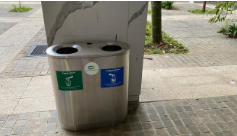
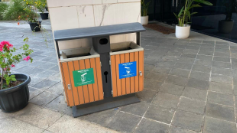
UIII manages campus waste through an integrated system that emphasises waste reduction, material recovery and environmental protection. Dedicated bins for organic and inorganic waste are placed in academic buildings, public areas and outdoor spaces, so that the campus community can separate waste at the point of disposal. Organic waste is collected for composting, while inorganic waste is sorted for reuse or recycling through designated channels.
Reusable tumblers, food containers and tote bags are promoted to minimise single-use plastics.
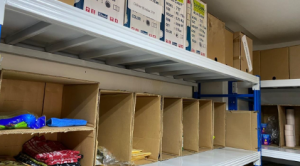
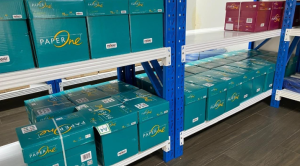
Used cardboard boxes are repurposed as storage and display containers; waste-sorting drop boxes are provided at events.
Partnerships with the TPS team and the Depok Environmental Agency, plus composting of organic waste.
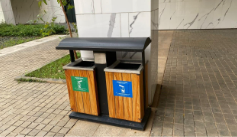 Figure 1. Organic and inorganic waste segregation bins in a public area.
2. Reducing Paper and Plastic Consumption
Digital-first Administration
UIII has replaced many paper-based processes with digital systems:
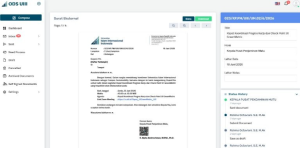
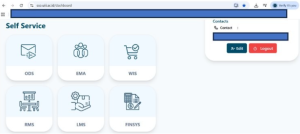
- Office Digital System (ODS) — official correspondence, approvals and administrative documents.
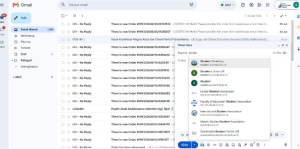
- Learning Management System (LMS) and email — thesis supervision, assignment submission and lecturer–student communication.
- Room Management System (RMS) — room reservations and facility bookings.
- Warehouse Information System (WIS) — office supply and logistics requests, and inventory management.
- Digital Certificate Management System — electronic certificates for seminars and conferences.
The Digital Transformation Office has also moved surveys, registrations and forms online. Where printing is still necessary, double-sided printing is mandatory and data are checked before printing to avoid reprints.
Reducing Single-use Plastics
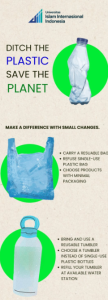
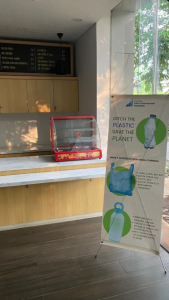
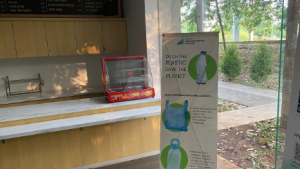
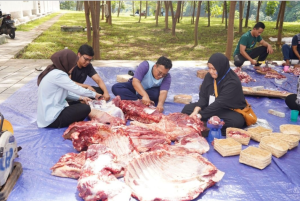
The “Bring Your Own Tumbler and Totebag” campaign is supported by awareness programmes, classroom materials, digital communication and posters and banners in campus facilities such as the canteen. During Eid al-Adha, UIII replaced plastic bags in Qurban meat distribution with woven bamboo baskets (besek).
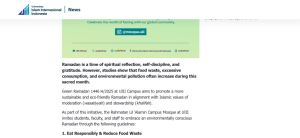
Under “Green Ramadan 2025”, the Rahmatan Lil ‘Alamin Mosque ran a university-wide initiative to reduce waste and promote sustainable living. The daily iftar, with 250 meal packages, emphasised waste reduction and sustainable packaging.
Results
| Type of material | Previous year (t) | Current year (t) | Reduction (t) |
|---|---|---|---|
| Plastic (total) | 0.045775 | 0.025325 | 0.020450 |
| Plastic cup (225 g) | 0.022275 | 0.003825 | 0.018450 |
| Plastic trash bag (500 g) | 0.023500 | 0.021500 | 0.002000 |
| Paper (total) | 1.08706 | 0.56600 | 0.52106 |
| HVS paper, A4, 75 g | 1.00854 | 0.34866 | 0.65988 |
| HVS paper, F4, 75 g | 0.0754 | 0.0551 | 0.0203 |
| HVS paper, A4, 100 g | 0.00312 | 0.16224 | +0.15912 |
Table 2. Volume of paper and plastic, previous year versus current year (tonnes). A “+” sign indicates an increase.
Plastic fell by 44.7%, driven mainly by an 82.8% drop in plastic cups. Paper consumption fell by 47.9%. The rise in A4 100 g paper reflects a shift in paper specification rather than higher overall consumption, since total paper use fell by almost half.
3. Organic Waste Management
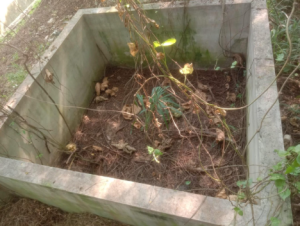
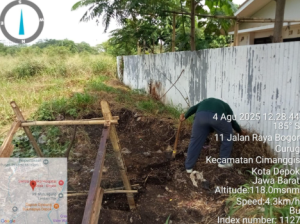
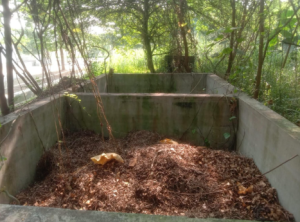
Organic waste is managed centrally by AMSP, the entity that runs the campus Temporary Waste Collection Point (TPS). AMSP collects and processes canteen food waste, green waste such as fallen leaves and garden trimmings, and livestock manure from the campus cows and goats. Instead of sending these to landfill, AMSP treats them on site through controlled composting, and the compost is used to maintain the campus landscape. The quantified data cover food waste and leaves.
| Type of waste | Previous year (t) | Current year (t) | Reduction (t) | Reused | Down-cycled | Up-cycled |
|---|---|---|---|---|---|---|
| Organic waste (food waste and leaves) | 0.01175 | 0.010275 | 0.001475 | 0 | 0.008220 | 0 |
Table 3. Organic waste produced and treated (tonnes). Composting is recorded as down-cycling. 0.002055 t (20.0%) was not treated during the reporting period.
Organic waste generation decreased by 12.6%, and 80.0% of the waste generated in the current year was composted. Recording food waste and leaves also gives the university baseline data to identify further opportunities for waste reduction and more efficient composting.
4. Inorganic (Non-Toxic) Waste Management
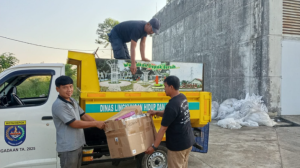
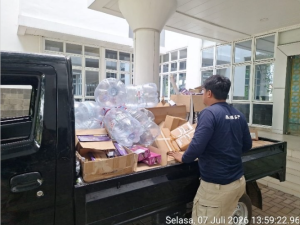
Colour-coded, clearly labelled bins are placed in the Rectorate Building, student dormitories, the Mosque, the canteen, academic buildings and administrative offices. UIII works with DLHK Kota Depok, which periodically collects recyclable materials and transports them to authorised processing facilities. A dedicated TPS stores special inorganic waste — electrical cables, plastics, cardboard and soft plastics — until transfer to authorised partners.
| Type of waste | Previous year (t) | Current year (t) | Reduction (t) | Reused (t) |
|---|---|---|---|---|
| Inorganic non-toxic waste (total) | 0.1201 | 0.1179 | 0.0022 | 0.08253 |
| Paper food boxes | 0.054045 | 0.047560 | 0.006485 | 0.033012 |
| Soft plastic | 0.018015 | 0.017000 | 0.001015 | 0.014030 |
| Hard plastic | 0.024020 | 0.028340 | +0.004320 | 0.016506 |
| Cardboard | 0.024020 | 0.025000 | +0.000980 | 0.018982 |
Table 4. Inorganic non-toxic waste produced and treated (tonnes). “Reused” covers material reused internally or handed to DLHK for onward management. No material was down-cycled or up-cycled.
Inorganic non-toxic waste decreased by 1.8%. Of the total generated, 53.9% (paper food boxes, soft plastic and hard plastic) was transferred to DLHK for onward management, and 16.1% (cardboard) was reused internally — 70.0% in total. UIII will continue to improve segregation and strengthen collaboration with authorised waste partners to raise this share.
5. Hazardous Waste (B3) Management
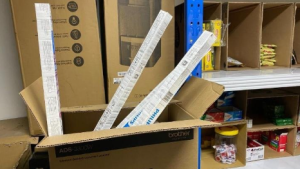
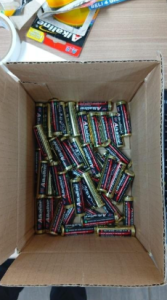
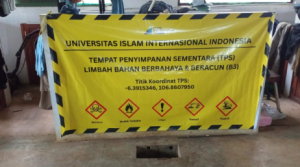
UIII does not treat or dispose of hazardous waste on campus. All hazardous waste — used batteries, fluorescent lamps, LED bulbs, electrical cables and other hazardous materials — is segregated and held in a Temporary Hazardous Waste Storage Facility, then transferred to authorised external parties in line with Indonesian environmental regulations, through collaboration with DLHK Kota Depok.
| Type of waste | Previous year (t) | Current year (t) | Reduction (t) | Transferred to licensed management (t) | Held in temporary storage (t) |
|---|---|---|---|---|---|
| Hazardous (B3) waste, total | 0.066 | 0.047 | 0.019 | 0.0376 | 0.0094 |
| Batteries | 0.006 | 0.005 | 0.001 | 0.0046 | 0.0004 |
| Lamps | 0.060 | 0.042 | 0.018 | 0.0330 | 0.0090 |
Table 5. Hazardous (B3) waste produced and managed (tonnes).
Hazardous waste fell by 28.8%. During the reporting period, 80.0% was transferred to licensed hazardous waste management services, and the remaining 20.0% was held safely pending the next scheduled collection.
6. Contribution to the SDGs and Way Forward
Key initiatives supporting responsible consumption and production across the campus:
- Campus-wide waste segregation at source, with dedicated bins and collection facilities.
- Reduction of single-use plastics through reusable tumblers, tote bags and besek baskets for Qurban distribution.
- Community initiatives such as Green Ramadan 2025.
- On-site composting of organic waste and reuse of cardboard boxes.
- Digitalisation of administrative and academic processes to reduce paper consumption.
- Safe segregation, storage and transfer of hazardous waste with DLHK Kota Depok.
- An on-site wastewater treatment system for domestic wastewater from campus activities.
- Integration of sustainability topics into academic programmes, research, student projects and community engagement.
These initiatives contribute directly to SDG 3, 4, 6, 11, 12, 13, 14, 15 and 17, and indirectly to SDG 7, 8 and 9 through resource efficiency, sustainable operating practices and the use of digital technologies. UIII will continue to strengthen waste reduction, improve segregation and raise the proportion of waste that is composted, reused or recovered, in collaboration with authorised waste management partners.